Update: I brought this back and updated with even more of my favourite red and green fashion history moments for 2020!
I fully admit that I have taken liberties with this post, but it was also one of the most fun to write. While I love my Christmas sweaters, I don’t quite know that the people of the past dressed as thematically. So, instead of searching for the rare Christmas themed outfits that I’ve seen, I went another direction. I decided to share some of my favourite red and green fashion history, intended for Christmas or not. These are from different museums and exhibitions, different designers and different styles. So Merry Christmas, it is time for some festive fashion!

I’d like to think that someone at some point wore one of these pieces during the holidays, to share the festive spirit. Red, white, and green are all in play here in fashion and footwear, and all are gorgeous in their own way.

Various Dates, White Reindeer Skin Boots, Bata Shoe Museum
I featured these white reindeer skin boots in my Art and Innovation post looking at Arctic footwear. While these are obviously worn for several months of the year, the red and white combination on these boots are very festive. These are worn by the Sami people, and reflect the regional differences in populations. They will use different inlaid skins, and different lengths and patterns of coloured bands (though all would be warm!). You will notice that distinctive curled toe carries throughout, though- it is unique to the Sami. And not only warm, these boots are an important visual reminder of their cultural identity. (Head to the traditional Arctic footwear post for more!)

1860s Dress, Fashion Museum Bath
With only a hint of green detailing, this dress would be perfect for the subtle holiday fan. The nineteenth century saw a wide-range of silhouettes, with the full skirt being one of my favourites. While I don’t think that I would want to wear a crinoline myself, I love the way that it works. The Fashion Museum explains, “A printed cotton day dress, made up of a separate bodice and skirt. There was a fashion for lightweight printed cotton dresses in the 1860s. The spreading skirts were held out by a cage crinoline, a new light and airy under-structure of hoops of steel, which liberated women from the countless layers of petticoats they had worn previously.” (Exhibition Info)
While it often appears that dresses were made of one piece, historically women’s dresses were often separate pieces. You could have more options if there are separate pieces, and also makes mending and replacement easier. Oftentimes, lace collars and pinnings were also separate and could be used on multiple garments. Given that these adornments were often expensive, it is frugal and practical approach.

1982 Ballgown, Fashion Museum Bath
If this silhouette looks familiar to you, you aren’t imagining things. This gown was designed by The Emanuels. The couple shot to fame in July of 1981 when they were revealed to be the designers of Lady Diana Spencer’s wedding dress. Obviously this dress does not have quite the poof and volume of Diana’s but it does still made a statement. I particularly enjoyed reading about the connection between fashion and royalty with this gown. “Throughout history, royalty and public figures have harnessed the power of clothes to project an image and to help play role. Diana acted as an ambassador for the British fashion industry in the 1980s, in the UK and overseas. She was a fashion trend-setter, with her clothes much copied on the high street.” (Exhibition Info) Unfortunately, this wasn’t worn by Diana herself, but the scarlet colour would have looked lovely on her.
I was lucky enough to see Diana: Her Fashion Story at Kensington Palace before it closed- Diana’s fashion certainly evolved. While we would have seen this gown in the early- and mid-eighties, it is quite different from her sleek designs in the 1990s.
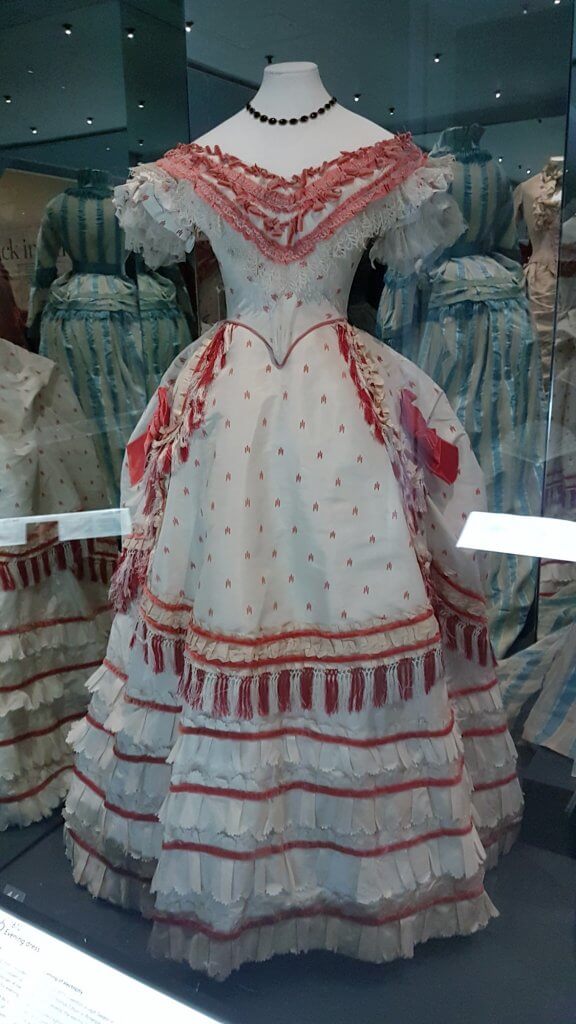
1870s Evening Dress, Fashion Museum Bath
I don’t know that this is a winter evening dress., but I thought of Christmas immediately when I saw it. The red and white together, the tassles, the fringe, it is all so festive! And as you can see from the side, it has quite the bustle. You wouldn’t think that electricity would have anything to do with nineteenth century fashion, but it was quite important. These lightweight cotton and gauze and muslin gowns caught on fire in second, and many women burned to death in their beautiful gowns. The advent of electricity and slimmer silhouettes would go on to provide a safer fashion.
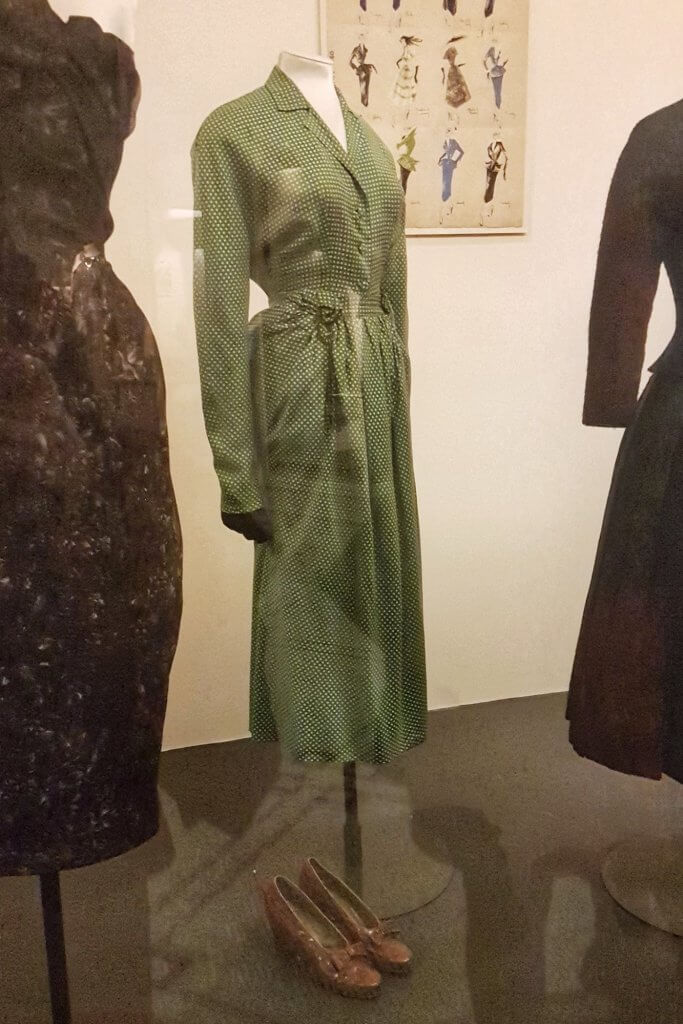
1947 Green Dior Day Dress, V&A
Although I did see countless gorgeous Dior pieces in the Dior: Designer of Dreams exhibition at the V&A, this day dress is part of the permanent collection. It is rather hiding in the fashion gallery, but is perfectly understated for the holidays. The V&A describes it as:
Day dress consisting of a jacket and skirt made from green silk twill foulard with small white spots. The bodice has a tailored collar with lapels, long batwing sleeves, and tightly fitting at the wrist. It is tightly fitted at the waist and has a centre front fastening of three covered buttons. The skirt is softly gathered at the waistband and is straight cut. ‘New Look’ length. It is full at the front with two vertical open insets. It has a centre back zip fastening. It has a triangular handkerchief attached at the front and arranged to drape behind.
What is unique about this early Dior dress is that it doesn’t feature the specific and structured undergarments that many New Look pieces do. It is perhaps a softer look for his first collection, but still beautiful. (That gathered waist could not be better… Nothing says present like a wrapped bow!) It would also be a great holiday outfit for a more elegant daytime event.
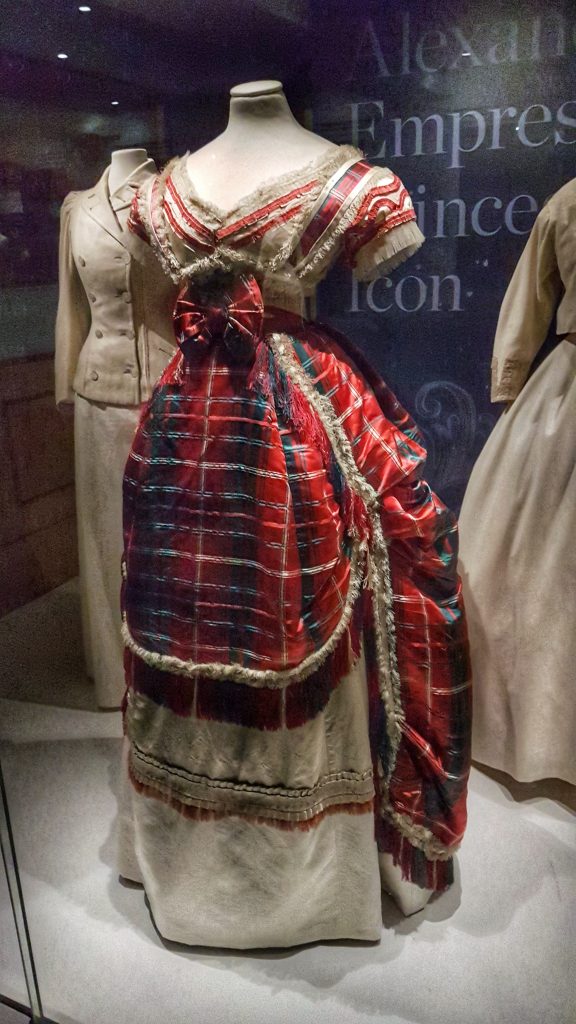
c.1870 Tartan Ballgown, Fashion Museum Bath
You will probably remember this gown from the Royal Women exhibition in Bath, as it was my favourite piece. This ballgown belonged to Alexandra, Princess of Wales (later Queen to Edward VII). Fashion historians think that she wore it to summer functions at Holyroodhouse in the 1870s, but in my dreams, she wore it for Christmas! (If it isn’t the height of red and green fashion history, I don’t know what is…) The queen of thematic dressing (royal pun intended), Alexandra took every opportunity possible. (Including twin outfits with her sister, Empress Maria Feodorovna of Russia) Madame Elise made this particular gown; although you might think she was French, she was an English dressmaker. As of 1870, she actually had a warrant as royal dressmaker for Alexandra. I can see why if she created more dresses like this!
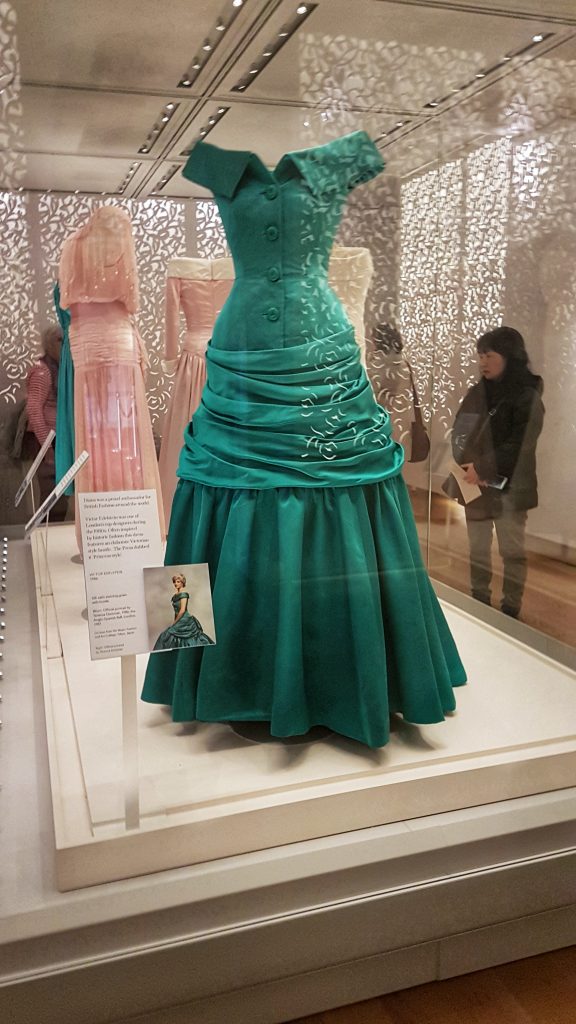
1986, Silk Satin Evening Gown with Bustle, Kensington Palace
The Diana: Her Fashion Story exhibition was full of so many modern royal fashion moments, which I of course expected. What I didn’t expect was the number of nods to fashion history! According to the exhibition, designer “Victor Edelstein was one of London’s top designers during the 1980s. Often inspired by historic fashion this dress features an elaborate Victorian-style bustle. The Press dubbed it ‘Princess-Style’.” You can see the bustle clearly in the 1986 portrait featured beside the gown. If only we had Christmas balls in the modern period- this would be a must-wear.
The Princess line historically is made with long panels and darting to define the wearer’s shape, with no break at the waist. Although it is a modern interpretation, it is in fact a Princess line gown!
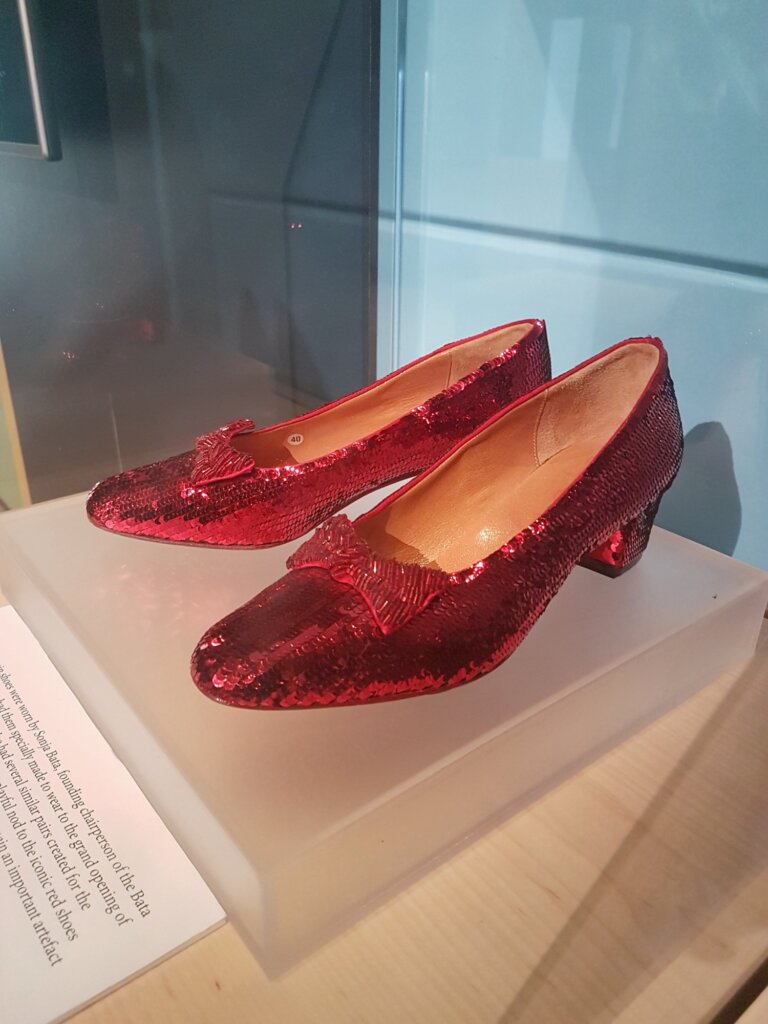
1995, Sonja Bata’s Red Sequined Shoes, Bata Shoe Museum
If these shoes weren’t perfect for a holiday party, I don’t know what is. Sonja Bata, the founding chairperson of the incredible Bata Shoe Museum, wore these to the museum’s opening on 5 May 1995. They are a nod to her love of those red shoes in The Wizard of Oz, a piece of cinematic shoe history. And interestingly she actually had pairs made for the entire museum staff. (The Bata Shoe Museum does a wonderful job of integrating its own history into exhibitions, and in such a meaningful way- you must visit.)
Red and green fashion history: what are your favourite pieces?
Cheers,
The Historian
Facebook | Twitter | Instagram | Pinterest | Bloglovin’