I will admit, I’ve been saving this exhibition for nearly a year- I knew that I wanted to share it in December when the Northern hemisphere is getting cold and dark. (Plus it seems rather appropriate for Blogmas, no?) People don’t often turn their attention to the far north, aside from Northern Lights and polar bears. However, the different groups of people living in the Arctic all have their own rich heritage, including unique footwear. Art and Innovation: Traditional Arctic Footwear at the Bata Shoe Museum showcases some truly gorgeous Arctic footwear, and the fascinating history behind them.

As you might imagine, this exhibition focuses on Arctic-specific footwear. Living in the world of snow and ice changes your footwear needs (I can attest to that). Arctic populations not only created functional footwear for an extreme climate, but incorporated their cultures in gorgeous and unique ways.
Art and Innovation: Traditional Arctic Footwear (Running Through 2020)
According to the exhibition site,
Situated at the very top of the world, the Arctic spans over fourteen million square kilometres and eight countries. While its landscape seems harsh and inhospitable, over forty distinct cultural groups have thrived here for centuries. And among the most beautiful and innovative of their products are the footwear and clothing they created to meet environmental challenges and express cultural meanings.
I was lucky enough to see this in December of 2019, before the world mostly shut down in March 2020. (If you do live in Toronto, I hope that you were able to catch this when the BSM was open!) I’m not sure if there are plans to keep it open longer, but your best bet would be to check the BSM site before you visit.

Greenlandic National Dress and Footwear
The largest island in the world, Greenland has been home to many different populations for over 4,500. It is in a unique position, as Inuit and European groups have both called the island home. You can see both of these influences in Greenlandic dress and footwear.
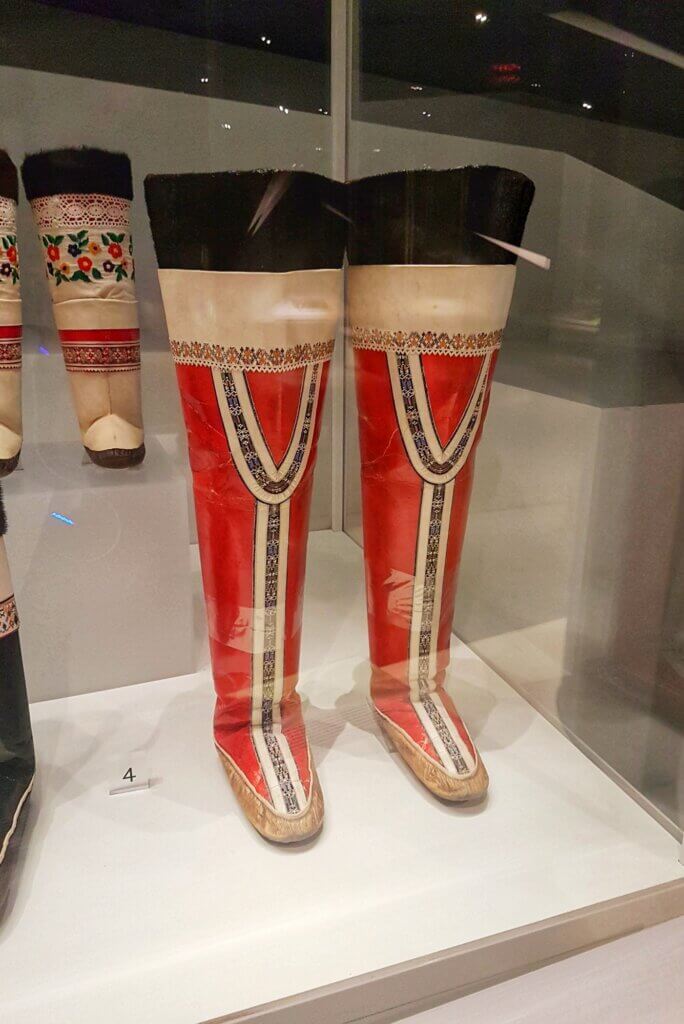
According to the exhibition, “In the middle of the 20th century, Greenlandic dress was central to discussions concerning national identity. The resultant national costume is a colourful mix of naturally-sourced materials, such as animal skins and sinew, and manufactured, commercially available materials such as ribbons, beads and lace.” You will notice that these sealskin boots are thigh-high; women’s boots or kamiit, are well-above the knee while men’s fall roughly mid-calf. You can also see in the photo above that they are worn with an annoraak (top) and sealskin short, called seeqqernit (both also beaded and decorated). We can see both Indigenous and European ancestry here, through the natural sealskin and beading/colouring, respectively.

Women in the north of Greenland will often wear much simpler boots. These thigh-high red boots are striking but far more simplistic than the previous pair. Interestingly, these boots are lined with a caribou-skin stocking, and then cardboard is placed between the stocking and the boot. Although it creates quite a definitive line, it can make the boots more difficult to wear.
Western Siberia
There are two semi-nomadic groups in Western Siberia, the Nenet and the Khanty, that practice reindeer herding. And as you might expect, reindeer skins are used in much of their outerwear and boots. The reindeer skin parka that you see is gorgeous in person, and particularly useful. “This Nenet woman’s parka was made using multiple reindeer leg skins. Reindeer, or domesticated caribou, are prized for the insulative qualities of their hair, which is hollow and effectively retains heat.” (Exhibition info) Living in an extreme climate, harnessing natural fibres/materials was the only way to survive brutal winters.
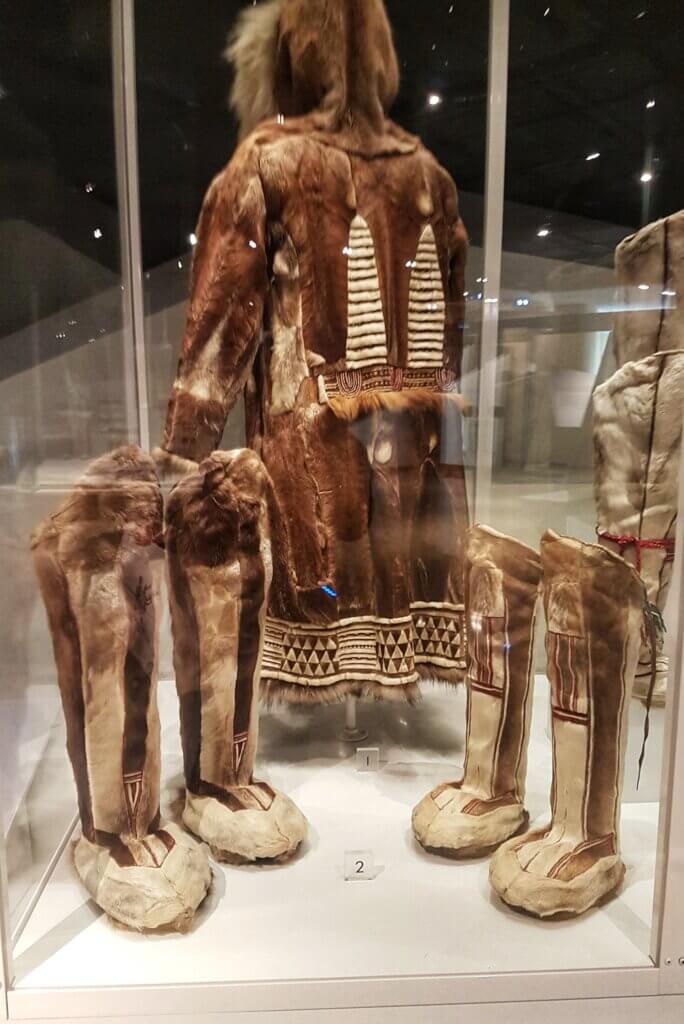
“Garments and boots made of white reindeer fur are prized and only individuals with large reindeer herds can afford to kill enough animals to supply the desired white skins needed for a particular garment.” (Exhibition info) Fascinatingly, there is an annual reindeer festival held in March each year, and people would often wear boots like this to it. Quite frankly, if you can’t wear them to a reindeer festival, where can you wear them?

The Sami
The Sami are the northernmost indigenous peoples in Europe. Their homeland, Sápmi, transcends political boundaries and includes parts of Norway, Sweden, Finland, and Russia… As one of the most politically active Arctic peoples, the Sami have made use of their variety of distinctive dress to establish and proclaim cultural identity. (Exhibition Info)

I found this section to be the most interesting. Being Canadian, I’ve always thought of Inuit footwear when it comes to traditional Arctic footwear, but there is so much more than that. And I’ve absolutely seen different clothing and footwear that is inspired by Sami designs, but had no idea. They often use brightly coloured materials, reindeer skin, and a curled toe. (The curled toe is quite unique.) You can identify where the boots were made by their construction- these boots are similar in style but by no means identical. There are regional differences in the long ties, called vuodaggat. And “footwear with complicated inlaid strips of skin in the seams worn with colourful bands wrapped partway up the leg are from Sami living in northern and central Sweden”. (Exhibition Info)

This was a wonderful exhibition, and I hope that you have a chance to see it before it closes. Although people tend to think of “the north” as one homogenous entity, there are numerous groups with their own culture and heritage. Their wardrobes absolutely demonstrate this, and offer us many insights into their lives.

The Bata Shoe Museum
If you are interested in more footwear history at the Bata Shoe Museum, I can help.

I shared my favourite pieces from the Bata Shoe Museum here!

You can find The Gold Standard: Glittering Footwear From Around the Globe exhibition highlights here!

And if you are interested in Want: Desire, Design, and Depression Era Footwear, there are some incredible and surprising pieces in my post here!
Have you visited Art and Innovation: Traditional Arctic Footwear at the Bata Shoe Museum? Are you surprised by anything?
Cheers,
The Historian
Facebook | Twitter | Instagram | Pinterest | Bloglovin’