We return to the art history world once more! Sadly, I am not as well-versed in art history as I would like, but I do know my royal painters. Prior to photography, these surviving portraits are one of our biggest clues as to what these historical figures may have looked like. While we do have photographs of Queen Victoria from 1844 and onwards, we only have portraits prior to that. Therefore, one particular artist’s portraits of Queen Victoria have become emblematic of her younger years. For this month, we are looking at Court Painters: Sir George Hayter!

George Hayter’s Early Years
George Hayter was born to English painter Charles Hayter and his wife, Martha Stevenson, in 1792. Hayter (Senior) was appointed as Professor of Perspective and drawing to the daughter of the future King George IV, Princess Charlotte of Wales. Hayter (Junior) did study at the Royal Academy Schools like his father but soon ran away to join the Navy instead.
After returning to his artistic studies, he married Sarah Milton in 1809 but did not tell anyone of the relationship. The pair had separated by 1816 after having three children together; he entered into a relationship with Louisa Cauty. The couple lived openly for a decade.

A Move to the Continent
Hayter acquired the Duke of Bedford as a patron, and the Duke suggested that Hayter travel abroad to further his studies. He spent two years in Italy where he studied under Italian artist Antonio Canova. While in Italy, Canova nominated Hayter to the Accademia di San Luca where Hayter became the youngest member elected to the academy.
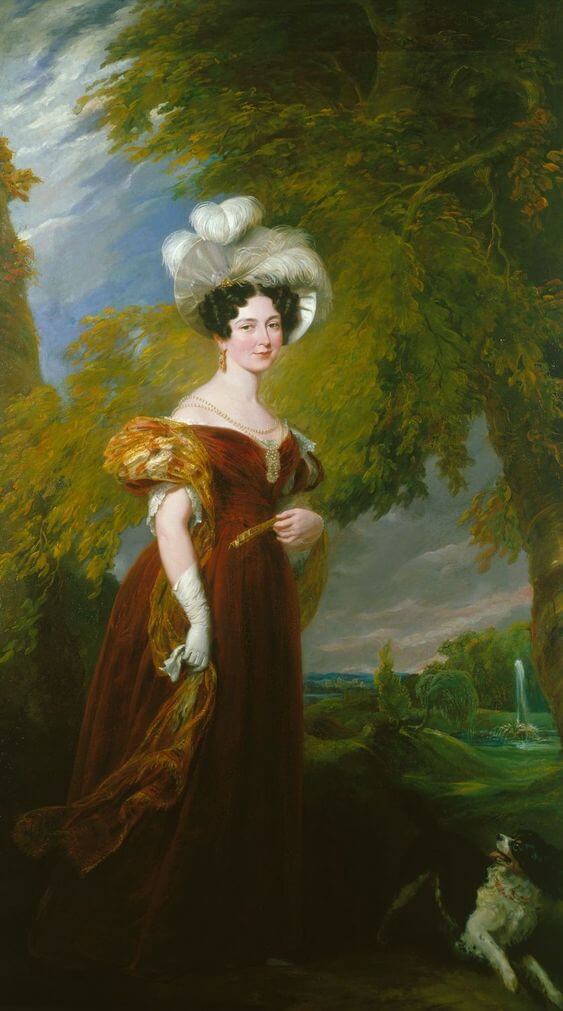
Princess Charlotte’s Painter of Miniatures and Portraits
In 1815, Hayter was appointed to the role of Painter of Miniatures and Portraits for Princess Charlotte and her husband, Prince Leopold of Saxe-Coburg-Saalfed. The Princess was establishing her own household, and this would be the first of several royal patronages for him. Not only did his travels to Italy challenge his connection with Charlotte’s household, her tragic death in childbirth severed his connection with the British Royal Family. He did continue to work for Leopold throughout his life, including during his reign as King Leopold I of Belgium.
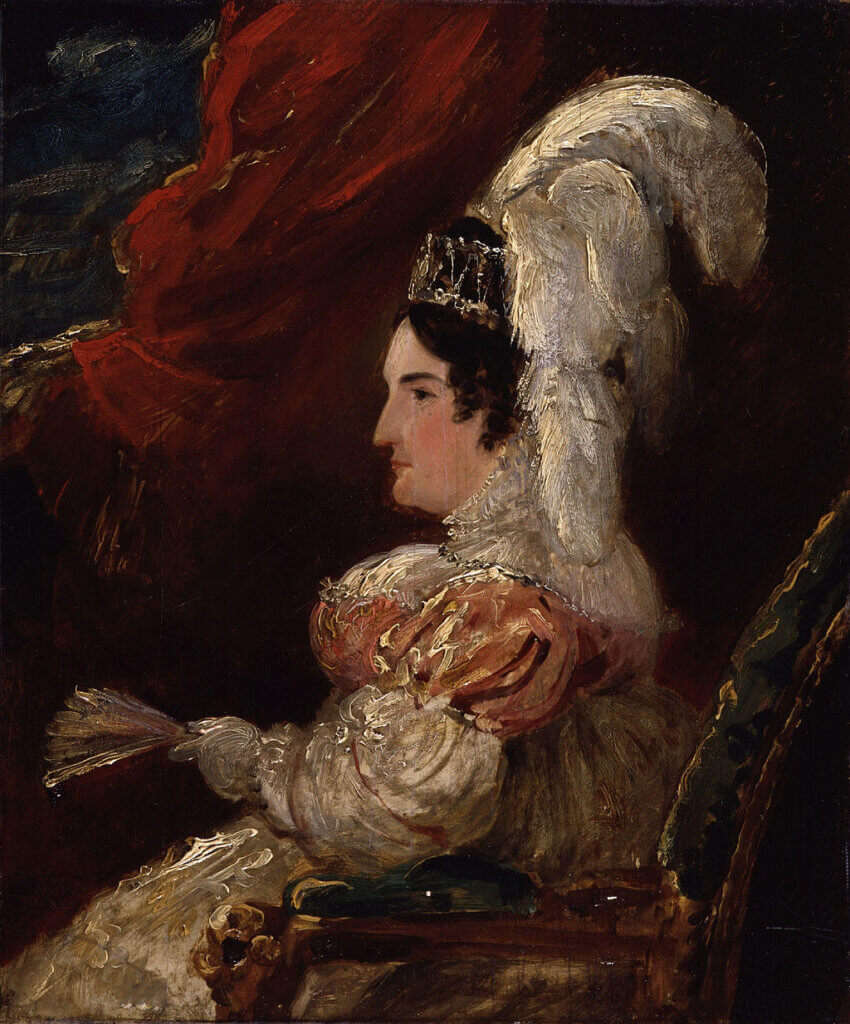
A Return to Britain… and Leaving again
Hayter returned to Britain in 1818 and was a popular artist among the aristocracy. He was never admitted to the Royal Academy like his father, setting him aside from many painters of the period. One of his notable paintings from the 1820s is The Trial of Queen Caroline where The King attempted to divorce his estranged wife, Caroline of Brunswick.
Hayter then moved back to Italy in 1826 where he continued to draw acclaim and then by 1828 he was in Paris.

Principal Painter in Ordinary to Queen Victoria
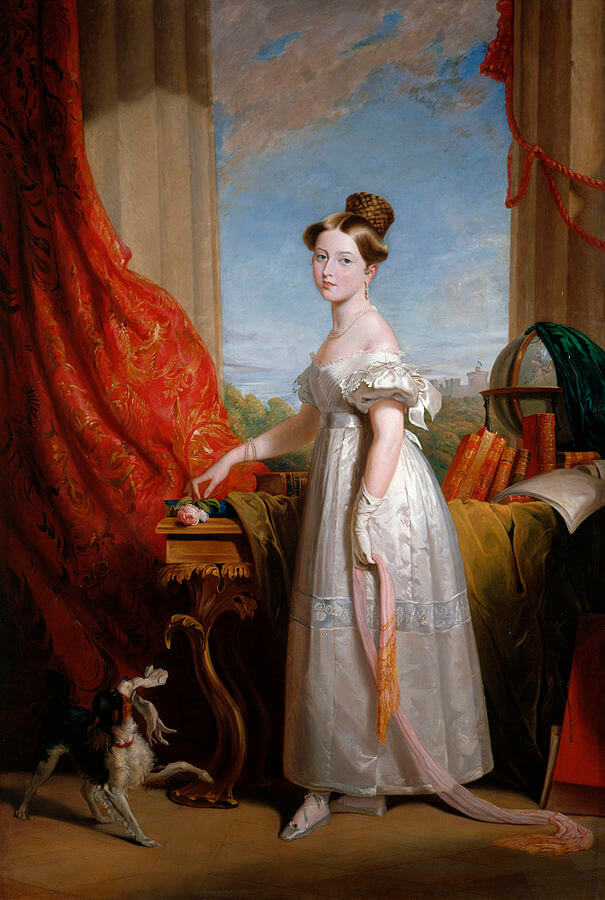
Hayter finally returned back to England in 1831 and in 1832 painted a young Princess Victoria. Notably he worked on an independent painting of the first sitting of Parliament in 1831 after significant reform acts passed, and this painting would be one of the best records of the previous Parliament buildings before an 1834 fire destroyed much of the complex.
Queen Victoria named Hayter as her Principal Painter in Ordinary in 1841. On the one hand, it was not a surprise as she had sat for the 1832 portrait, in addition to a painting of Victoria’s wedding, and clearly the artistic relationship was successful. However, Hayter’s personal life was not exactly upstanding which was absolutely a red flag when it comes to Victoria (and Albert).
Hayter’s appointment to the position was a bit of a shock as historically that position had gone to the President of the Royal Academy. It is the monarch’s choice though, and given that Hayter painted the official coronation portrait of Victoria, it was a sound choice. (Victoria’s daughter, Princess Louise, actually used Hayter’s coronation portrait as the basis for her sculpture of her mother that is still on display outside of Kensington Palace.

Hayter’s Later Life
Like many other artists, Hayter struggled in his later career. His style was deemed out-of-date by the end of the 1840s and he was largely in debt. Hayter died in 1871 and his remaining paintings were auctioned at Christie’s that year. His work is well-represented in the Royal Collection today.
Interested in more court painters?
Were you familiar with George Hayter’s work?
Cheers,
The Historian
Facebook | Twitter | Instagram | Pinterest

,_Windsor_1837.jpg)


