Today we journey on in this series on the history of court painters! When you think of royal portraits, there is a good chance that you think of a portrait of King Henry VIII. The portrait of the second Tudor king does not include any symbols of monarchy but exudes his power as sovereign. However, Holbein’s career was much more than solely Henry VIII. As an official court painter, his work can give us great insight into the Tudor court and more. Let’s get into the History of Court Painters: Holbein! (And yes, that would be Hans Holbein the Younger.)

Hans Holbein’s Early Life
Hans Holbein the Younger was the second son of Hans Holbein the Elder, a painter and draughtsman in Augsburg, and was born in 1497/1498. Holbein (the younger) and his elder brother studied under their father from a very young age, and he took to painting very quickly. Unfortunately, not a lot of information survives about the painter’s early years.

Holbein’s Early Career
After studying under Holbein the Elder, both Holbein the Younger and his brother moved to Basel as journeyman painters. They found work as woodcutters, and within the first year of arriving, Holbein was asked to create some pen drawings for the margins of The Praise of Folly for a preacher. (An early connection to Erasmus that will pop up below…)
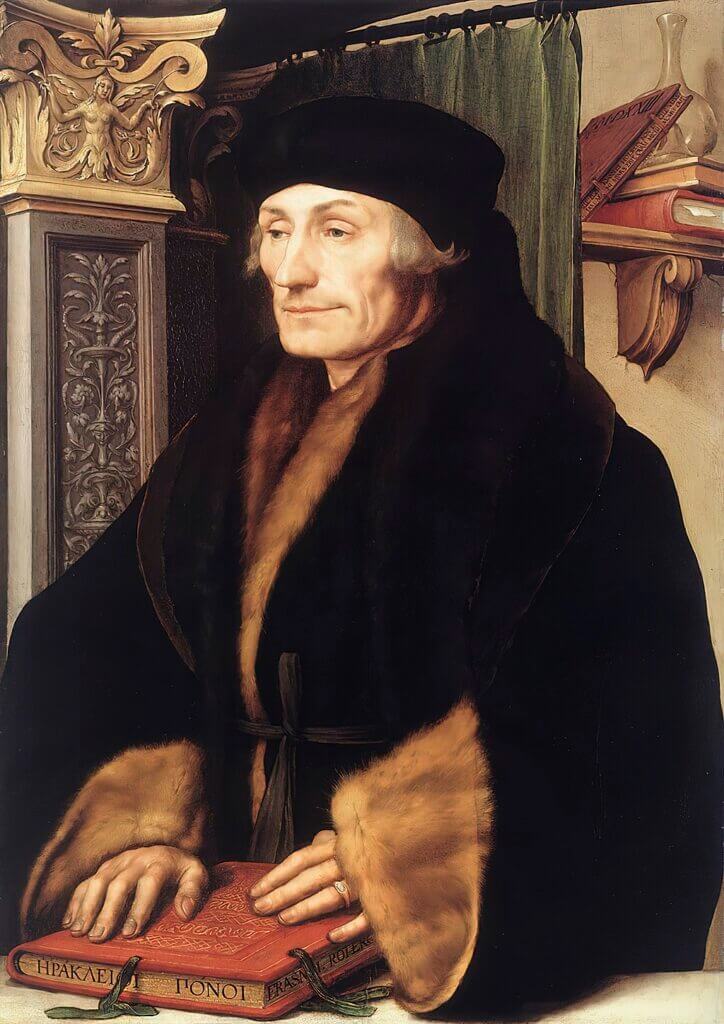
In 1517, he spent time in Lucerne with his father completing a set of murals. Many historians also think that he toured parts of Italy where he was introduced to a number of different artists’ works. He had returned to Basel by 1519 and his career continued to flourish with several commissions. Notably, the Renaissance scholar Desiderius Erasmus commissioned a portrait from Holbein. His Erasmus portraits remain some of his best-known.
A First Move to England
After stopping off in Antwerp, Holbein made the long journey to England. He was welcomed by the English, Renaissance Humanist scholar Sir Thomas More. Given that Erasmus had written Hobein an excellent reference, and Erasmus and Sir Thomas More were close friends, More’s wholehearted support makes sense. And helped secure Holbein’s career in England.
Holbein did not paint any portraits of King Henry while first living in England, but he was able to create portraits of several notable aristocrats and members of the English clergy.
You can see some of those portraits in my post here!

Back to Basel
In 1528, Holbein returned to Basel. It was a different Basel, though, as religious turmoil from the Reformation created massive waves of changes. While Erasmus chose to leave Basel as a Catholic, Holbein stayed for four years. Historians do not have a consensus on what Holbein’s religious views actually were, but he was able to maintain a steady flow of work. Much of his work in Basel in this period was commissioned by the Council, including murals, clockfaces, and frescoes. He did have some private patronages, but patronages slowed and he decided to leave again.
Working for Anne Boleyn
Holbein arrived back in England in 1532. At the time, his previous patron, More, was falling out of favour with the King and thus not a strong connection for the painter. Two rising stars at court, Anne Boleyn and Thomas Cromwell, appreciated Holbein’s work and their circles supported him.
He completed many private commissions, as an artist tends to need several projects to secure a living. In 1533, he completed The Ambassadors, a portrait of two French ambassadors that contains several religious and Renaissance symbols. (You’ve probably seen it [above] even if you did not realise what it is!) The Ambassadors might have been commissioned by Anne, but there is not conclusive proof.
He worked with Anne on several items, including jewellery and cups, as well as working on sketches of her ladies. Holbein also worked with Cromwell on several high-level commissions. Given that Cromwell was in a key position in the King’s government, Henry became very familiar with Holbein and his work.

The King’s Painter
In 1536, King Henry gave him the job of King’s Painter. It only came with a salary £30, but the prestigious title came with more connections. Given that 1536 was the year that both Anne and Cromwell met their downfall, Holbein was lucky to continue on in his role. It was in that year that Holbein created one of his most famous portraits, the portrait of Henry. It was part of a larger painting that included his third wife, Jane Seymour, and his parents, Henry VII and Elizabeth of York. Unfortunately, only copies of the portrait survive.
Holbein also created portraits of the future Edward VI, Henry’s only surviving legitimate son, and his future fourth wife, Anne of Cleves. This latter portrait would be contentious after Henry dissolved his fourth marriage after claiming that she did not look like Holbein’s portrait.
While he remained the King’s Painter, his work moved to more private commissions. By the time of his death in 1543, he had not worked the King in some time.
Holbein’s legacy outside of his paintings lives on in Six, with the Haus of Holbein an incredibly popular song!

Are you a fan of Holbein’s royal portraits?
Cheers,
The Historian
Facebook | Twitter | Instagram | Pinterest