Mary, Queen of Scots remains one of my favourite figures from history. Since, well,her lifetime, Stuart has been considered a stupid, emotional woman who was inept at pretty much everything. (In contrast to her apparently not-emotional Tudor cousin, Elizabeth I…) However, she was much more complex than she gets credit for and was dealing with a politically unstable kingdom. All of this is to say that I will always be excited for a fictional portrayal of the Scottish Queen. Appropriately for Women’s History Month, we are chatting about The Tower by Flora Carr!
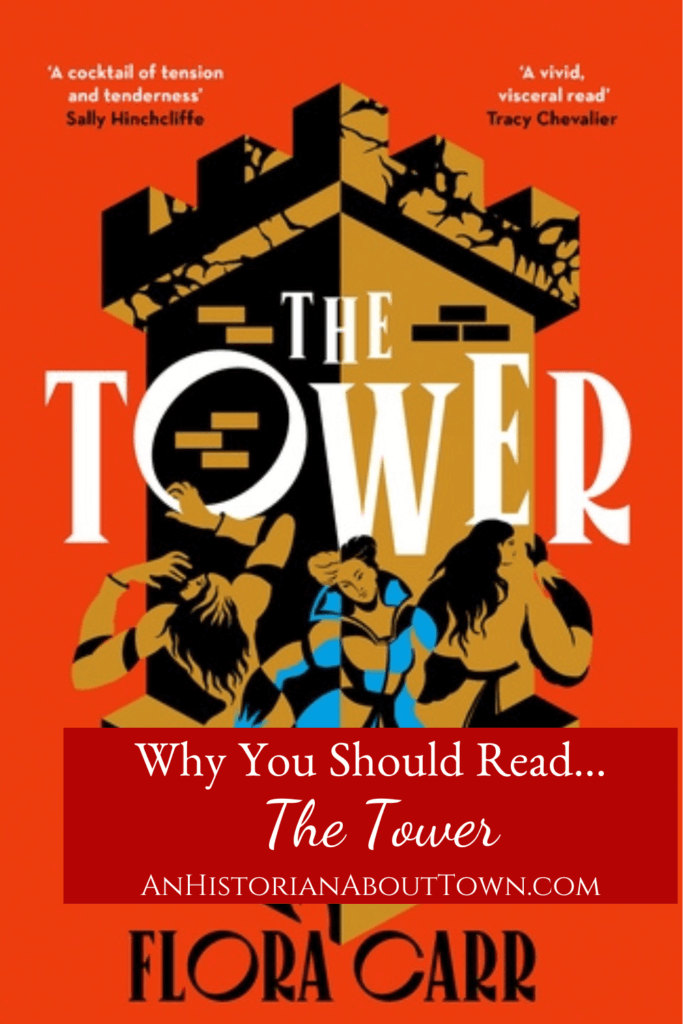
The Tower, Flora Carr
A bold, feminist debut novel, reimagining Mary, Queen of Scots’s darkest hour, when she was held hostage in a remote Scottish castle with a handful of loyal women while plotting a daring escape to reclaim her country and her freedom.
Scotland, 1567. A pregnant Mary, Queen of Scots is dragged out of her palace by rebel lords and imprisoned in the isolated Lochleven Castle, an ancient fortress surrounded by a vast lake. Her infant son and heir, James, has been captured by her enemies.
Accompanying Mary are two inconspicuous serving observant, ambitious Jane and romantic, quick-tempered Cuckoo, who endeavor to keep their mercurial mistress company while sharing the space of a claustrophobic room over the course of their eleven-month forced stay. Their hosts want them dead. They’ll settle for Mary’s abdication.
After Mary reluctantly surrenders her throne, her closest friend, the reserved, devoted Lady Seton, is permitted to join the captive women. Against the odds, as they hatch a perilous getaway plan, the four women form a bond that transcends class and religion, and for Jane and Seton, becomes something even deeper. At the center of it all is Mary–calculating, charming, brave, and unbowed. Flora Carr’s thrilling, feverish debut is a celebration of resilience, a meditation on the meaning of power, and a testament to the unshakeable strength of female friendship, starring one of history’s most charismatic leaders.
Why You Should You Read This…
Note: there are some graphic descriptions of medical events and symptoms in this book. (I wasn’t expecting it, so I was taken aback, but if you are able to handle the few scenes, I would recommend this!)
This book was not what I was expecting- this is definitely literary fiction. It isn’t a bad thing at all, it simply makes for a different reading experience for me. It is somewhat haunting and a poetic sort of prose that you sit with for a bit. It’s not a “this happened, then this happened, then this happened” type of book- it is often a metaphorical look at women’s positions in the sixteenth century, and all of the baggage that comes with that.
I think that Carr brought a new perspective to an often-ignored part of Mary’s life, and she brought to life the women around her. They are often forgotten and I think that it is an aspect of Mary’s story that deserves more attention. The men in Mary’s story also feature in this- her third husband and her brother are given some page space, but through the viewpoint of the women around that. And it certainly gives a different feeling than we usually get with Mary’s story.
Finally, I truly appreciate all of the research that Carr did for this novel. It is clear that she thoroughly research Mary in this period, and it adds so much to the book.
♠
Want to know more about Mary, Queen of Scots? You can find my favourite biographies here: https://anhistorianabouttown.com/the-best-mary-queen-of-scots-biographies/!
Is The Tower by Flora Carr on your to-read list?
Cheers,
The Historian
Facebook | Twitter | Instagram | Pinterest