Happy St. Patrick’s Day, all! (Hopefully you are having an appropriately festive day.) As it is both St. Patrick’s Day and Women’s History Month, I wanted to feature a woman from Irish history. There are many to choose from- Gráinne O’Malley, Ninette de Valois, and Brigid of Kildare come to mind. However, there is always one figure that stands out to me. She witnessed several crucial moments in modern Irish history and played a significant role throughout. Today we are going to be looking at the revolutionary countess, Constance Markievicz!

Constance Gore-Booth’s Early Years
Constance Gore-Booth was born in London in 1868 to Sir Henry Gore-Booth and Georgina Hill. Her parents were Anglo-Irish landowners, and she and her sister spent much of their childhood at Lissadell House in Co. Sligo. Notably, W.B. Yeats, the Irish poet, would frequently visit the house and the two were friends in childhood.
Constance hoped to train as a painter and in 1892 went to study in London at the Slade School of Art. She then studied at the Académie Julian in Paris. It ws during her studies where she was first exposed to politics and joined the National Union of Women’s Suffrage Socitiies.

Countess Markievicz, the new revolutionary
It was in Paris where Constance would meet Count Casimir Markievicz, a Polish count who was also an artist. The count was still married when he met Constance; however, the couple married in 1900 (his first wife had died in 1899). They moved to Dublin and quickly established themselves amongst the artists, authors, playwrights, and poets of Ireland.
It was during this period that Markievicz (how I will refer to Constance from here and on) first became involved with Irish causes.
In 1905, she helped to found the United Arts Club in Dublin, a group that aimed to provide a home for the artists and creatives in the city. The club included several members of the Gaelic League, an organisation dedicated to preserving Irish culture and language; Markievicz met several individuals who would go on to hold leading roles in the future Irish government. She also joined Inghinidhe na hÉireann (‘Daughters of Ireland’), a revolutionary women’s group, and Sinn Féin, a political party dedicated to Irish independence. She supported suffragette causes in Ireland as she also had in England.
In 1909, she then founded Fianna Éireann, a scouting organisation for Irish boys. Many of the boys who joined and trained with the group went on to take part in the Easter Rising in 1916 and the Civil War in 1922.

Easter Rising and Election
Markievicz had also joined the Irish Citizen Army and as a member, she took part in the Easter Rising. The rising was planned to establish an independent Ireland and took place during Easter Week. Markievicz was in St. Stephen’s Green and fought alongside other members of the Army; she may have shot a Dublin Metropolitan Police constable but that has not been confirmed. The group at St. Stephen’s Green were able to hold out for six days but were eventually arrested.
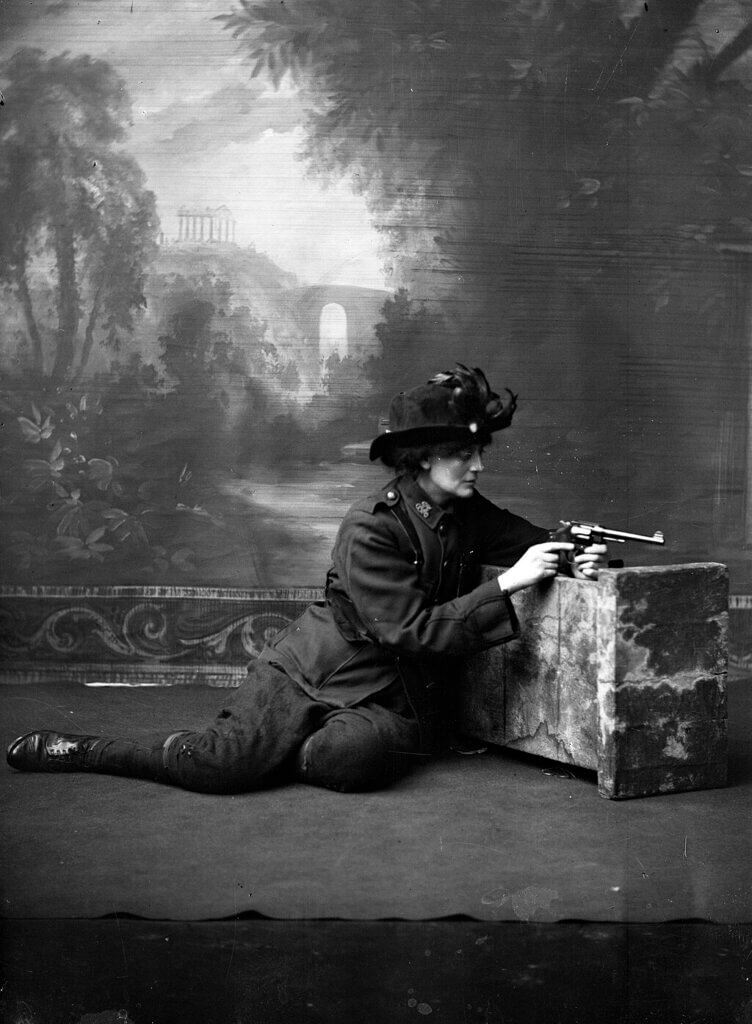
Markievicz was the only woman out of seventy to be put in a solitary cell at Kilmainham Gaol. (If you ever find yourself in Dublin, Kilmainham is an incredible [but sober] place to visit that is so rich in history.) She was sentenced to death for her role in the uprising but her sentence was commuted to life due to her gender. After being transferred to prison in England, Markievicz was released from prison in 1917 when the UK government issued a pardon for those involved.
In 1918, Markievicz was elected to parliament in Westminster- she won the seat of Dublin St. Patrick’s. This means that Markievicz was the first woman elected to Westminster- people will often say that Nancy Astor was the first women elected, but she was the first woman to take her seat. Markvievicz and the other seventy-two Sinn Féin MPs elected refused to take their seats in London and instead established their own parliament in Dublin. The First Dáil (Dáil is the Irish word used for the meeting of the government) was held from 1919 to 1922, and she served as the Minister for Labour.

The Civil War
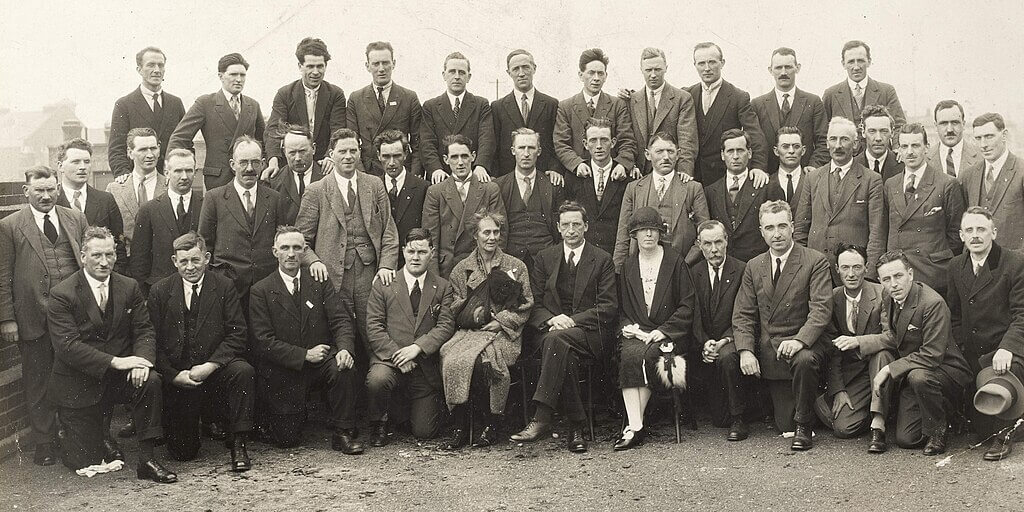
In 1922, Markievicz was part of a group that left the Dáil as the new government was in favour of signing the Anglo-Irish Treaty. She once again took up her role in the Irish Citizen Army during the Civil War, this time in an organisational capacity. After the war, she joined Fianna Fáil, a republican party founded by Éamon de Valera in 1926 after they left Sinn Féin.
Sadly, Markievicz died on 15 July 1927 from complications from appendix surgeries. Although the Irish government at the time refused to give her a state funeral, thousands still visited her coffin in Dublin before she was buried. Her legacy in Irish history remains for the Irish state and for Irish women.
Were you familiar with the revolutionary countess, Constance Markievicz?
Cheers,
The Historian
Facebook | Twitter | Instagram | Pinterest

.jpg)
.jpg)

.jpg)