We are into week 2 of Women’s History Month here in Canada! Sadly, women’s history is not taught or shared nowhere near as much as it should be. (Given that half of the population is female, you would think that our history would be included in more books, documentaries, and curricula…) You often see women missing and forgotten from a lot of historic sites and monuments. So, today we are looking at 7 women buried in Westminster Abbey!
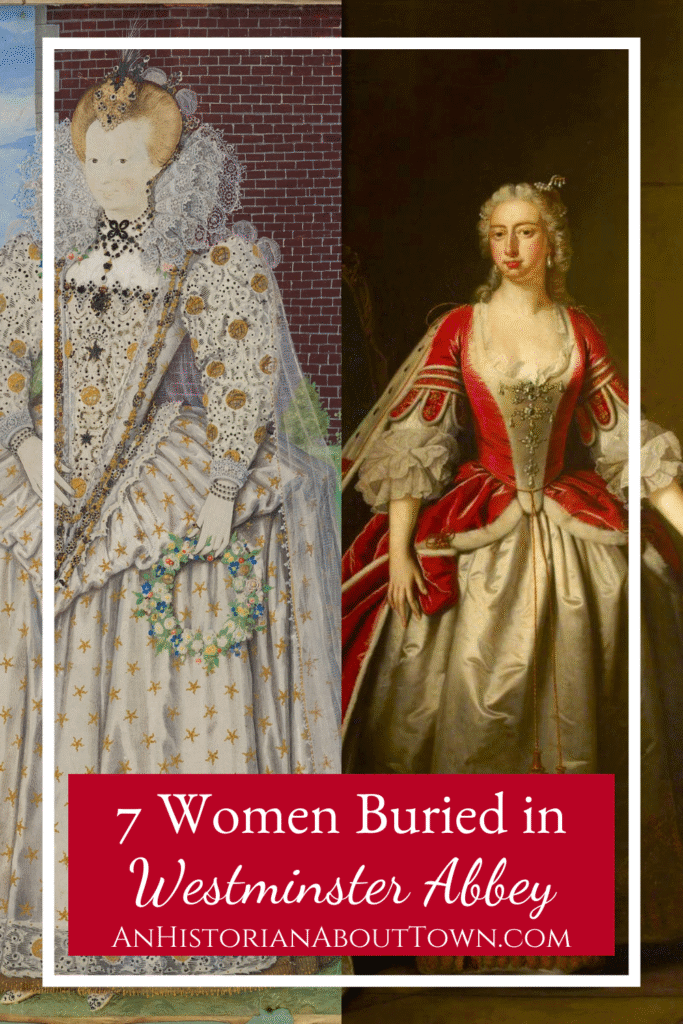
7 Women Buried in Westminster Abbey
There are more than seven women buried in Westminster Abbey, but I thought I would choose a selection to focus on for today. It has to be said, the women (and men) buried in a place like the Abbey are from a very narrow cross-section of society- the average person is not being buried in Westminster Cathedral or Notre-Dame Cathedral. But between burials and commemorations, there are over 3,300 people found in the Abbey (or a tribute) and the very, very large majority are men. And you will note that almost all women buried in the Abbey are royals. However, there are some that you might not recognise.

Queen Philippa of Hainault (1313- 1369)
Philippa of Hainault was the wife of King Edward III, a monarch known for founding the Order of the Garter and for reinforcing royal authority following the disastrous reign of his father and his mother’s plot to gain control (with her lover).
Philippa was lucky to be fairly well-versed in both politics and business, and would quickly become an asset to her husband after they married in 1328. Her coronation was held at the Abbey in 1330 and she was essentially the model consort. In addition to advising her husband on commerce, she also brought Flemish weavers to Norwich to encourage the textile industry and even acted as Regent while he was away at war.
Philippa of Hainault died in 1369 and was then buried in Westminster Abbey in 1370 in the Chapel of Edward the Confessor. Her husband’s tomb can be found beside her.

Queen Anne Neville (1456-1485)
Anne Neville was the daughter of Richard Warwick, 16th Earl of Warwick, also known as “the Kingmaker”. She first married Edward of Westminster, Prince of Wales in 1470 but he died in 1471, and her family recognised that she could make another strong match. In 1472 she married Prince Richard, Duke of Gloucester- meaning that when he became King in 1483, she became Queen. The couple had a joint coronation in July quickly after taking the throne, the first in well over a century.
Sadly, Anne died in 1485, from what was most likely tuberculosis. The couple had not had any children, and Richard himself died in battle in August of 1485. Anne was buried in the Abbey in an unmarked grave close to the High Altar. There was no mention of her grave until the Richard III Society put up a plaque in 1960.

Mary, Queen of Scots (1542-1587)
Many people are surprised to see Mary, Queen of Scots buried in Westminster Abbey, no less opposite the tomb of Queen Elizabeth I. After Elizabeth signed off on her execution after having been found guilty of treason, Mary was originally buried in Peterborough Cathedral. (Notably, Elizabeth refused her request to be buried in France.) In 1612, Mary’s son, King James VI/I, had his mother reinterred in the Abbey in the Lady Chapel.
Notably, several of Mary’s relatives, including Elizabeth Stuart (see below) are interred in the same vault as Mary. Now, Mary Stuart, Elizabeth Tudor, and Mary Tudor are spending eternity resting together in the Abbey.
Want to know more about Mary? You can read my Monarch of the Month post!

Lady Arbella Stuart (1575- 1615)
Lady Arbella Stuart is the only aristocrat on this list, but she held a fairly high position in Stuart society. She was originally considered as a potential heir to Elizabeth I, as a great-great-granddaughter of the first Tudor king, King Henry VII. While she did not aspire to the throne herself, many considered her a threat to the line of succession. A group plotting to overthrow James and place Arbella on the throne asked her to take part, she immediately told James and did not join the plotters.
She married William Seymour, 2nd Duke of Somerset, in secret in 1610. Given that she should have asked James’ permission to marry, and William himself had a claim to the throne, James was less than happy. He imprisoned them separately- Arbella was in Lambeth and William in the Tower of London. Arbella attempted to escape and after being caught was also imprisoned in the Tower.
Lady Arbella Stuart died in September 1615 shortly after falling ill. Her coffin was actually placed on that of Mary, Queen of Scots (her aunt).

Elizabeth Stuart, Queen of Bohemia (1596-1662)
Elizabeth Stuart was the only surviving daughter of King James VI/I and Anne of Denmark, and as such, was considered one of the most eligible princesses in Europe. The lucky groom chosen was Frederick (Friedrich) V, Count Palatine of the Rhine, a Protestant ruler who would become King of Bohemia.
The couple married in 1613 in Whitehall, with their wedding being a major event. They left for Europe and Elizabeth spent several years as Electress of the Palatinate. However, in November 1619, Frederick was crowned as King of Bohemia. However, his reign ended just a year later, and Elizabeth would be known as the Winter Queen.
After Frederick’s death in 1632, her brother, King Charles I, invited her back to England, but she chose to stay on the Continent. However, in 1661, Elizabeth finally arrived home following the Restoration of the Stuart monarchy. She sadly died of pneumonia in early 1662, though.
Known as a queen without a country, Elizabeth was also buried in Mary, Queen of Scots’ tomb in Westminster Abbey. Notably, the line of succession following Queen Anne’s death in 1714 followed Elizabeth’s line. (King George I was her grandson.)
Want to know more about Elizabeth Stuart? Find my Consort of the Month post here!

Queen Anne (1665-1714)
Queen Anne was the last Stuart monarch, the daughter of the future King James II and Anne Hyde. Her adult life was largely consumed with producing an heir; she had seventeen pregnancies and no surviving heirs. However, her reign was a fascinating time for politics in Great Britain. In 1707, the Acts of Union 1707 joined the independent kingdoms of England and Scotland together, a move that still has lasting effects to this day. (Wales was considered to be part of England, and Ireland was subordinate to England for nearly a century.) Anne’s reign was also largely marked by further development of the two party system, with the Whigs and the Tories each representing different interests.
In addition to her many pregnancies (and related miscarriages and still births), Anne was ill for much of her adult life. She most likely suffered lupus, and struggled with obesity, gout, and eye problems. Continual issues with leading politicians also added stress that affected her health. She died on 1 August 1714, and is buried in Westminster Abbey in the Henry VII Chapel.

By Thomas Hudson – Art UK , Public Domain, Link
Princess Augusta of Saxe-Gotha-Altenburg, Princess of Wales (1719-1772)
If you have watched Queen Charlotte, the Bridgerton prequel, you will recognise Princess Augusta as the mother of King George III. Her husband, Frederick, Prince of Wales, died before he could take the throne, meaning that Augusta never became queen. However, Augusta would have served as her son’s regent had King George II died before George III came of age.
Augusta was in an odd position, as her husband refused to share any of his politics or plans with her. As she became a widow at 31, though, she forged her own path. She notably was not a huge fan of Charlotte when she married George, and did not do anything to welcome the teenage princess to England or the family.
Kew Gardens is Augusta’s physical legacy- she spent a good deal of time and energy expanding the gardens and broadening its scope. (The Great Pagoda was built as a gift for her- not a bad gift!) Princess Augusta died in 1772 of throat cancer and was buried in the Lady Chapel of Westminster Abbey.
Have you visited Westminster Abbey?
Cheers,
The Historian
Facebook | Threads | Instagram | Pinterest