Walking tours can be a wonderful way to see things when you travel. They can also be a disappointing cash grab. However, the walking tour of Bath offered by the Mayor’s Guides is an absolutely amazing walking tour, and is a must-do for anyone visiting Bath. The guides are knowledgeable, engaging, fun, and entertaining, and Bath has a lot to offer. It is a full two hours (our tour was nearly three), but it is the best way to get know a fascinating and historic city that has many stories to tell!

Mayor’s Guides
The Mayor’s Guides in Bath exist to offer free, welcoming, and informative tours of Bath. The residents of Bath knew that their city had some amazing stories to tell, and that visitors wanted to learn more. The earliest mention was in 1934 but by the 1960s, guides were officially trained and organised. By 1975, there were at least two walks scheduled a day! Nowadays, you can catch a walk at 10:30am or 2:00pm Sunday to Friday, or at 10:30 on Saturdays. These walks are entirely free, and from all of the reviews I’ve read, are far superior to the paid walks other tour groups organise. You will notice all of the Mayor’s Guides have a blue badge, which others won’t.
All you need to do is meet outside the Roman Baths (conveniently right beside Bath Abbey ) before the tour. Look for the “Free Walking Tour” sign and group of blue badges, if you are lost! We went on a Saturday, so it was incredibly busy- there was 5 different groups heading out. (They have many volunteers there, no need to book ahead or worry about limited space.) I would recommend arriving at least 10 minutes ahead, just to make sure they don’t leave without you.
A warning: I noticed that paid tour guides were trying to poach people waiting for the free tour. Make sure your guide is a blue badge guide!
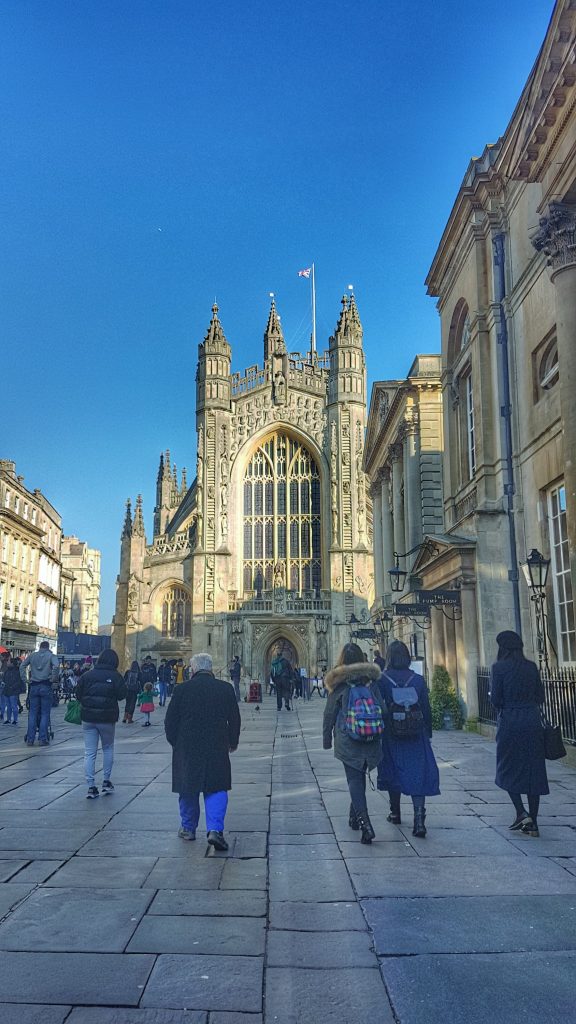
The Roman Baths
Okay, here is where I admit to being a terrible visitor to Bath. Tickets to the Roman Baths are £20, and I had no desire to pay that much (or miss out on something else I wanted to do) when I have visited several different hot springs already. However, we actually were allowed to quickly duck in and see them on our free walking tour! You see them from the Pump Room, but as long as you don’t need to be RIGHT there, it is the perfect solution.
So, Bath is named Bath for, well, the baths. Apparently the UK was too cold for the Romans (who clearly never ventured to truly cold climates….), and upon discovering hot springs here, quickly set up baths to enjoy the heat. The baths fell into disrepair after the Romans left in the 5th century, but were rebuilt in the 12th century, and again in the sixteenth century. People came from all over the UK to take the waters, as doctors believed that the waters could cure countless ailments. After a while, heading to Bath morphed from a medical excursion to a social, and the Bath season was born!
 The Pump Room
So, if you need to go to Bath for medical reasons but don’t want to go so far as to physically get in the water, you do the next best thing- you drink it! If you’ve read Austen, you will know that in Regency Bath, the Pump Room was the place to be. Technically known as the Grand Pump Room, it sits adjacent to the Roman Baths, and you can still enjoy a meal there today. The building was open in 1795 but not finished until 1799, and a second story was added in the nineteenth century. Should you want to taste the Bath Water for yourself, you can order a glass at the Pump Room. (It contains 43 minerals, so it could replace about 15 different supplements…) And yes, you have spotted an alcove for the musicians, much like the Bath Assembly Rooms. On my next trip to Bath, a meal at the Pump Room will be on the itinerary.

Medieval Bath
One of my favourite things about this walking tour of Bath is that you find out about all of the Baths that existed. The Bath that you see today is largely a Georgian bath, with the neo-Palladian architecture looming large. However, Bath was very much a medieval city with firm town walls. The Bishop of Wells moved his seat to Bath in the eleventh century, and the town flourished. Nowadays, it isn’t too easy to spot the actual physical walls (they are either long gone or covered), but you can spot the walls in street names. The Upper Borough Walls were just that, the upper walls of the town. It now exists the form of several Georgian buildings… I have to say, I do love the style of carving the name into the stone.

The Pulteney Bridge
The Pulteney Bridge is one of those famous Bath landmarks that you’ve probably seen on Instagram many times. Spanning across the River Avon, it was built in the late eighteenth century to connect the Pulteney family lands with the City of Bath to allow for further urban spread. We didn’t have a chance to actually walk across it, but it is famous for having shops along both sides of the bridge. Also, if that water looks familiar to you at all, it happens to be where Russell Crowe’s fall into the water was filmed for the 2012 Les Mis. Although Bath looks to be beautiful in the spring, I’ve got to say, the gloom suits it well.

Queen’s Square
Remember how I chatted about medieval Bath? Well, Georgian Bath is pretty prominent as well. I’ve already chatted about the Circus and the Royal Crescent but Queen’s Square really kicked off Bath’s redevelopment. Designed by John Wood the Elder in the eighteenth century, Queen’s Square was the first piece in the neo-Palladian Bath (with the Circus and Crescent following). The square itself sadly isn’t anything to write home about, although their a large obelisk dedicated to Frederick, Prince of Wales.

Interestingly, Wood only designed the front of the buildings, not anything else. So if you wander round the buildings in the Square, you will find that the fronts all uniform, but the backs are a complete hodge-podge. It looks quite a bit funnier, and less impressive, from the back. I also enjoy that you can easily spot add-ons. The right-hand side of this building is clearly an afterthought, but I appreciate that they went to the effort of matching the style.

Beau Nash
This is the front of the Theatre Royal in Bath- yes, we found the Theatre, and yes, it was one of my favourite places. The Theatre was built in 1805, and was designed by architect George Dance the Younger (appropriately). It replaced the Old Orchard Street Theatre, and quickly became another place to be seen in Bath. You can still attend performances there now, if you happen to find yourself in Bath. And that building just to the right of it? That just happens to be Beau Nash’s home.
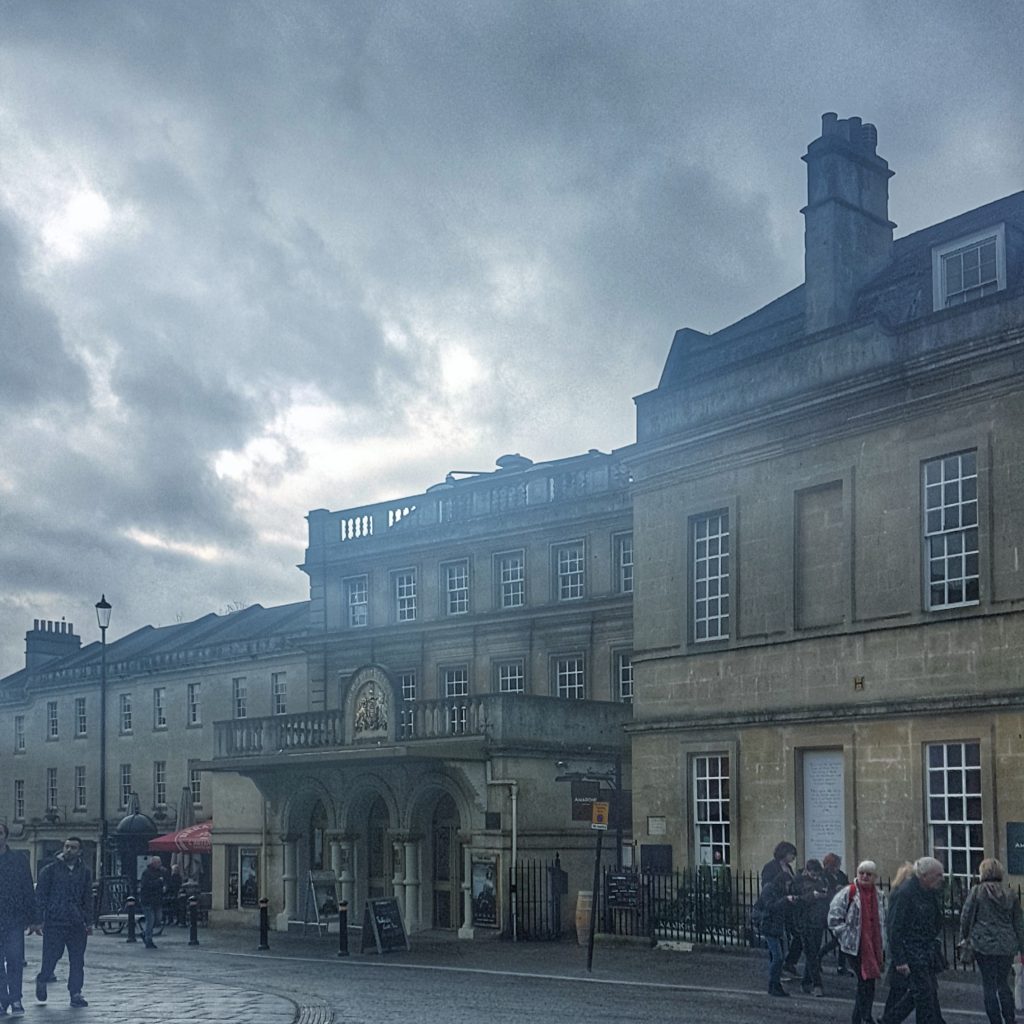
Nash was known as the King of Bath. More technically, he was the Master of Ceremonies in the spa town of Bath, and was essentially single-handedly responsible for making Bath the social scene that it was. He decided if newcomers could ascend to the “Company”, a higher social set of 500-ish people who were allowed to eat, dance, gamble, and drink at all of the fashionable places. He had a veritable string of mistresses, and lived with them at his home here. As the window tells us,
This was the splendid home of Beau Nash, “The King of Bath,” and his handsome and faithful mistress Juliana Popjoy. They spent the whole of the latter part of their lives here until the Beau’s death, in 1761 at the age of 86. We preserve in this building all the high standards Beau Nash set for Bath.

This is now the back of the Theatre Royal, but was actually the original entrance to the theatre. It faces Beauford Square, a small square of two-storey cottages. Originally, it was a communal garden but is now an enclosed green. The Square was erected from 1727 to 1736, and far predated the theatre. I found it interested that the coat of arms (the ever-present Dieu et Mon Droit) was left after the front moved. If I couldn’t live in the Circus, I would take a townhouse in Beauford Square (should I win the lottery…)! Also, interesting fact to leave you with: the spikes in the fence are modelled on the pikes used in the Battle of Trafalgar.
Have you done a walking tour of Bath? Or a walking tour anywhere else?
Cheers,
The Historian
Facebook | Twitter | Instagram | Pinterest | Bloglovin’

One of these, I will get to Bath. This post is great! I had no idea there was so much beauty in this town. I definitely wanna go there now. Loved learning about the history of the baths, too. I didn’t realize you could drink the water — which, admittedly, kinda skeeves me out, but only because I hear “bath water” and think of what someone has bathed in, haha. Obviously, they wouldn’t serve you bathing water (…right?? 😉 lol). Sounds like a unique experience, though!
And, I love walking tours. My husband and I do one every time we visit a new city, either domestic or abroad. It’s such a great way to learn about the local history and sights before figuring out what exactly you want to see in more depth during your visit. Plus, it’s great exercise! A few scheduled walking tours per vacation, and I have no guilt about vacation eating. 😀
Bath is my favourite city, and should my office happen to win the lottery one of these weeks, I will absolutely be there, no questions asked! And yes, when you hear “Bath water”, the first thing that springs to mind is literally Bath water haha. I didn’t drink the water because it’s a whole extra stop to do, but come next time, I think I will haha! I mean, I could probably use at least half of those minerals….
I loved both of the walking tours I did, both the one in London and this one in Bath. I like that in the UK they have Blue Badge guides, so that you know there is some governance in place. I’m just sad that my next two trips are to Edmonton in November and Toronto in December, not the best weather for walking tours haha!
Great post! I love Bath, but I never even considered doing a walking tour! How many people were involved in your tour? Was it super busy? I might have to do that next time I visit. 🙂
I want to say between 20-25 people? The meeting place is VERY busy, but I think that there were 7 groups, maybe even 8! They specifically cap it so it isn’t a ridiculously large group, which I really appreciated 🙂 I loved getting the history from locals!!