Bath is quite possibly my new favourite city. Although it is much, much quieter than London, it is gorgeous and rich with history from the medieval, Georgian, and modern periods. It is also easily walkable, and you quickly realise why Jane Austen’s characters were always walking around Bath in Northanger Abbey and Persuasion. You can recognise a few key spots in Bath from Austen’s novels even today. The one that truly stands out above others are the Bath Assembly Rooms, which you can still visit today and experience the Georgian rooms!

The Bath Assembly Rooms hold my interest for two reasons. I am a bonafide Jane-ite, and it is the home of the Fashion Museum! I’ve already shared my thoughts on the Royal Women exhibition, but I will soon be sharing my thoughts on the rest of the museum. You thankfully can view much of the clothing for both men and women that would have been worn in Bath when Jane Austen was living there herself.

You can reach the Assembly Rooms by walking up Gay Street or Brock Street to the Circus (the King’s Circus, for Austen’s Bath) and then walking about 30 seconds down Bennett Street. Sidenote: for anyone who has been to Bath, is this street what the infamous Bennett sisters are named for?!

To be precise, these are the Upper Assembly Rooms in Bath. The Lower Assembly Rooms were the original rooms, and were in the medieval city of Bath. They were torn down in 1933 to make room for roads, as the city decided that they no longer needed two sets of assembly rooms. Although some people were horrified by this when they talked about this on our walking tour, I can understand that not all of your city can be a museum, and I am grateful that the Upper Assembly Rooms are so well preserved! And in case you were wondering, someone in a sedan chair could carried directly to the door with the height of the entryway.

The Great Octagon is in the centre of the Assembly Rooms. (It is a true Octagon, this panoramic shot distorts it.) Originally it was a card room, where people who weren’t busy dancing the evening away could gamble and chat and do who knows what else. I can imagine how busy it would be, and hot, with the fireplaces going and the amount of candles needed to keep it lit. If you live in Bath, it seems the perfect room to give talks in (if you need an idea). It was tough to get pictures of the portraits being so high, but they really do seem prominent in the room. (Not sure who most of them were, though…) The chandelier really stands out as the centrepiece though, hanging low enough to readily catch your eye.

When I was in Bath, I bought myself “A Map of Bath in the Time of Jane Austen”. It’s a map of the city dating to when she would have lived there, and includes comments and descriptions from her novels and personal correspondence. I think it was only £2 or £3, but it is one of my favourite souvenirs from the trip. The Upper Rooms are an important setting in Northanger Abbey. “The important evening came which was to usher her into the Upper Rooms. Her hair was cut and dressed by the best hand, her clothes put on with care, and Mrs Allen and her maid declared she looked quite as she should do… The season was full, the room crowded, and the two ladies squeezed in as well as they could. As for Mr Allen, he repaired directly to the card-room, and left them to fend for themselves.” Although men would have been needed in the ballroom so that there were enough partners, I can imagine that many of the men would have stuck to the card room.

The Ballroom
I think that I can speak for most Janeites when I say that the ballroom is what you really want to see. It is equally huge and small when you think about the number of people that would have been in this room. Catherine Morland can barely move in the ballroom in Northanger Abbey, and if you are factoring in that people would have needed at least some space to make the formations for dances, it is quite small. However, it had changed by the time Jane returned back to Bath. On 12 May 1801, “the before tea did not last long, for there was only one dance, danced by four couples. Think of four couples, surrounded by about an hundred people, dancing in the upper rooms in Bath!” (That would be quite a manageable number in the space.)
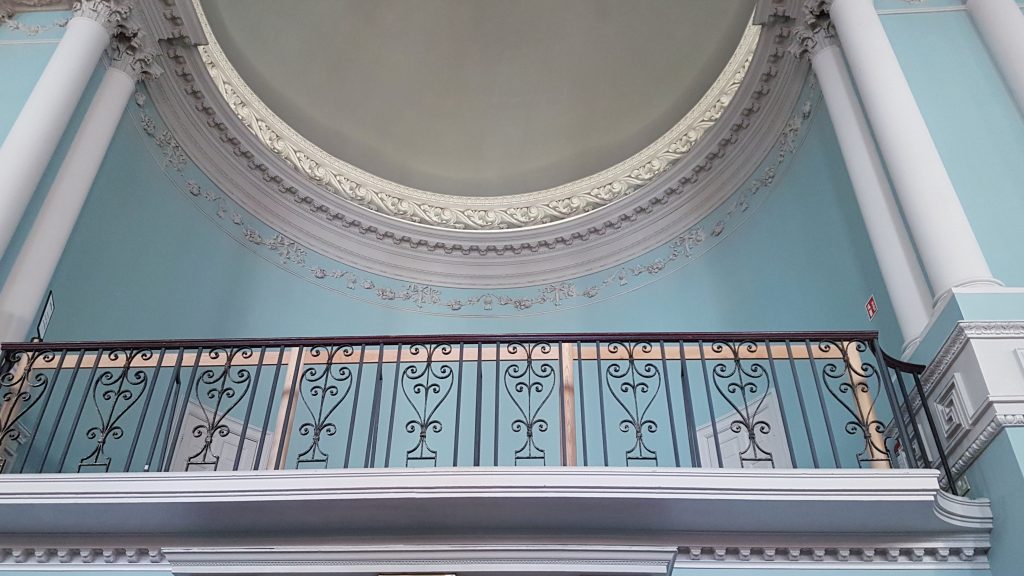
In order to ensure that they could maximise the space in the ballroom, the band actually played in alcove just above the doorway. I think it is quite a fantastic use of space, and also allows for more of the neo-classical detailing that makes the space so beautiful. Although it is a bit tough to see from the main level of the ballroom, the crown molding on the ceiling is the perfect finishing touch on the room. I would imagine that if you hosted an event there nowadays, it would be the ultimate vantage point for photos! (Us regular folk weren’t allowed up there, though, sadly.)

One of my favourite things that I learned about the Assembly Rooms on our walking tour is that the windows were placed on the upper storey of the room to make sure that people weren’t peeping in and watching the goings-on without actually paying or properly attending. I’m not 100% sure what you could see in an overly-crowded room, but I suppose when you are the place to be, you want to keep it that way.
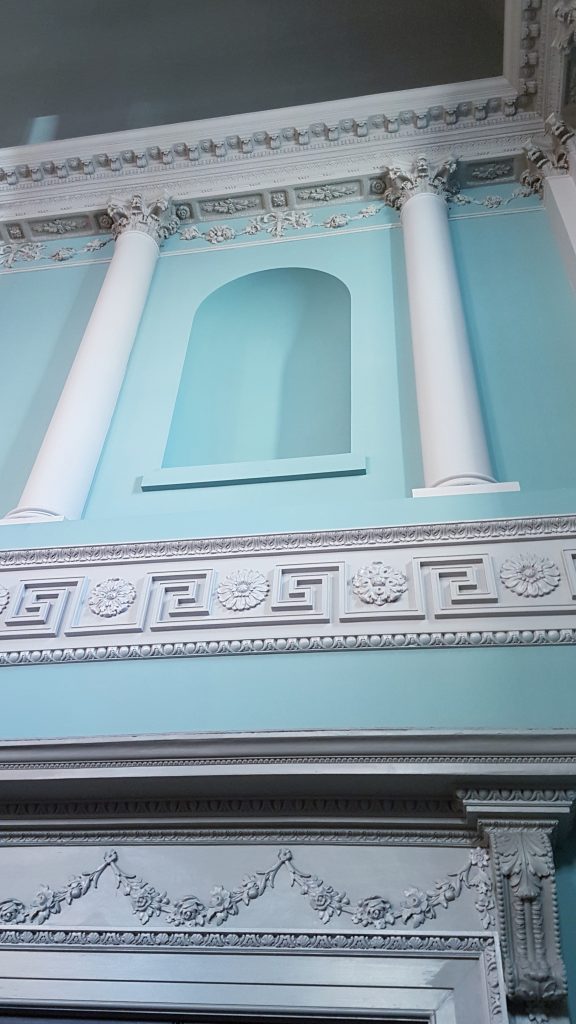
The molding and columns throughout the ballroom is such a striking sight, though. I think that the light blue and white combination works well together, embodying the neo-classical idea of mimicking the sky. And this is just a theory of mine, but I wonder if all of the interior design work was kept at the upper story as to not distract from the people meeting and dancing and chatting on the main level.

I’ve also just got a thing for decorated ceilings. Before Bath, I had not seen a lot of neo-Palladian architecture, but it is beautiful in the most classic sense. I do wonder what this shot would look like with warm candlelight instead of electric lighting, but I think that the cool look here is perfect. I can very much understand how this building and this room in particular was the place to be, where everything of note happened.
Have you been to the Bath Assembly Rooms, or walked in the path of Jane Austen elsewhere?
Cheers,
The Historian
Facebook | Twitter | Instagram | Pinterest | Bloglovin’

Love this place! Many thanks for a interesting and detailed blog posr
Thank you, Claire!! It is just so beautiful, and so fascinating 🙂