Netflix isn’t really known for their original historical content. Yes, there is The Crown, and there was The Outlaw King (which I still need to watch) but it isn’t their MO. So, I was curious when I saw that Netflix was going to release The Last Czars in early July 2019. The Last Czars is a docuseries about the last generation of the Romanov house, and the crises that ushered in their downfall. Of course I had to watch it as soon as it was released, and of course I have thoughts. This post is my review of The Last Czars and my recommendations on what to do after!

The Last Czars is a Netflix original series, meaning that anyone who has Netflix on the globe should be able to watch it. (My biggest pet peeve is when people don’t recognise that most shows aren’t available in every region, but this should be.) It is six episodes long, and follows the Romanov family from Nicholas II taking the throne in 1894 to their murder in 1918. It is framed by the children’s tutor meeting Anna Anderson (the woman who claimed to be Anastasia in Berlin), and recounting the whole episode. The acted portions are supplemented by historians of the period explaining what was happening.

The Last Czars Review
Overall, I really enjoyed The Last Czars. Netflix took a rather human approach to the series. The focus is on the people rather than the costumes or the sets, which is novel for them. (That isn’t to say that it is cheap looking. However, you won’t see many glittering jewels or long sweeping shots of the Winter Palace.) It was a smart approach to take, as I think that people often get caught up in mechanics of the Romanovs’ downfall, and forget that these were very real people. I also think that the inclusion of historians briefly narrating was an excellent choice. They can quickly explain something and save us several minutes of exposition. It also allows the audience to get the full picture (with the benefit of being able to look at it from a century on). Their interjections make up maybe 10-15% of the show, so it isn’t particularly overbearing. I’m hoping more shows will follow their lead on this! (Can we stop having 80% historian, 20% cheesy acting, please?)
There were a few things that felt off. There really isn’t any of the Romanov grandeur that you would expect. None of the jewels and sumptuous clothing, no sweeping shots of beautiful palaces. Their extravagant wealth played a sizeable role in their downfall (when their country was starving), so ignoring this entirely seems an odd choice. The actors don’t look too terribly close to their Romanov counterparts, but I don’t know that it is an issue. The language is probably the biggest issue for me. The actors all have British accents, which isn’t a problem as Nicholas and Alexandra actually spoke English quite frequently. (Thanks, Queen Victoria!) However, there are a lot of F-bombs throughout, and it tends to bring you out of it. And I know that several historians have raged about various terms being used, like calling Rasputin a “mad monk”. I personally don’t have an issue with it. When it comes to Orthodox/Catholic priests/monks/holy men, I don’t think that the average person makes a huge distinction. And my one last quibble? It isn’t exactly the last czarS, as we really only get Nicholas, and no one before him. (I know that technically his son and brother were both very briefly czar, less than a day each, but those don’t really count… And that isn’t really gone into any detail.)
Is it worth watching? Absolutely! It is a new take on the Romanovs, and a historically informed one at that.
What to Do After You’ve Watched The Last Czars
So, you’ve now watched all three episodes, and like many of us, still want more of the Romanovs. What can be done? If you happen to find yourself in Edinburgh, the Queen’s Gallery at Holyrood has the perfect exhibition for you: Russia, Royalty, and the Romanovs!
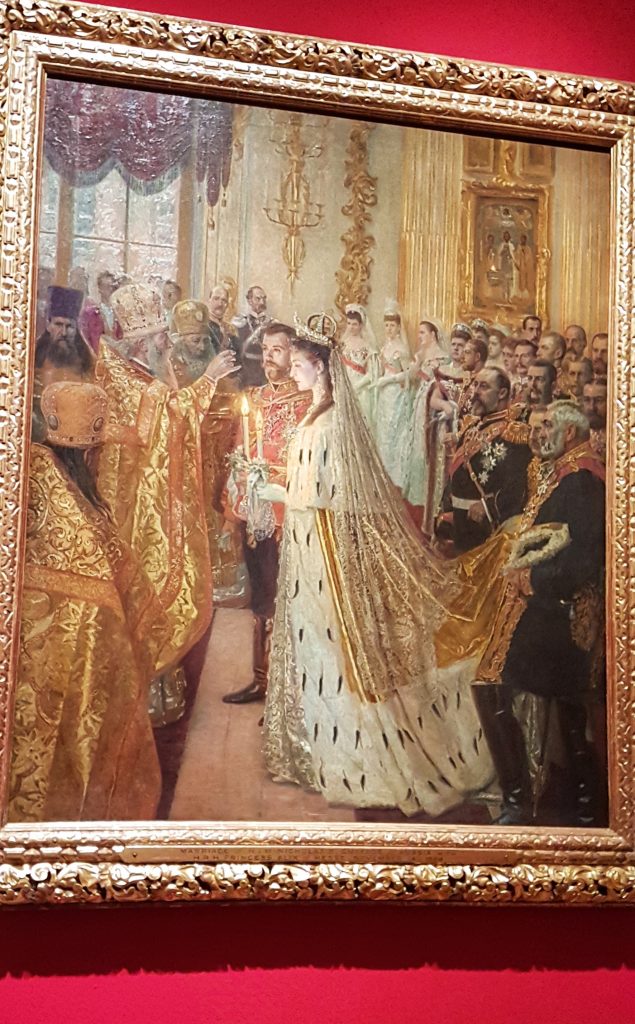
I was lucky enough to see the exhibition at the Queen’s Gallery, Buckingham Palace, and it is now at the Queen’s palace in Edinburgh until Nov 2019. It looks at the relationship between the British royal family and the Romanov family, over three and a half centuries. Portraits, gifts, letters, clothing, and more are all included. If you are really interested in Nicholas and Alexandra, you will love the second half of the exhibition! I personally was fascinated by the above painting of their 1894 marriage, and all of the souvenirs of their coronation. I don’t know why, but the handkerchief below was one of my favourites.

And what would this post be without a book recommendation or two? From Splendor to Revolution: The Romanov Women, 1847-1928 is one of my favourite Romanov books that doesn’t get the love it deserves. To understand how the Romanovs ended up where they did, you really need to go back a few generations. The Romanov women played a massive role in the history of the dynasty, not just Alexandra, and Gelardi’s exploration of these five different women is insightful and interesting. I understand why the show focused solely on Alexandra and none of the other women, but they do deserve their time, as well!

And if you would like an overall look at the state of Europe, I would recommend George, Nicholas and Wilhelm: Three Royal Cousins and the Road to World War I by Miranda Carter. The Romanovs didn’t live in a vaccum, and the relationships between the European royal families played a large role in the entire conflict. It takes somewhat of the same approach as The Last Czars, looking at the men themselves rather than the politics of the time. This book works well with the Russia, Royalty, and the Romanovs exhibition, as the relationship between George and Nicholas is featured there.

Have you been watching The Last Czars? What are your thoughts on it?
Cheers,
The Historian
Facebook | Twitter | Instagram | Pinterest | Bloglovin’