The Royal Family has entrenched themselves in Christmas celebrations in Christmas and across the Commonwealth. They aren’t responsible for creating or inventing these traditions but they do popularise them. (Of course, this is in addition to celebrating the regular local traditions from that region and period.) And they might actually surprise you. Each week we are going to explore a different English and/or British dynasty and how they uniquely celebrated the holiday season. For our first week in this Blogmas 2023 series, we are going to be exploring the history of Tudor Christmas!
The Twelve Days of Christmas
We enjoy good food, festive beverages, and parties in the lead up to Christmas, and we enjoy our daily treats via Advent Calendars. However, in Tudor England, Advent was a period of fasting (including Christmas Eve) with Christmas Day the beginning of the Twelve Days of Christmas. This nearly two-week period was full of feasting, community gatherings, and different traditions like the Boy Bishop where a boy in the church would be elected to be the bishop on 6 December and would give his final sermon on 28 December. The Lord of Misrule is a similar tradition where a commoner or lower member of the clergy would be in charge of holiday festivities.

A Royal Present of Gingerbread
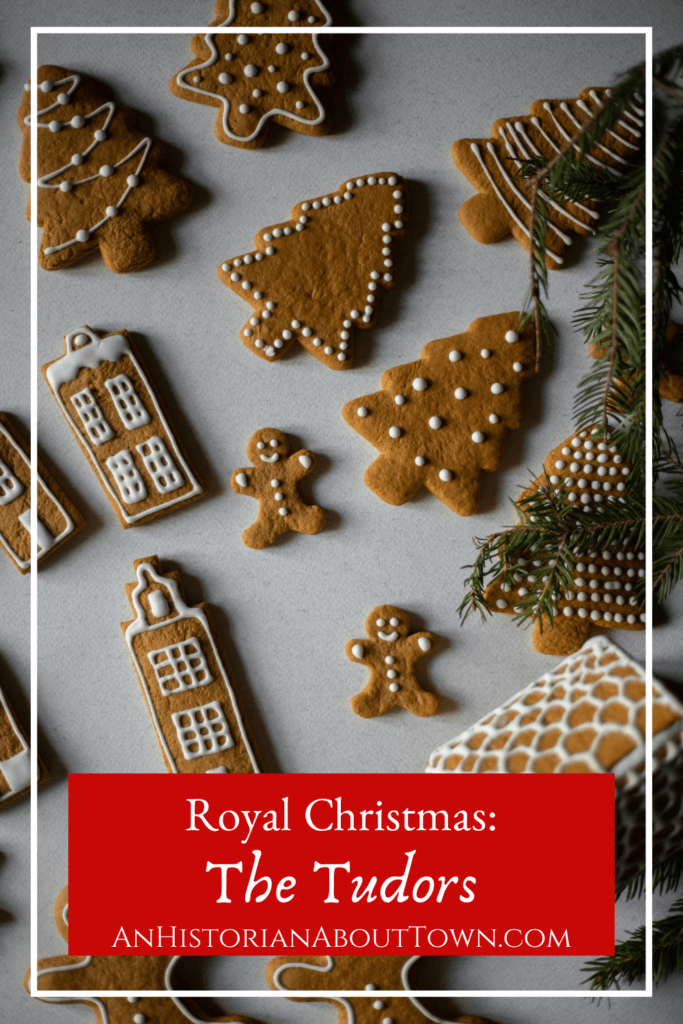
Gingerbread was not a cheap recipe to make in the mediaeval and early modern period in Britain- it requires several spices that are expensive and difficult to get with limited transportation. Yes, the cookies, aka biscuits, are delicious, but it was eaten in the Tudor period to help aid digestion. (Ginger is incredibly helpful that way.)
While Queen Elizabeth I was not the first Tudor monarch to have her kitchens make gingerbread, she was the first to give gingerbread as a gift to notable courtiers. She had her chefs create gingerbread biscuits that looked like her favourites in order to curry favour. Rather the early modern version of the personalised mug!

New Year’s Gifts
While the current British Royal Family famously exchanges gifts on Christmas Eve now, this was not the holiday way of things for the Tudors. Instead, they would exchange gifts with each other and those at the court on New Year’s Day. Firstly, noblemen, servants, and even commoners that lived nearby would give their presents to the monarch, who would then return the tradition. Gifts were very specifically chosen with both the giver and receiver’s social status in mind. Common items were cups, plates, or jewellery made of gold, silver, or gemstones, as well as leather bound books and artworks.
According to the Royal Collection Trust,
It was in the reign of Henry VIII that the formal court ceremony of giving New Year’s gifts developed. On the morning of New Year’s Day, gifts were presented to the King by the donor or their representative in the Presence Chamber in order of precedence, with the highest-ranking donor offering their gift first. As the King received each offering, the Treasurer of the Royal Household would record it on a gift roll… The King could choose not to accept gifts as a sign of displeasure. (A Royal Christmas, 33-34*)
Just as the social hierarchy and Tudor body politic was set very firmly, so was gift-giving!
*Cooling, Louise. A Royal Christmas. London: Royal Collection Trust, 2018.
Were you familiar with the history of Tudor Christmas?
Cheers,
The Historian
Facebook | Twitter | Instagram | Pinterest