When Buckingham Palace announced that Queen Camilla will be wearing Queen Mary’s Crown for the Coronation in May, the press release focused on the fact that it will be reset with three of the Cullinan Diamonds (III, IV, and V). However, it sidestepped the glittering elephant in the room- the Koh-i-Noor. This diamond was set in the coronation crowns of Queen Alexandra in 1902, Queen Mary in 1911, and Queen Elizabeth (later the Queen Mother) in 1937. Charles and Camilla have specifically chosen to not include Koh-i-Noor but why? For Style File Friday this week, we are looking at the history of the Koh-i-Noor diamond and the controversy that surrounds it.

Note: I will get into this below, but the monarch does not have the authority to return the Koh-i-Noor or any piece in the Crown Jewels as they do not actually own it. That authority would fall with the government.
The Early History of the Koh-i-Noor Diamond
We do not actually know the specific place where the Koh-i-Noor was discovered or when. There are several myths surrounding its discovery but none have been confirmed. We do know that it first came into the written record in 1628* when Shah Jahan, a Mughal ruler, commissioned a jewel-encrusted throne that included the Koh-i-Noor. Like the British Royal Family, he knew it deserved a place of prominence- it was set at the top of the Peacock Throne.
The Persian ruler Nader Shah invaded in 1739 and took the Peacock Throne, amongst many other treasures when he conquered Dehli.
*The diamond may have been mentioned a century earlier in Mughal ruler Babur’s writings, but this cannot be confirmed.
Returning to India
Unsurprisingly, the Koh-i-Noor was stolen several by different rulers as different kingdoms were conquered. Ranjit Shah, the founder of the Sikh empire, claimed the Koh-i-Noor in 1813 and brought it back to India. Singh understood the symbolism of the diamond, and defended its significance. However, after his death in 1839, the diamond’s future looked uncertain again.
Singh’s sons inherited his kingdom but were not able to hold onto it and were each killed, aside from his youngest son. A five-year-old Duleep Singh took the throne and was the last Maharaja to own the Koh-i-Noor. Given that he was a child, Singh had little power personally over the Kingdom of Punjab.
The British Acquire the Koh-i-Noor
In 1849, Britain annexed the Kingdom of Punjab. Singh, then eleven years old, signed the Last Treaty of Lahore on behalf of the kingdom and this included surrendering the Koh-i-Noor to the British forces.
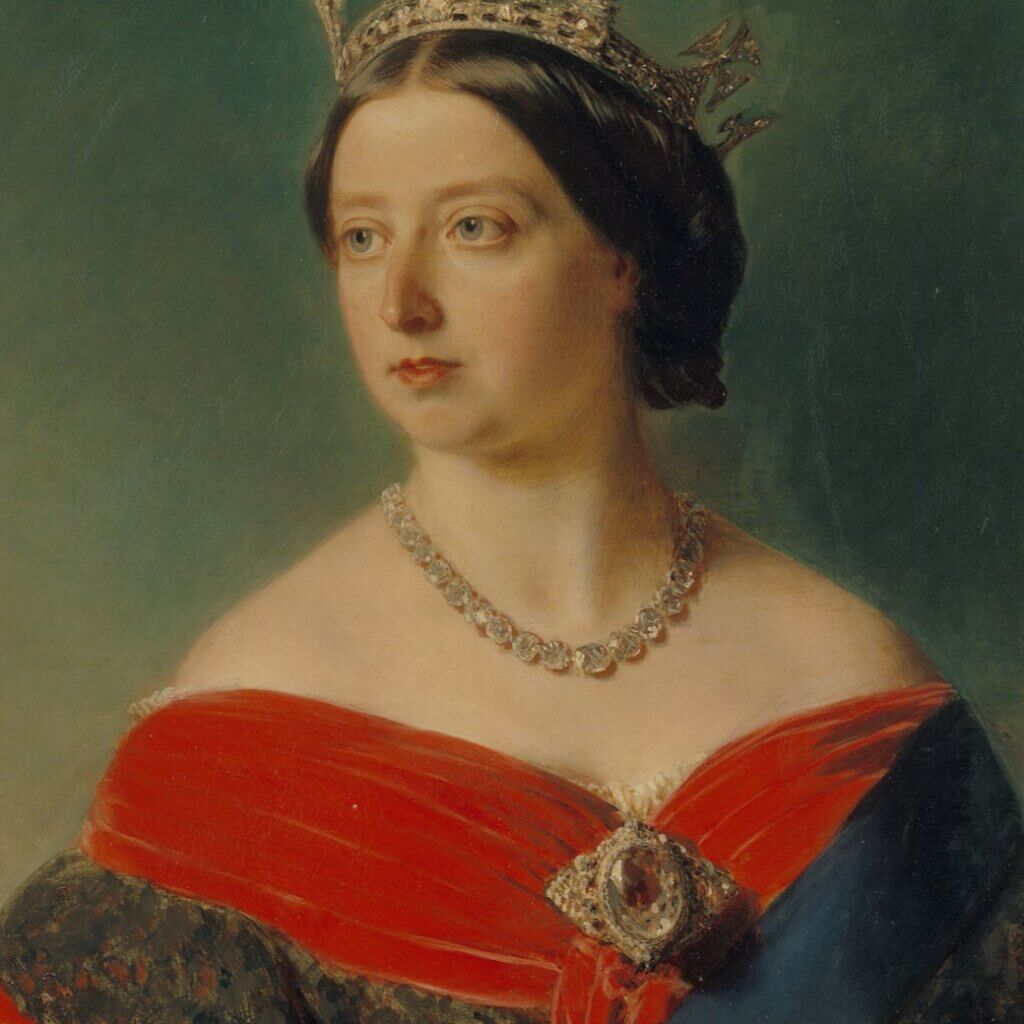
Unsurprisingly, Queen Victoria was more than happy to receive the substantial diamond. It was on display at the Great Exhibition in 1851 and was not as impressive to British crowds. Prince Albert then decided that something needed to be done and had Garrard & Co cut the nearly-186 carat gem down to 105.6 carats that it now is today. (Yes, he had 80 carats shaved off- you read that correctly.)
Victoria owned the Koh-i-Noor personally and frequently wore it set in a brooch. Despite expressing concern to her family about how the jewel was acquired, Victoria did not return it. After her death, it became a part of the British Crown Jewels, and was set into the consort crown of each queen following Victoria. Queen Camilla will be the first consort to break this modern tradition in May 2023.
You will note- only female members of the British Royal Family wear the Koh-i-Noor. There is a myth that says that tragedy will befall any males who wear it.
Current Claims on the Koh-i-Noor Diamond
Many people will say that the British should return the Koh-i-Noor Diamond, but the question is, who do they return it to? Upon gaining Independence in 1947, India’s government immediately demanded the gem’s return, and again in 1953 ahead of the Coronation.
Pakistan also lodged a claim on the diamond in the 1970s based on the fact that the area that Duleep Singh ruled over is in present-day Pakistan.
The latest claim comes from Afghanistan in 2000, with the Taliban arguing that the diamond was found in Afghanistan and is substantiated by a journal. This is the weakest claim but is a claim nevertheless.
And of course, the fourth claimant is Great Britain. As I stated above, the monarch does not personally own any of the Crown Jewels are therefore cannot give them to anyone. The British government could, but every time they have been asked in the last 70+ years, they have declined.

What Should Be Done With the Koh-I-Noor Diamond?
I must admit, I am unsure of where I think it should be now. While the British coerced the gem away from a child ruler (in very simplified terms), I don’t know how they would determine who to return it. While it remains in Britain, I do not believe that it should be worn again. I also do not think that it should be on display at the Tower of London, at least not without significant explanation included. (That is somewhat tough- unless things have changed since I was last there in 2019, you ride a moving sidewalk to view the gems, not leaving a lot of reading time. Perhaps this has already been added, though?)
Want to know more? You can read a Smithsonian essay here!
Were you familiar with the history of the Koh-i-Noor diamond?
Cheers,
The Historian
Facebook | Twitter | Instagram | Pinterest

.jpg)
