We are less than a week away from King Charles III’s coronation on 6 May 2023, and we also happen to be kicking off Georgian history month on the blog. In honour of both, today we are going to look at all five of the Georgian coronations, as they all had their… moments. (And if you missed my Georgian History Month post, I am including William IV in the Georgians.) A coronation is never boring but these are all more entertaining than you might think. Onto the history of Georgian coronations!
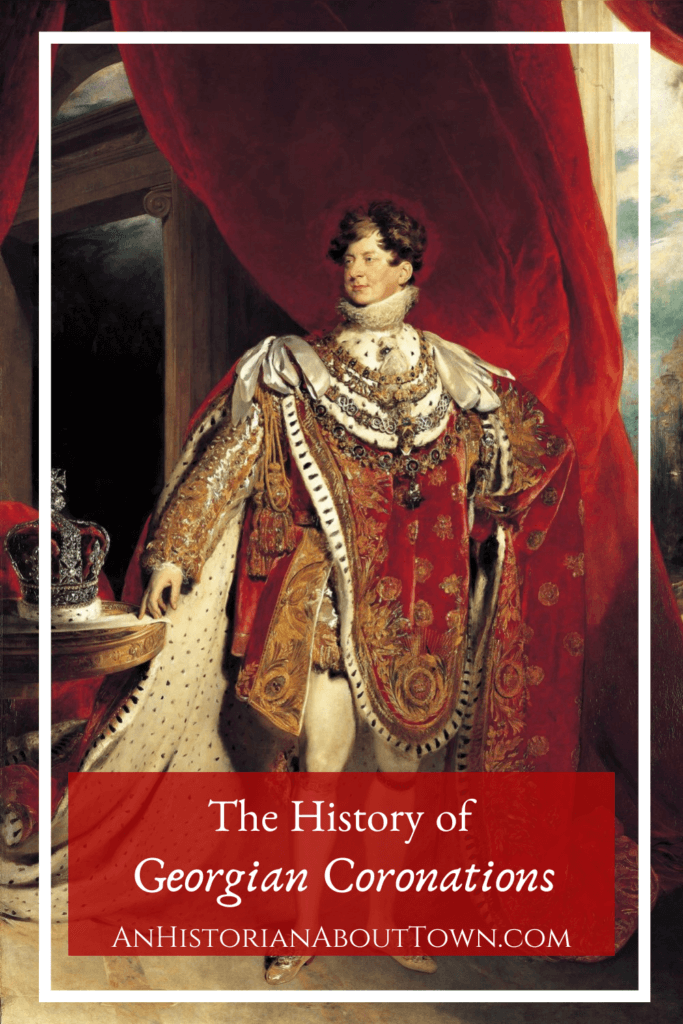
George I’s Coronation- 20 October 1714
As the first Hanoverian monarch to ascend the throne in Great Britain, it was obviously a big change for both George and everyone in Britain. And it led to some difficult moments during the first Georgian coronation.
George grew up in Germany and did not step foot on British soil until he arrived in 1714 after Queen Anne’s death. George did not speak any English, and none of the clergymen who were taking part in the coronation service spoke German, so they had to turn to that trusty language of many of our schooling careers: Latin. Despite everyone understanding Latin to some degree, it was a bumpy ceremony at best.
George I was the first Georgian monarch to not be crowned with his consort. George’s wife, Sophia Dorothea of Celle, was imprisoned in a castle in Germany after having an affair with a Swedish count, and George successfully petitioned for divorce in the 1690s. (Nothing says celebratory like an imprisoned ex-wife, no?)
Interesting Fact: There is actually a surviving receipt from the coronation for the king’s embroidery for £1782 which would be over £280,000 today.

George II’s Coronation- 22 October 1727
George II’s coronation was more successful than that of his father, given that he spoke English and had learned the language from a young age. While his father’s coronation was known for being fairly haphazard and disorganised, George II’s coronation was remembered as being spectacular and impressive.
The Archbishop of Canterbury at the time, William Wake, planned the service carefully and it is Wake’s template that is still used for British coronations to this day. There is another element of British coronations that began with George II: Handel’s music. German Baroque composer George Frederic Handel composed ‘Zadok the Priest’ and three other coronation anthems. We will be hearing ‘Zadok the Priest on 6 May for King Charles III’s coronation, marking nearly 300 years since it was first performed.
Interesting Fact: A walkway from Westminster Hall (the oldest surviving part of Westminster Palace, now Parliament) to Westminster Abbey was erected, allowing the crowds outside to witness the peers processing to the coronation in their finery.
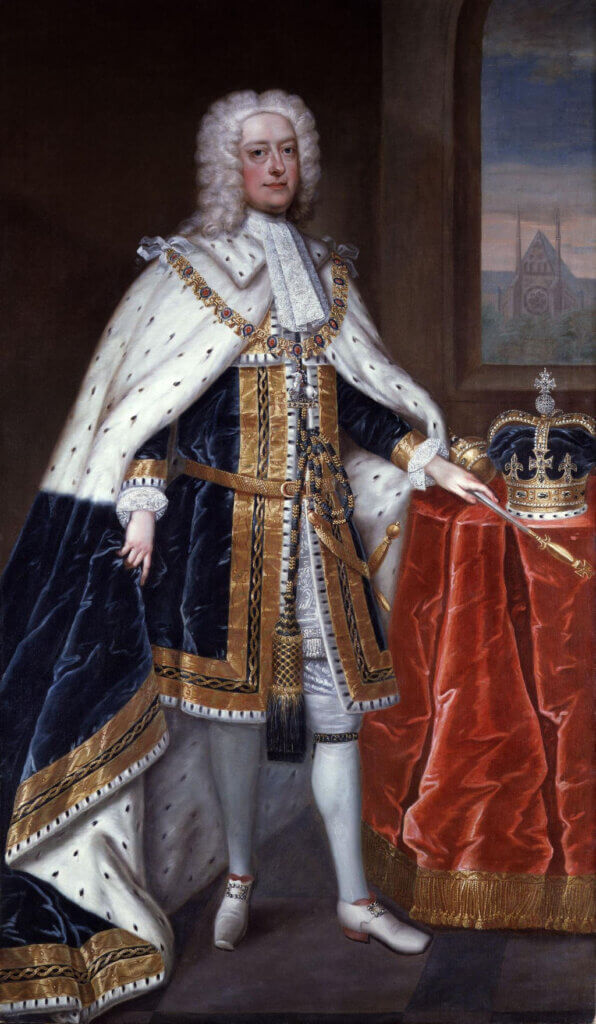
George III’s Coronation- 22 September 1761
I suspect within a week of this post being published, many, many more people will be interested in the coronation of George III as it appears to be included in the new Queen Charlotte show. It was also a bit of a haphazard event.
When George and Charlotte first arrived at Westminster Hall to go into the Abbey, there were several issues. The Sword of State was forgotten, there were no chairs for the couple, and there was no canopy for their procession to the Abbey. It was also an extremely long day; George and Charlotte left St. James’s Palace at 9am and were not crowned until after 3pm.
However, in spite of the chaos, the public was still happy for their sovereign. There were several public parties and bonfires to celebrate the coronation, and there were theatrical productions of the young king and queen’s coronation for several weeks in the West End.
Interesting Fact: George and Charlotte had only married two weeks prior to their coronation- that must add to the stress of a newlywed period when you already do not know your spouse.

George IV’s Coronation- 19 July 1821
We now arrive at the second Georgian monarch to not have their consort at their coronation. George’s relationship with his wife, Caroline of Brunswick, was not as bad as that of George I and Sophia Dorothea, but really only in that George IV didn’t imprison his wife and most-likely have a hand in the murder of her lover.
As Prince of Regent, George dictated the trends of fashion, culture, food, and more. (He would be the Regent that the Regency is named after.) Therefore, it should come as no surprise that his coronation is the most expensive British coronation on record coming in at over £21,000,000 in today’s money. He chose the most luxurious fabrics for his garments and the most elaborate meal for his banquet- quite literally, no expense was spared. When people accuse coronations of being over-the-top and a misuse of funds, George IV’s coronation does come to mind.
Interesting Fact: Caroline tried to enter the Abbey for the coronation, but she was physically barred from entering. (She was immensely popular with the public, this did not help George in any way.)

William IV’s Coronation- 8 September 1831
Following his elder brother’s coronation, William was determined to have the most economical and simple coronation possible. Known as the “Sailor King”, he spent much of his adult life in the Royal Navy and reached the rank of Rear Admiral. Because of his relatively spartan lifestyle in the navy, William abhorred the ceremony and pomp that accompanies all royal functions, but especially a coronation.
William’s coronation- with his wife Adelaide of Saxe-Meiningen- was as simple as the government and church would let him get away with. He eliminated the coronation banquet and many other extravagances. He grimaced throughout his coronation and made it clear that he hated it.
Still, many of the traditions that are still observed today began with William. The procession and pre-coronation ceremonies that he established allowed those outside the peerage to take part. His procession in the Gold State Carriage is also the template that is still used to this day.
Interesting Fact: William wore his Admiral’s uniform for the coronation under his robes.

Of all of the Georgian coronations, which would you have liked to attend?
Cheers,
The Historian
Facebook | Twitter | Instagram | Pinterest

.jpg)


