The Jane Austen Centre in Bath is rather a mecca for Austen fans. It has something for everyone; from the brand-new reader to the experienced Austenite. Both Northanger Abbey (my favourite novel) and Persuasion are set in Bath, and the Centre does a fantastic job of delving into them. However, it also covers Jane Austen’s life in general, and life in Bath during the Regency period. And although you can read endlessly on Jane Austen’s life and writings, there is nothing like seeing it in person. The fashion at the Jane Austen Centre is one of the Centre’s strengths, and offers great insight into Austen’s life and characters.

For many historically-minded folks such as myself, watching period films can be a trial because of the costumes. (Hey, Tudor period films- we would never see those women’s hair….) However, Austen films seem to be more or less accurate, with a general slim Regency silhouette. But, are they accurate? I have to admit, I wouldn’t actually know beyond that silhouette. Thus started my Regency fashion education…
I think my number one question for Regency fashion has to be, how did we go from the outrageously wide court mantua of the 1760s and 1770s to the very slender muslin dresses we see all over in the 1790s and onwards? While I was in Bath, I found the perfect book to help me get started answering it. Fashion in the Time of Jane Austen (Downing, Sarah Jane. Fashion in the Time of Jane Austen. Oxford: Shire Publications, 2010) is part of the Shire Library series, and is a great primer for the basics of Regency fashion.

Why Were Regency Fashions So Simple?
Essentially, fashions made their way from France to England and were slowly disseminated around the country. As a response to the French Revolution, the aristocracy embraced everything neoclassical in honour of classical democracy. Simplicity overtook the elaborate Baroque. You can see it in the English Palladian architecture that has made Bath a UNESCO heritage city, with it’s striking columns and overt symmetry. And it is incredibly evident in the simple, streamlined gowns that Catherine Morland and Anne Elliot wear on their Bath adventures.
The first ‘Grecian’ gowns were simple shifts of muslin with practically no shape except that given by a ribbon tied beneath the bosom. It was a style most suited to the young and slender, and although it did not carry the political significance held in France, the freedom and comfort of a light gown worn with little underpinning and flat slippers must have been a relief that many women were unwilling to give up. (17)

If you compare the white muslin gown above with this robe á la française at Fashion Museum in Bath, it is easy to see why women would want to embrace these fashions. In the Regency period, promenading was an important social activity. (For anyone new to the Regency, it is essentially walking in nice places in order for people to see you.) If a key part of my day and social life was dedicated to walking, I would personally appreciate having an ensemble that makes that comfortable.

Muslin- The Great Equaliser
The one key aspect that seems to stand out from most every Regency gown is the white muslin. Most surviving gowns and illustrations do show colour somewhere- it might be in the jacket, hat, or shawl, but that bright white muslin is key! Austen clearly understood the importance of white muslin, as it is the very basis for Catherine and Henry’s first conversation in Northanger Abbey. In chapter III, Henry gallantly impresses both Catherine and Mrs. Allen with his knowledge of muslin. As Mrs. Allen states, ‘Men commonly take so little notice of those things”, so Henry is really going for bonus points with that move. (Austen, Jane. Northanger Abbey. London: Penguin Books Ltd, 2012. p.18)
Being that it was a relatively inexpensive fabric (compared with silks, taffetas, and embroidered pieces), it was quickly adopted across society. “The simple democratic muslin had become the mainstay of fashion, and with the triumph of industrialisation, was affordable to everyone. Where once this was thought an advantage, by 1813 it was lamented that ‘as to dress, no distinction exists between mistress and maid except that one wears a cap’.” (Downing, Fashion, 27.) However, it did remain quite popular through to the end of Jane’s life in 1817.

The Spencer Jacket
As you walk through the Jane Austen Centre, you quickly notice that almost all of the women’s costumes include these very specific cropped jackets. The Spencer was originally a men’s jacket, shorter and without tails. However, it was adapted during the Regency period for women. It was usually worn tailored to the bust line and very neatly followed the lines of the dress. Those very popular muslin dresses had the dis/advantage of being quite thin, meaning that you would need something to keep you warmer. Henceforth the Spencer became popular quite quickly!
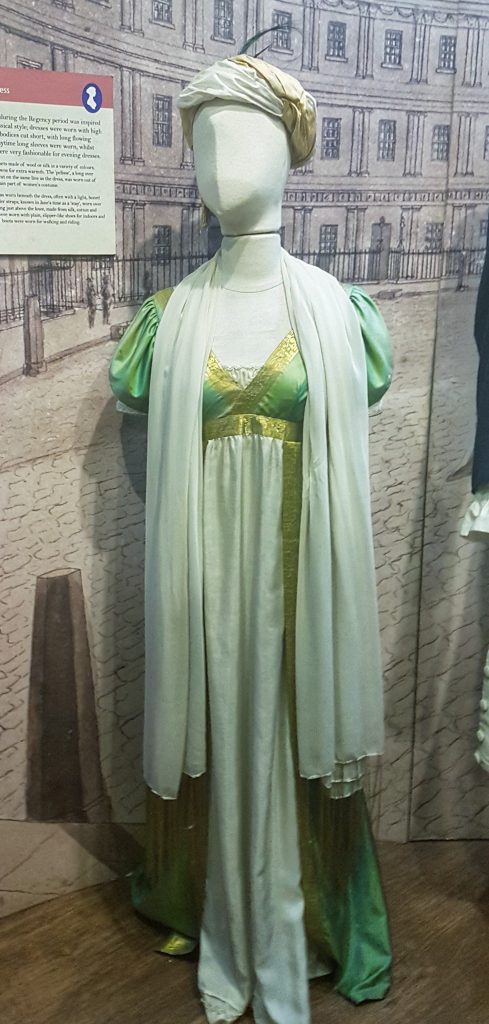
The ‘Oriental’ Influence
As you can see with this green ensemble, and in various prints and illustrations from the Regency period, there was also a strong Asian influence on fashion (particularly in millinery).
The 1790s also saw the rise of the ‘oriental’ style of a silk turban topped with nodding ostrich plumes. Jane borrowed a Marmalouc (or Mameluke) cap, which was ‘all the fashion now’ in January 1799. It was inpsired by the success of Nelson’s Nile Campaign in 1798, and a Nelson cap in Coquelicot velvet was one of the many articles of Nelsoniana worn to commemorate the hero. (Downing, Fashion, 50-51)
Although Bath is a smaller city, the influences of the quickly growing British empire was felt strongly. As indicated by the countless references to hats in Jane’s correspondence, hats were clearly important to her and any chance for a new or improved hat was seized. (I also just enjoy that this gown has so much more colour- it is quite dazzling comparatively!)
♠
The Jane Austen Centre is a treasure trove for any Austenite, and is quite simply, great fun! Regency fashion is a wonderful case study of historical fashion, and the fashion at the Centre are perfect for learning more.
Have you visited the Jane Austen Centre in Bath?
Cheers,
The Historian
Facebook | Twitter | Instagram | Pinterest | Bloglovin’