I shared a couple of weeks ago my thoughts on the Marie Antoinette Style exhibition at the V&A. It may just be one of my favourite exhibitions that I’ve ever seen, with so many incredible pieces and such creativity in the staging. However, there is one exhibition that may just rival it in my affections- a much smaller exhibition. The Royal Collection Trust always does a brilliant show, the collection is just so incredible. And this was no exception. Today I am sharing my thoughts: this my Edwardians: Age of Elegance review!

The Edwardians: Age of Elegance Exhibition
Explore the opulence and glamour of the Edwardian age through the lives and tastes of two of Britain’s most fashionable royal couples – King Edward VII and Queen Alexandra, and King George V and Queen Mary – from their family lives and personal collecting to their glittering social circles and spectacular royal events.
More than 300 objects from the Royal Collection are on display – almost half for the first time – including works by the most renowned contemporary artists of the period, including Carl Fabergé, Frederic Leighton, Edward Burne-Jones, Rosa Bonheur, John Singer Sargent and William Morris.
The exhibition covers the period from Edward and Alexandra’s wedding in 1863 up to the end of the First World War.
The exhibition closed on 16 November 2025- we caught it on 7 November, very close to the end. (Keep that date in mind…)
My Exhibition Highlights
This exhibition was one of my favourites, and I have seen a fair few throughout my life. The Royal Collection is obviously one of the best in the world, and I love that some incredible pieces are included in exhibitions. (Princess Charlotte’s gown and the Vladimir Tiara in the 2019 Russia exhibition spring to mind.) There were countless pieces in this exhibition that made me stop and stare. And given that it is a relatively small gallery, it is all the more impressive.
Notably, all of my inclusions here are connected to Queen Alexandra. That isn’t to say that there aren’t many other wonderful pieces but she has long been one of my favourite historical figures.

François Flameng 1908 portrait of Queen Alexandra
This is one of my favourite pieces of art, and I didn’t know that I would even see it in person. It normally hangs in the West Wing of Buckingham Palace, and although we did a Buckingham Palace tour, we did one of the special tours in the East Wing- I feel especially fortunate to have seen it now. (Given that I only seem to make it over to the UK every 5-8 years, I feel even more lucky.) It is an absolutely massive portrait, and if I had an ornate drawing room, I would also use it as a focal anchor there.

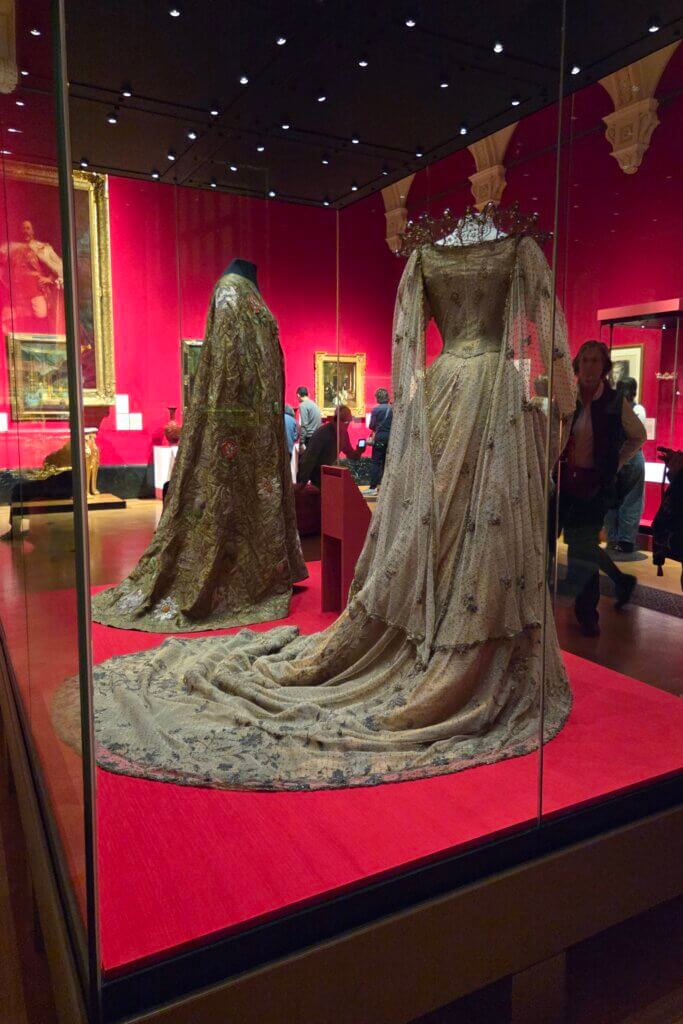
Queen Alexandra’s Mary, Queen of Scots fancy dress costume
Queen Alexandra and Mary, Queen of Scots are tied as my favourite historical figures, so to see Alexandra’s Mary Stuart costume was some sort of cosmic present that I will never again experience in my life. Alexandra was a queen, so it is not surprising that she would have an exceptionally elaborate fancy dress costume. The details on the sleeves, the embroidery work, everything was impeccable. (The staging was also fantastic!)

The Dagmar Necklace
Alexandra received this as a wedding gift. The necklace is based on one worn by the thirteenth century Danish Queen Dagmar, and it reportedly has a piece of the True Cross inside it. The True Cross fragment initially made me think it was intended to be worn for religious events but instead using it for any event calling for formal jewellery! Notably, Alexandra wore it with the Mary, Queen of Scots gown from above, as well as to her husband’s 1902 coronation. (Queen Elizabeth II also wore it a few times early in her reign.)

Queen Alexandra’s watercolour paintings
As someone who primarily works in watercolours, I was very excited to see her sketchbook. I’ve written extensively on the Queen Alexandra Christmas Gift Book with her photography throughout, but we don’t see royal paintings and drawings often. (Other than Princess Louise’s sculpture of her mother outside of KP, that is…) While this may not be the flashiest piece in the exhibition, it was incredibly meaningful to see.
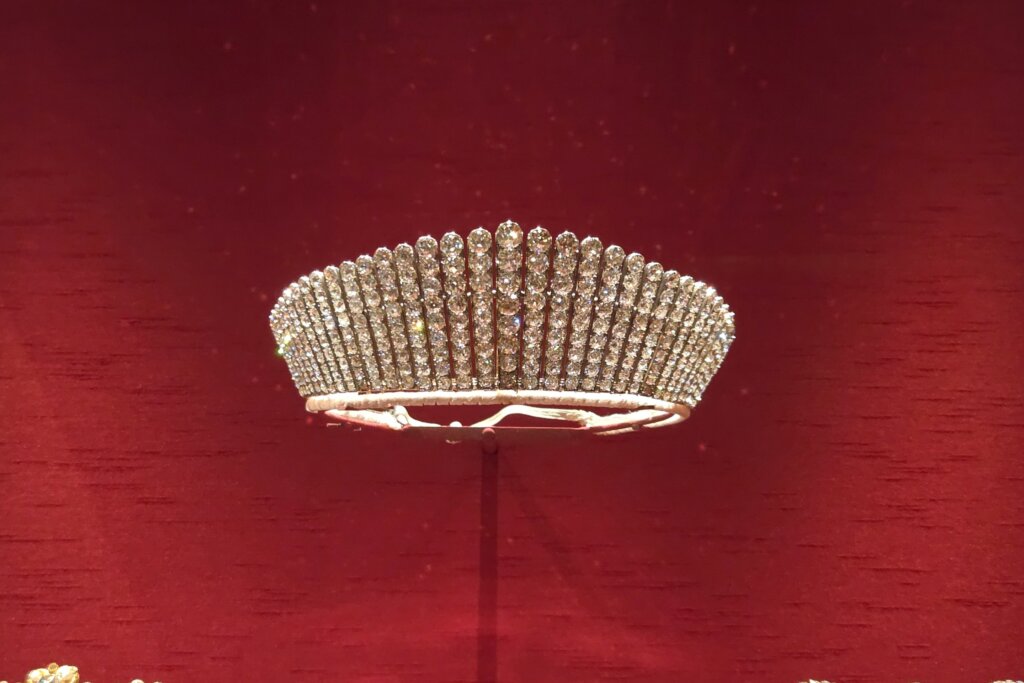
Queen Alexandra’s Kokoshnik Tiara
And now for what everyone has been waiting for… the tiaras. Garrard created this Russian style tiara for Alexandra in 1888, based on her sister’s similar pieces. (Her sister being Empress Maria Feodorovna of Russia…) She wore it in 1893 when her son, Prince George, Duke of York, married Princess Mary of Teck.
Queen Mary wore the piece several times as queen, and Queen Elizabeth II regularly reached for the tiara several times throughout her reign. The versatile piece can actually be worn as a necklace, though Elizabeth typically wore it as a tiara.

The Girls of Great Britain and Ireland Tiara
Another go-to tiara for QEII, I have been hoping to see the Girls of Great Britain and Ireland Tiara for as long as I can remember. It looks to be a lighter tiara (and from what Elizabeth has said, it was one of her most comfortable tiaras), but it still has an incredible amount of detail. The diamond tiara has floral and fleur-de-lys elements, and originally had a base of diamonds (removed to be worn as a separate bandeau tiara) and pearl toppers (also removed to be used elsewhere). The then-Princess Elizabeth received “Granny’s tiara” as a wedding gift from her grandmother in 1947, and quickly began to reach for it.
As I said above, we saw the exhibition on Friday, 7 November and this tiara was there. By Tuesday, 11 November, it had been removed from the exhibition. Many speculated that the Queen or Princess of Wales would be wearing it for the Diplomatic Reception on 19 November. However, Queen Camilla wore it at the German State Banquet on 3 December. I have to say, the exhibition was only open until the 16th- I don’t understand why they wouldn’t have waited until it closed. I cannot see how it would be in such rough shape from being staged by the Royal Collection that an extra five days on top of the two and half weeks were needed… (To be very honest, had it been gone when I visited, I would have been very upset.)

The Delhi Durbar Tiara
Queen Mary commissioned this tiara from Garrard in 1911 for her husband’s Delhi Durbar, an event to celebrate his coronation in India. Made using the stones and metals from a Boucheron tiara, the new Durbar tiara has lyre, scroll, and festoon designs throughout. When Mary first wore it, it included diamond toppers but it is worn without now.
The tiara passed to Queen Elizabeth the Queen Mother, but the future Queen Mum only wore the tiara in 1947. It wasn’t seen again publicly until 2005 when the then-Duchess of Cornwall wore the tiara for a State Banquet.
The tall profile of this tiara pairs with the varying elements and brilliantly cut stones for a breathtaking piece. It was staged close to the end of the exhibition- although it was not in the very last room, I thought it was a great choice to largely conclude the exhibition.
I hope you’ve enjoyed my Edwardians: Age of Elegance review!
Cheers,
The Historian
Facebook | Threads | Instagram | Pinterest