Finally, after part I and part II of my Dior: Designer of Dreams series, we have now reached the third week of it. (I’ve decided to do four parts, with it finishing next week.) We’ve seen Dior’s New Look, Dior in Britain, the influence of Historicism, and the importance of Gardens. This week looks at two very different aspects of Dior, though, with another three gorgeous sections to complete it. We will look at the different designers who have taken the helm of the House of Dior. We will also look at the role of the Atelier and the production of toiles. Dior: Designer of Dreams is an otherworldly and opulent exhibition, and I’m thrilled to share these next two sections!
Designers for Dior
This section featured pieces from all of the different creative heads of the House of Dior. I quite enjoyed seeing these different groupings, because it really allowed you to see the trends and habits of each designer. It also highlighted the designers that I loved, the ones I liked, and the ones I disliked. Overall, a fantastic approach!
Yves Saint Laurent, 1957-1960
Although YSL only served as creative director for 3 years, he was appointed at 21 after serving as an assistant to Christian Dior himself. “His first collection for Spring- Summer 1958, titled Ligue Trapeze… was a phenomenal success, presenting a new silhouette for the house which moved the emphasis away from the waistline. Yves Saint Laurent’s designs for Dior had a youthful approach, echoing the style of his own generation.” (Christian Dior, Oriole Cullen and Connie Karol Burks, p.130)

Normally I’m not a fan of high/low hems, but when it’s YSL for Dior, you have to love it. This also would have worked well in the Garden room- I love that it is a blue floral print, a little different from the standard pink or purple.

The Guépard dress is a perfect reflection of the late 1950s, early 1960s fashion scene, but is also timeless. I wish that wool was used more in clothing nowadays! (But non-scratchy wool…) I think that the muted charcoal palette works well, as it allows you to focus entirely on the shape and lines. And the Bal Masqué dress below is a unique piece- the bow design is playful but still elegant! And interestingly, it was given to the V&A by the late Duchess of Windsor.

Marc Bohan, 1961-1989
I didn’t know much about Marc Bohan before, but I am quite impressed after seeing his work in this exhibition. He served as creative director of Dior for 28 years, an impressive tenure as the longest-serving director. “His initial role was to design the London collections. In 1961, he showed his first collection as Christian Dior’s creative director in Paris. … Bohan steered the house through the cultural shifts of 1960s, 1970s, and 1980s. Characterized by sculpted silhouettes and a fluidity of form, his modern clothes maintained a distinct Dior style while evolving with the times. He achieved an elegant simplicity by a mastery of cut, creating accents with purposefully placed buttons or dense embellishment.” (Dior, Cullen and Burks, p. 134)
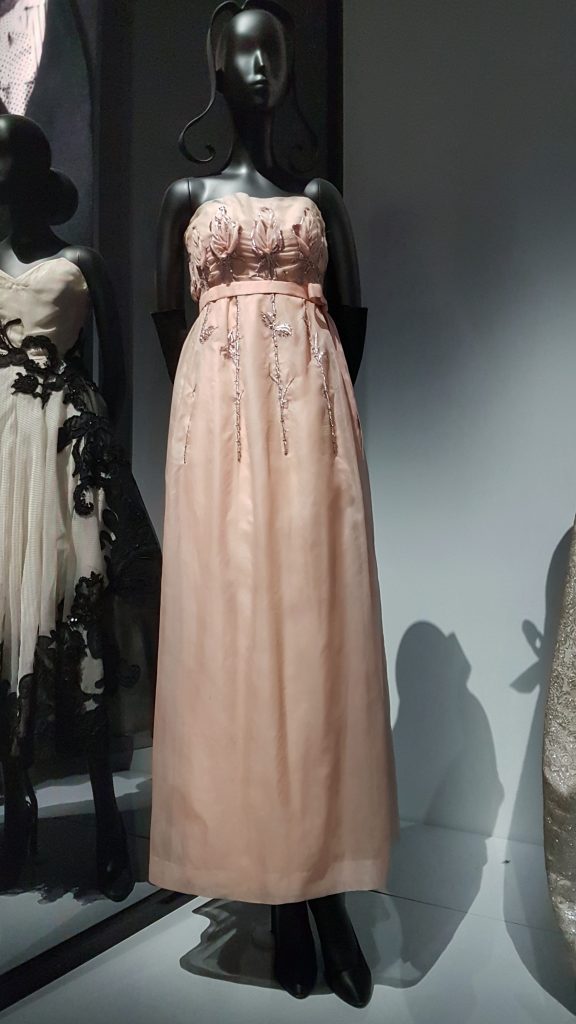
While I think that a modern designer might approach the embellishments slightly differently, this dress could absolutely be worn today! This is the Opéra de Vienne dress, and I would love to wear it on my next visit to the Royal Opera House. (If you are new to the blog, I am a big proponent of dressing to the formality of the ballet or opera…) Also, it makes me wonder if I will ever be able to afford a dress that has Swarovski crystals sewed onto it.

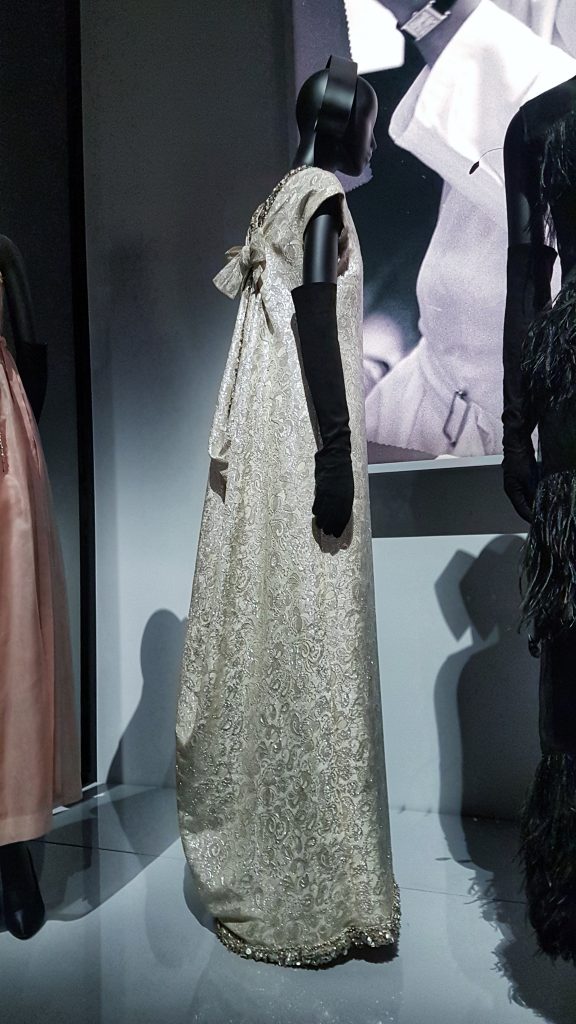
This is another day look that I loved- although we tend to associate suits with older, CEO type figures, I wish that we could bring these youthful suits back! And obviously, I need that hat to go with it. (WHY AREN’T WE WEARING HATS???) And the Antinéa dress is fairly plain from the front, but the bow, embellishment, and draping in the back will take your breath away. I know that when we try on clothing, we tend to just look at the front view and then move on, but this is a good reminder to check all angles!
Gianfranco Ferré, 1989-1996
Ferré was one designer that I admit I had never heard of. I do think that part of it has to do with the fact that he wasn’t creative director for an overly considerable amount of time, and it was when I was a small child and not versed in fashion. Still, it was fascinating to learn about his time at the house! “Gianfranco Ferré trained originally as an architect before establishing his own fashion line in 1978. He was appointed to the House of Dior in 1989, heralding in a new era as the designer under the aegis of Bernard Arnault (who had purchased the company five years previously)… With his deep appreciation of textiles and materials, Ferré’s work at Dior was extravagant and exuberant, and… [h]e crafter dramatic, structured silhouettes using the finest fabrics and rich embellishments. His strong lines frequently referenced the nipped-in waists and the large skirted ballgowns of Dior’s ‘New Look’.” (Dior, Cullen and Burks, p. 142)

What I love most about this evening dress is that it isn’t incredibly fitted. Yes, it features that nipped-in waist that we all associate with Dior, but the bodice isn’t skin tight, and has a gorgeous loose but fitted quality. The black lace contrasting with the cream silk is also the perfect amount of drama! And this coat is magnificent, there is no other word for it. I have seen several Kate Spade coats that I now believe were inspired by this coat, and I wish I had bought one. The bow feature at the neck, the princess cut showcasing the waist, the pleating. I love every single aspect of this coat, and I would permanently seek out winter so I could wear it.

John Galliano, 1996-2011
As I said in part II, I really struggle with Galliano’s design work. It doesn’t have the elegance and simplicity that Dior is usually known for. I have a fairly simple and classic sense of style myself, so looking at Galliano’s designs goes against all of my style instincts. Still, I have to appreciate the decade and a half that he took the lead for. “Galliano revelled in the possibilities presented by the skills of the Dior haute couture ateliers. He travelled extensively with his design team and researched voraciously, creating eclectic narratives for his shows that drew on varied sources. Through innovative set design, he transported his audiences to entirely new immersive worlds, populated with imaginary characters attired in exquisite and extraordinary designs.” (Dior, Cullen and Burks, p. 148) This dress sums up all of Galliano’s work for me- an over-the-top monarch with a whimsical and out-there sense of style!

Raf Simons, 2012-2015
Although Raf Simons was only at Dior for 3 short years, he certainly made his mark on the house, and on the wider fashion world. If you have seen the documentary, Dior and I, you will be familiar with Simons and his work. “Known as a master of minimalism, Simons maintained a focus on cut and line merged with touches of the romanticism and femininity as favoured by Christian Dior. Simons continuously referenced the codes of the house alongside an abstract and architectural approach.” (Dior, Cullen and Burks, p. 151) This red architectural coat is so gorgeous to see in person, and I think that you can see why he was considered to be a brilliant designer from such a young age.

His use of modern colour and prints, countered with more traditional silhouettes, certainly led Dior into a new era. Although he only lead Dior for 3 years, he absolutely left a lasting impression on the house and fashion in general. And this red wool coat is an impeccable throwback to earlier Dior designs. That scarlet wool is so incredibly striking, and the full, pleated skirt stays in your mind. Given that Dior’s sales rose 60% during his tenure, it is too bad from a business perspective that he left so early. However, most people believe that it is the pressure of designing for such a notable house that caused Simons to look elsewhere. At least we have his past work to admire!

Maria Grazia Chiuri, 2016 to Present
Maria Grazia Chiuri is the first female creative director of the house of Dior, and has been making her mark since she took up her post. “She caused much comment with her debut ready-to-wear collection of Spring-Summer 2017, particularly her slogan t-shirts including… ‘We Should All Be Feminists’… Chiuri aims to put the woman front and centre, reinterpreting the codes of the house with a view to addressing the varied needs and desires of the contemporary client. She has drawn inspiration from female characters from the past, such as explorer Freya Stark, author Virgina Woold, and artist Leonor Fini. The idea of femininity as shaped by Christian Dior is re-imagined in her mix of modern tailoring and ethereal romantic evening gowns.” (Dior, Cullen and Burks, p.160) I think that it is astounding that took nearly 70 years to see a woman leading the house of Dior, but now that Chiuri is, she is making up for lost time. I think that her evening gowns are some of the softest and most gorgeous dresses that I have ever seen, and in my dream world, I wear one daily.

I chatted about the Look 34 dress from Chiuri that was based on sixteenth century tapestries, in The Garden section recap. This piece appeals to the historian in me in a similar way. It is the Tarots de Visconti Di Modrone ensemble, and I think that it highlights her commitment to bringing history into the present. If you are able to see the collection in person, please spend some time with this dress. The panels are intricate and detailed, and you can see the scenes perfectly. How much work must have gone into this…

This silk organza floral dress is just so pretty, in the purest sense of the word. The contrasting black elements give the dress a bit of edge, but it features that classic Chiuri silhouette full of elegance. And yes, I had to share this black wool suit with you. Although ankle length skirts aren’t a good look for me personally, I love the drama and weight behind the skirt in this suit. And the floral embroidery at the neck is a subtle but beautiful touch. (I could do without the butterfly mask…) A true designer can make anything, including a basic suit, gorgeous.

The Ateliers
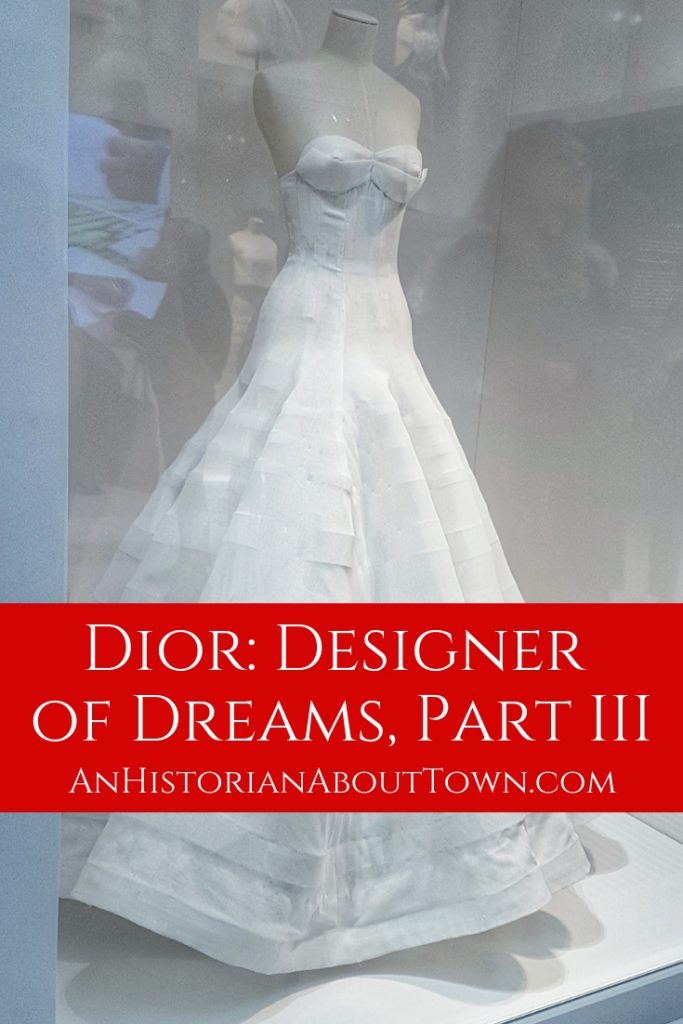
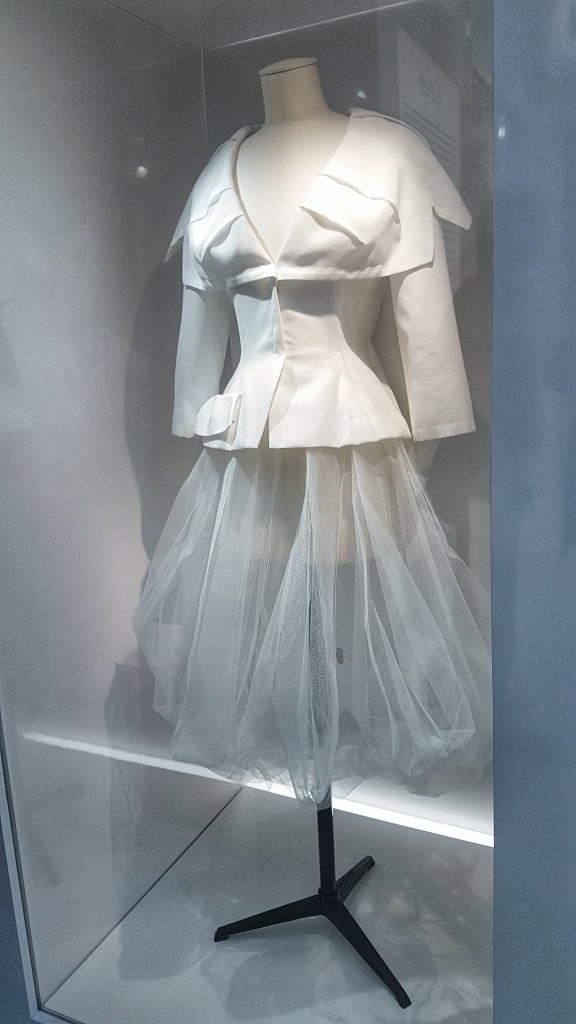
“The ateliers are the heart of the House of Dior. It is in these workrooms that ‘Petites mains‘, or seamstresses, turn ideas into exquisite haute couture garments…. Once one of Dior’s designs had been selected, it was taken to the ateliers to be turned into a toile. THis test garment, usually made in white cotton fabric, allowed for the fit, construction, and shape of the design to be checked. Once a toile was satisfactorily adjected, fabric and embellishments were chosen, and the garment could be made”. (Dior, Cullen and Burks, p. 170).
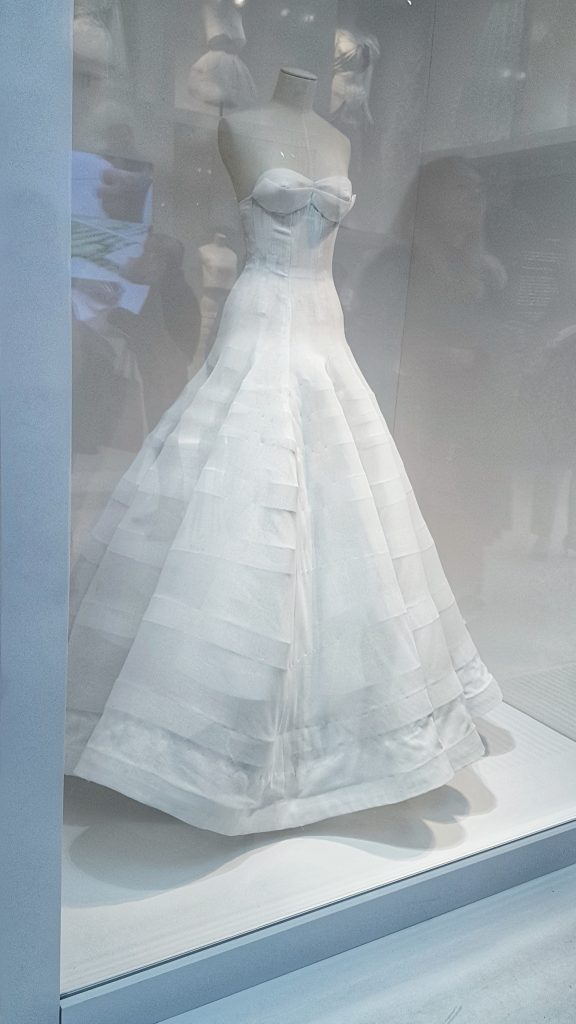
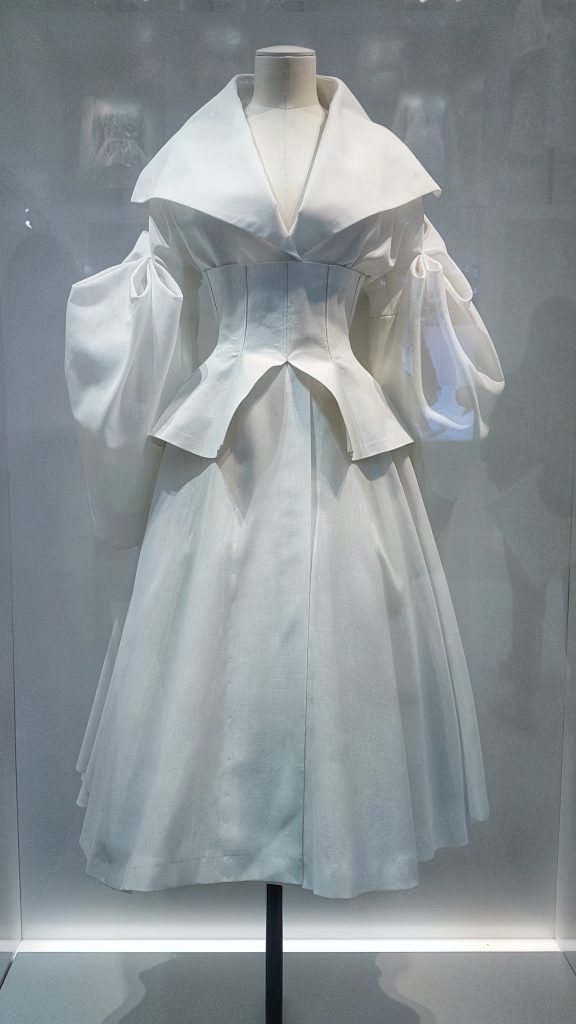
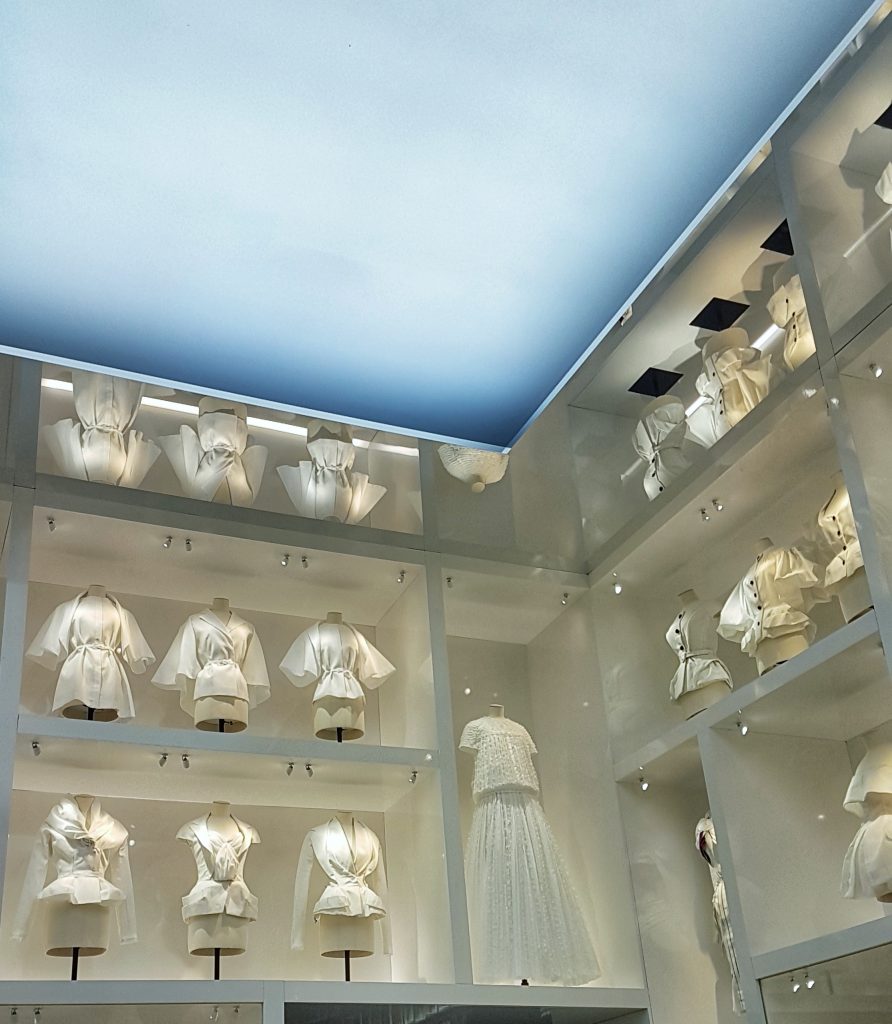
The Atelier room in the exhibition was not incredibly large, but certainly had an otherworldly feel. Although they are all made of basic white cotton, they still look gorgeous, and I think that many of us would wear these toiles on their own. My biggest question is how many of the toiles they keep for posterity!

The clever use of mirrors in this section made it seem like there were hundreds of toiles. While there was probably only 30-40, you could spend hours here alone. I love that it highlights the craftmanship behind the finished pieces we see, and that it recognises the women who are the talent behind these pieces but are often forgotten.
What are your thoughts of the Dior: Designer of Dreams exhibition so far? Are any of creative directors particularly memorable for you? And have you read Dior: Designer of Dreams, Part IV where I share the Ballroom?
Cheers,
The Historian
Facebook | Twitter | Instagram | Pinterest | Bloglovin’

Another great post Jess! Understandably I’ve really enjoyed your posts on the Dior exhibition 🙂
Aww, thank you, Claire!! We had such a wonderful day together 🙂