Last week on Style File Friday, I started my series on the Dior: Designer of Dreams exhibition at the V&A. I have to admit, these are some of my favourite posts that I’ve ever written. Not only am I getting to relive my trip but my approach has been fairly methodical, so I have been learning more about Dior as a house. Part II today may be my favourite of the series, as it includes both of my favourite sections of the exhibition! So without further adieu, the second instalment of my Dior: Designer of Dreams series…

Although I knew from doing a weird amount of research before going that the exhibition was going to be sizeable, I didn’t really comprehend until I was physically there just how big of an exhibition it would be. We spent over an hour and a half in it, and I think that we could have easily spent double that. With over 70 years of design history to cover, I’m impressed that they were able to distil it down.
Historicism
“Christian Dior often cited historic periods in his designs- the sinnuous lines of Belle Époque dresses… the tightly waisted mid-nineteenth-century styles worn by the French Empress Eugénie… The sumptuous silks and dramatic silhouettes of the eighteenth century held a particular fascination… Numerous references to the eighteenth century can be found in the dresses created by Dior and his successors. They draw on the lavish style of the court dress worn at Versailles and the décor and decorative arts of the period.” (Christian Dior, Cullen and Banks, p.72)

As an historian, obviously this room was going to be one of my favourites. Although some of the pieces can be fairly costume-y when they are modelled on court dress, I think that haute couture is the one area of fashion that allows for it. I loved the staging of the earlier rooms, they allowed pieces to really stand on their own. However, the setting for Historicism used the staging to contextualise the pieces, and it was then I swore that they made the exhibition specifically for me… These pink dresses caught my eye immediately, and I don’t even wear pink (aside from 1 blush pink skirt). Now it is taking all of my willpower to avoid pink!

Maria Grazia Chiuri’s gowns tend to have this shape, and I think it is one of the most beautiful designs. From a fashion standpoint, this silhouette works on a wide variety of body types, and blush is flattering colour on many skin tones. And then moving on to a historical standpoint, she “based the delicate print on this dress on an 18th-century toile de jouy pattern. It was used by artist Christian Bérard to decorate Christian Dior’s first boutique. An additional reference to the period appears in the carefully knotted silk fly-braid embroidery, a popular dress trimming from the 1750s to 1770s.” (Exhibition info) The attention to detail and the history of it’s inspiration is impeccable!
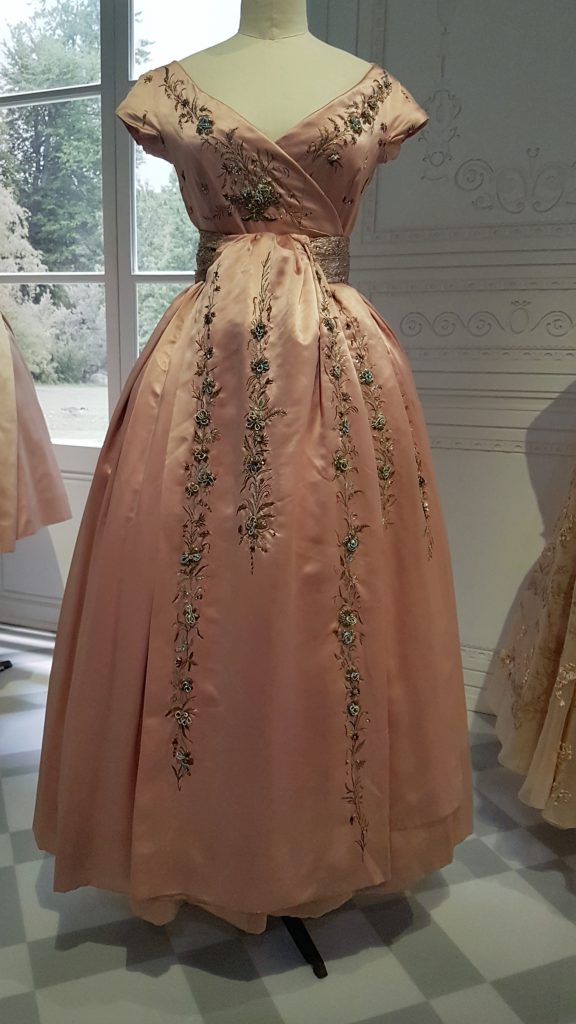
This Soirée Fleurie dress from AW 1955 draws on motifs and designs from the 18th century, and I think that limiting the amount of embroidery allows you to focus on it. I just have to ask, what would it be like to wear something made of gilded thread? I love this evening version of the New Look- the waist isn’t quite a sharp as the Bar Suit, but it still emphasises it.

This Raf Simons creation is what would happen if an 18th century court dress and an astronaut’s suit had a baby (literally). Had I not read the description with the dress, I would have guessed that it was simply a stylised re-imagining of a court dress. Taking the moon suit aspect out of it, the embroidery is once again what stands out to me. This dress is actually what made me want to learn embroidery myself- obviously I’m not going to be working for Dior, but maybe it is a skill I can learn for myself!

I just have to say, throughout the entire exhibition, I kept wondering how John Galliano was selected as artistic director. His pieces all seem to have a “Vegas showgirls on steroids” vibe that doesn’t quite jive with the rest of the House. Still, this coat dress does seem to embody the “Historicism” theme! (Seriously, where would you wear this?)
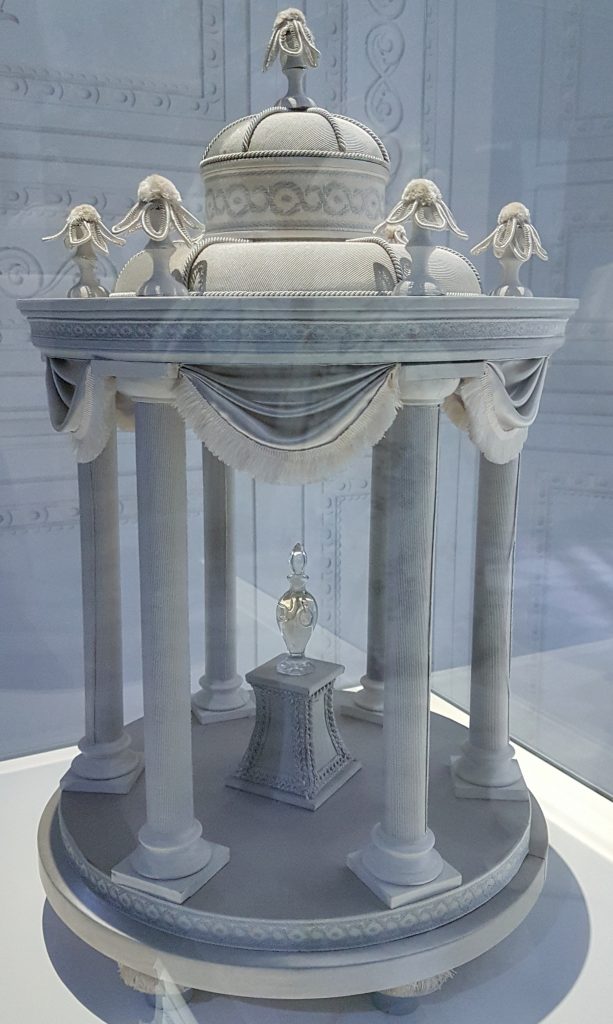
Obviously, you can’t just put your perfume bottle on the counter like a pleb. You need a Petit Trianon inspired stand to hold your singular bottle for people in your bathroom to admire. It does highlight one thing I love about mid-twentieth century fashion, though- houses designed everything. They designed clothing and shoes and accessories and boutiques and every possible item related to what they sell. It shows a commitment you don’t often see these days.

The Palomita dress was my other favourite piece in this room. Although neither gold nor white are my favourite colours, I think it is a beautiful design. Each centimetre of the garment is carefully designed, and the embroidery is stunning. The boat neck, the nipped waist, the weight of the silk, it all works together perfectly. Also, I know that it uses more materials but we need to bring back pleating…

Travels
“As a young man Christian Dior was drawn to travel. In his twenties, he ventured to London, Istanbul, and Leningrad.. From the launch of his first collection, Dior took inspiration from the architecture, landscapes, art, and textiles of different countries and cities, naming his dresses after the places that inspired him…. This section focuses on five of the countries that provided a source of reference for Christian Dior and his successors at the House of Dior: Mexico, India, Egypt, Japan, and China.” (Dior, Cullen and Banks, p.88)

I am not going to lie, this room was probably my least favourite of the exhibition. Not because I didn’t love the designs inspired by different cultures but because the room felt disjointed. I would have liked slightly more context on the cultures behind the dresses, but I can still tell that they are beautifully designed! This dress, inspired by Mexico, has a wonderfully light feeling.

This second dress inspired by Mexico seemed a perfect counter-point to the Palomita dress in the last section. Paired with the hat and gloves, it evokes quite a different feeling. The gold embroidery on the black silk really made me think of Mexico’s conquistador past, and the possibility of the New World.

This dress from the India section is just gorgeous. The damask pattern, the draping, the shape, it all works!! And I love the colour combination. Mauve isn’t a colour that you would normally associate with Dior, or at least I wouldn’t, but it is beautiful. And although there was a sari in the collection, I did love that they took the inspiration of India and worked with it to create something new. (Look out for the sari on my Instagram stories!)
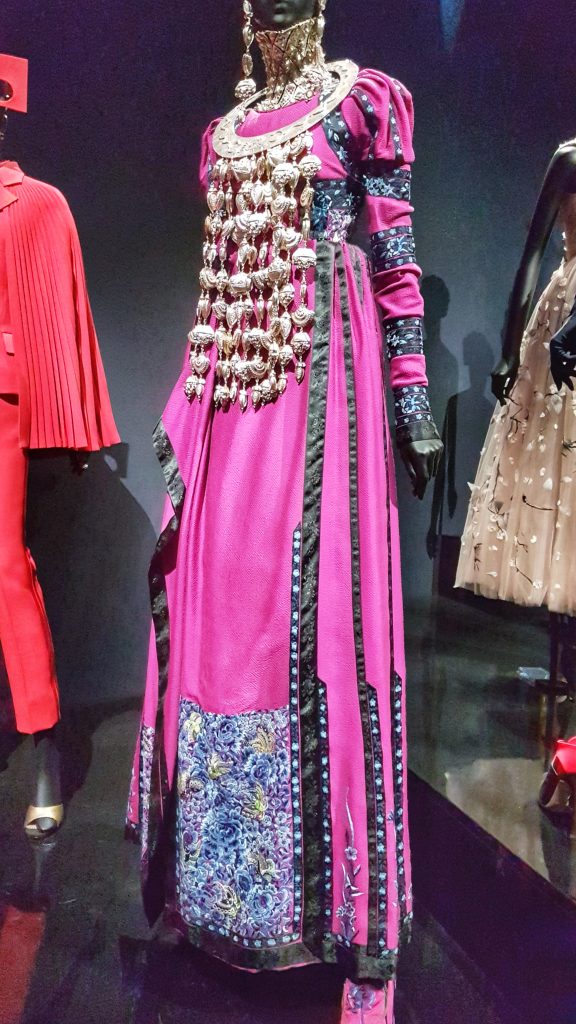
The Principessa Eleonora dress was a bit of a surprise to me in the China section, but it is an elegant and vibrant nod to Chinese design. The skirt borrows from Han Chinese qun skirt design, and I think that it could work equally well with the Historicism theme. Although I did say that Galliano’s work is more difficult for em to appreciate than other designers, I think that this borrowed beautifully.
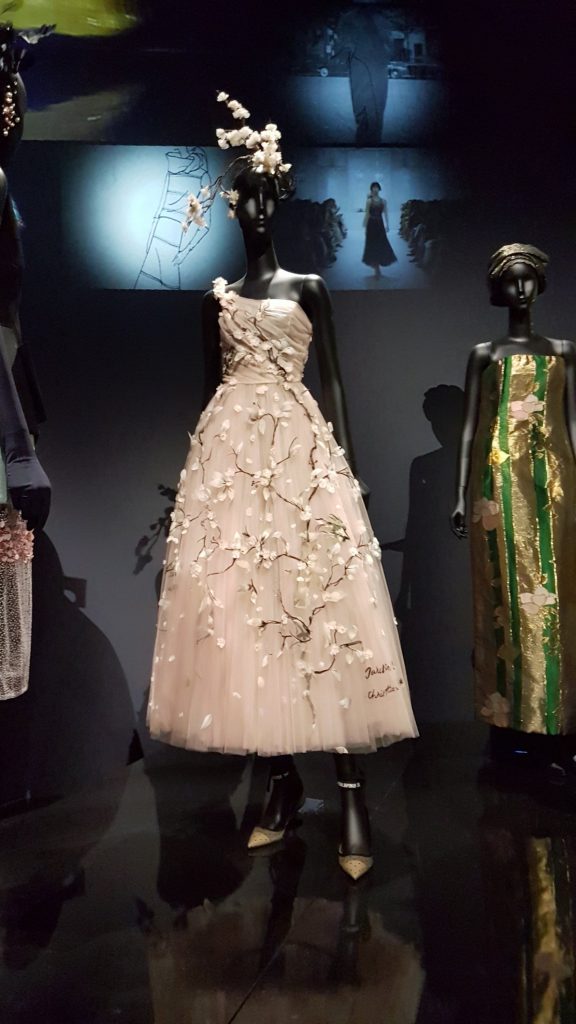
This dress, inspired by Japanese cherry blossoms, is not the most outrageous dress in the Travel section, but it is soft and gorgeous and a nod to Japan’s natural landscape. The headpiece is the perfect addition, and overall, would also belong perfectly in the next room…
The Garden
“From early childhood Christian Dior was fascinated by gardens. His mother Madeleine created and cultivated the family garden that overlooked the sea at Granville, and as a small boy, he loved to study her Vilmoin-Andrieux plant catalogues… His New Look was inspired by the shape of an inverted flower, and Dior salons were decorated with large floral arrangements… Florals abound in Dior’s work- from single silk flower decorations to decorative prints and intricate embroideries… The garden remains a theme to which successive designers at the House of Dior return.” (Dior, Cullen and Banks, p. 112)

We finally got to see more of the fragrant history of the House here! Not only are the florals the feature of the fashion, but Dior perfume is also featured. This small model of the Jardin Fleuri dress is the beginning of several beautiful Dior perfume bottles! I think that many of us ask why perfume is so expensive and the bottles are so elaborate nowadays. However, when you look at how gorgeous these antique bottles are, it starts to make more sense.
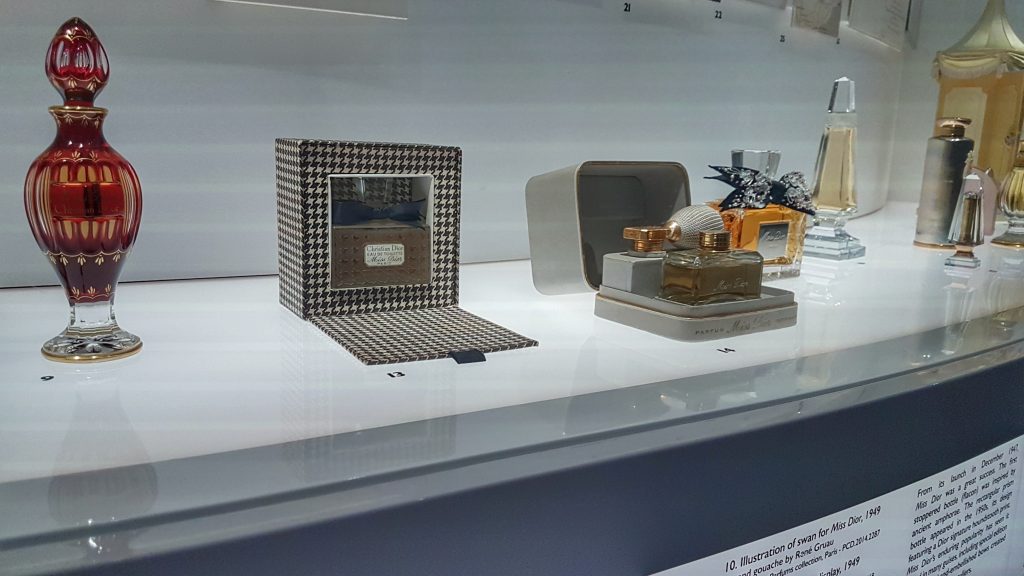
I love that they used to come in such beautiful cases. If I am going to pay $100+ for a bottle of perfume, I think it should come in a herringbone box, or a red enamel stand! I am going to keep my eye out for vintage perfume stands, and see if I can’t find myself something…

And if I can ever find this crystal terrier, I will spend all of the money I have to own it. (I am not kidding, I will make it happen if it is possible…) But now onto the dresses of my other favourite section!

This Maria Grazia Chiuri creation is a similar shape to her other gowns, but it is just as gorgeous as ever. The embroidered florals almost seem like they are pressed flowers on the dress, and they pair beautifully with the soft grey tulle. Originally, I wasn’t sure if I liked the belt, but now that I have time to think on it, I think the mahogany is the perfect touch and adds strength to an otherwise soft look.

White dresses look awful on me. As a pale person, it is pretty much the worst possible option. And because of this, I don’t tend to really enjoy most white dresses. This Lily of the Valley dress is something else, though. It is delicate and light, and the lack of colour allows the texture to stand on its own. It is another perfect use of the New Look silhouette, that still puts the focus on the floral elements.

You will see it in my Royal Women, Part II post that is publishing on Monday, but this is a very similar silhouette to a cream Dior dress of Princess Margaret. The delicate purple and vibrant green floral pattern is a feminine look, and the wrap effect is a design element we don’t tend to see anymore. I also love that the pattern is on the sparing side, so that you can appreciate the finer details rather than being overwhelmed.

I know that I’ve already looked at this dress in my Floral Fashion post, but it is without a doubt one of my favourite pieces in the entire Dior collection. The wrap design is almost universally flattering, the pink rose pattern is delicately stunning, and the nipped waist and full skirt bring you back to post-war England. I can’t wait until Spring when I can wear my rose print dress (so, probably late May…).

Before he started his own fashion house, Yves St. Laurent was the artistic director of Dior, and this is one of his designs. Although I am not a fan of the cheap chiffon high-low hems that seemed to dominate summer fashion from 2013-2016, this is an elegant approach to the look. And while I really am not a pink person, I love the blend of brighter and softer pink flowers. If the garden was to be embodied in a silk print, I think this is it!

And what would the Garden be without the Jardin Fleuri dress, another piece from Maria Grazia Chiuri. The sheer amount of time and talent that went into creating this dress is astonishing, as each of those petals was sewed on individually. When you see it in person, it feels like the dress is a garden unto itself. It is a wonderful mix of colours, and ties in several different palettes without feeling disjointed. I do hope that I can see this dress worn in person at some point in my life, as I would love to see some movement in it!
What is your favourite piece from these three sections of the Dior: Designer of Dreams exhibition? And do you have any specific inspiration for your own wardrobe?
Cheers,
The Historian
Facebook | Twitter | Instagram | Pinterest | Bloglovin’

omg, these dresses are GORGEOUS. I had no idea how amazing Dior’s creations are. Seriously, how did I miss this??? I feel like all I ever hear about these days from him is some perfume that I don’t care about. But these are all stunning. I want most of them. I’ll lose whatever weight I need to in order to fit into them, lol. Thank you so much for sharing these photos!!!
That is the problem with a lot of luxury houses- they have been diluted into fragrance, eye wear, and cosmetics brands that are kind of related (but not really), so there are some very skewed perceptions nowadays. I am curious as to who thought it would be a good idea; if you look at Chanel, the average person knows the perfume and that is it! Still Dior was an absolute genius!!