There is no better time than Women’s History Month than to explore women in Greek mythology. It always struck me that even when women are at the heart of a myth, they are almost always stuck in the background- we are only ever given the male perspective and point of view. However, Natalie Haynes is out to change that. This is her second non-fiction book to explore the women of Greek mythology, and it is a much-needed addition to the Classical myths. She brings women to the forefront, explores the primary sources where they are referenced, and dives into what they can say about both men’s and women’s perceptions in the period. Divine Might by Natalie Haynes is a must-read.
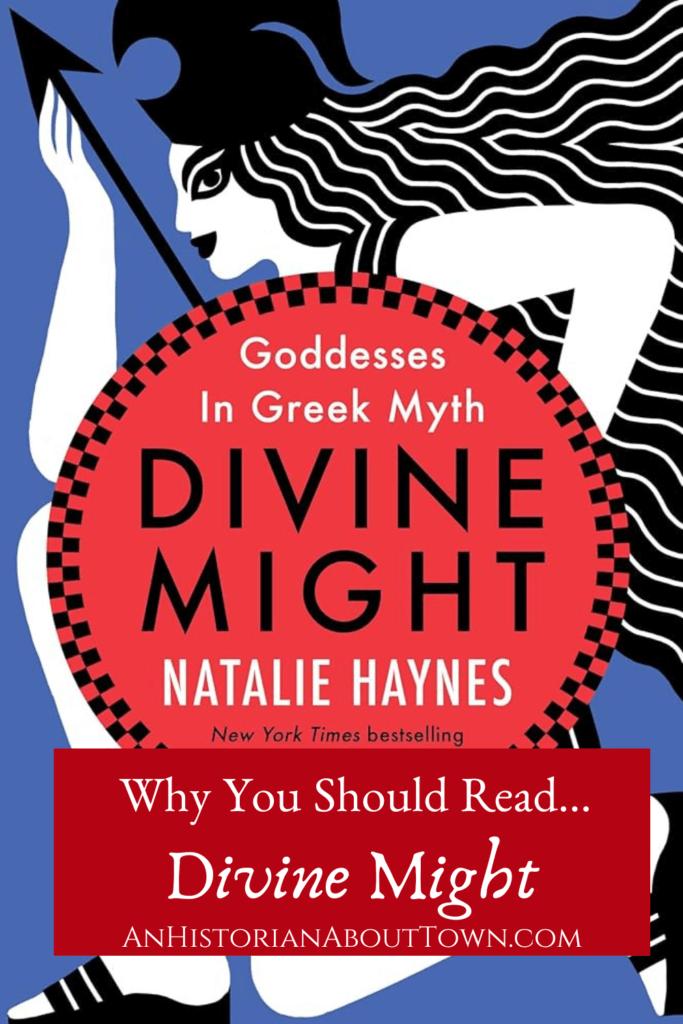
Divine Might: Goddesses in Greek Myth, Natalie Haynes
Few writers today have reshaped our view of the ancient Greek myths more than revered bestselling author Natalie Haynes. Divine Might is a female-centered look at Olympus and the Furies, focusing on the goddesses whose prowess, passions, jealousies, and desires rival those of their male kin, including:
Athene, who sprang fully formed from her father’s brow (giving Zeus a killer headache in the process), the goddess of war and provider of wise counsel.
Aphrodite, born of the foam (and sperm released from a Titan’s castrated testicles), the most beautiful of all the Olympian goddesses, the epitome of love who dispenses desire and inspires longing—yet harbors a fearsome vengeful side, doling out brutal punishments to those who displease her.
Hera, Zeus’s long-suffering wife, whose jealousy born of his repeated dalliances with mortals, nymphs, and other goddesses, leads her to wreak elaborate and often painful revenge on those she believes have wronged her. (Well, wouldn’t you?)
Demeter, goddess of the harvest and mother of Persephone; Artemis, the hunter and goddess of wild spaces; the Muses, the nine daughters of Zeus and Mnemosyne, the goddess of memory; and Hestia, goddess of domesticity and sacrificial fire.
Infused with Haynes’s engaging charm and irrepressible wit, Divine Might is a refreshing take on the legends and stories we thought we knew.
Why You Should Read This…
Haynes has one of the most interesting backgrounds I’ve seen- she is a Classicist, a comedian, and a broadcaster, meaning that she is well-informed and entertaining. (Those are not always packaged together…) You may not think it, but including a hefty dose of humour makes history and mythology all the more accessible to the general public. (Always a good thing!) And even as someone who is fairly familiar with Greek mythology, I found myself laughing several times. The original sources can sometimes skew dry but she brings them to life and points out how absurd they can be sometimes.
She is exceptionally knowledgeable in her subject matter, and it is one of her strengths that shines through in Divine Might. Because women are not in a prominent position in Greek mythology, her detailed references are all the more impressive. This is also her second non-fiction book, with Pandora’s Jar exploring a different group of mythological women, and she clearly applied just as much dedication to this book.
I also very much appreciated that paired with the humour is a very thoughtful discussion/commentary on the role(s) of women. This has evolved so much throughout the centuries and it is not a small discussion to tackle. All in all, brilliant, amusing, and thorough!
Is Divine Might by Natalie Haynes on your to-read list?
Cheers,
The Historian
Facebook | Twitter | Instagram | Pinterest | Threads