Peter Rabbit is one popular little rabbit. I think that many of us in the western world get to know him quite quickly. He and his friends are often used to decorate nurseries, baby clothes, little bowls and dishes that we use with tiny hands. And while we are surrounded with Peter when we are little, Beatrix Potter was creating him in her childhood. The Beatrix Potter’s Art: ‘drawn with design’ exhibition at the Victoria and Albert Museum is a journey through her childhood sketches and the beginnings of Peter Rabbit as we know him today.

Although I’ve waxed lyrical about the Dior: Designer of Dreams exhibition at the Victoria and Albert Museum, there was another exhibition that I was particularly excited to see. And that happened to be the Beatrix Potter exhibition. Opening just five days before I got there, the exhibition looks at her artistic development in childhood and compares it to her adult work. Running from 18 February 2019 to 17 November 2019 in Gallery 102 at the Victoria and Albert, you have a lot of time to catch it! (No special ticket is required.) According to the exhibition intro,
Beatrix Potter was born into a family with artistic leanings and contacts, who encouraged her precocious talent. At twelve, in 1878, she started formal drawing lessons. By her teens, she was regularly visiting art galleries, commenting critically on the linework and colour skills of the artists whose work she saw exhibited, and whether, in her words, they drew ‘with design’.
Potter had kept sketchbooks from at least the age of eight, delighting in picturing her observations of places, objects, and especially nature. Already they evidence the lively imagination and design instinct that eventually resulted ih her world famous little illustrated books.
Potter’s personal design projects- from decorative frames to pictorial compositions- show careful attention to page layout and colour balance, with sometimes playful effects. Later on, she took a close interest in the design of her published storybooks. However, her inventiveness and delight in making purely for fun comes across most strongly in her gifts to children.

This is Potter’s 1876 sketchbook, from when she was 10 years old. This was one of my favourite pieces in the gallery- there isn’t a westie, but the grey squirrel in the bottom left of the right-hand page is perfect. She also captures positioning really well, for any age. Why do a lot of us tend to draw people standing up straight? It’s easier to work out proportions if it’s essentially just a line. The seated bunnies in the sledges, as well as the skating characters are so well done, and they look proportionate. Even the movement in the umbrella is perfect! (Nothing to put your own artistic work as an adult to shame like comparing it with a 10 year prodigy’s….) Seeing this sketchbook has also made me realise that I should probably start dating my own work, if I want any chance of recognising timelines in my own work.
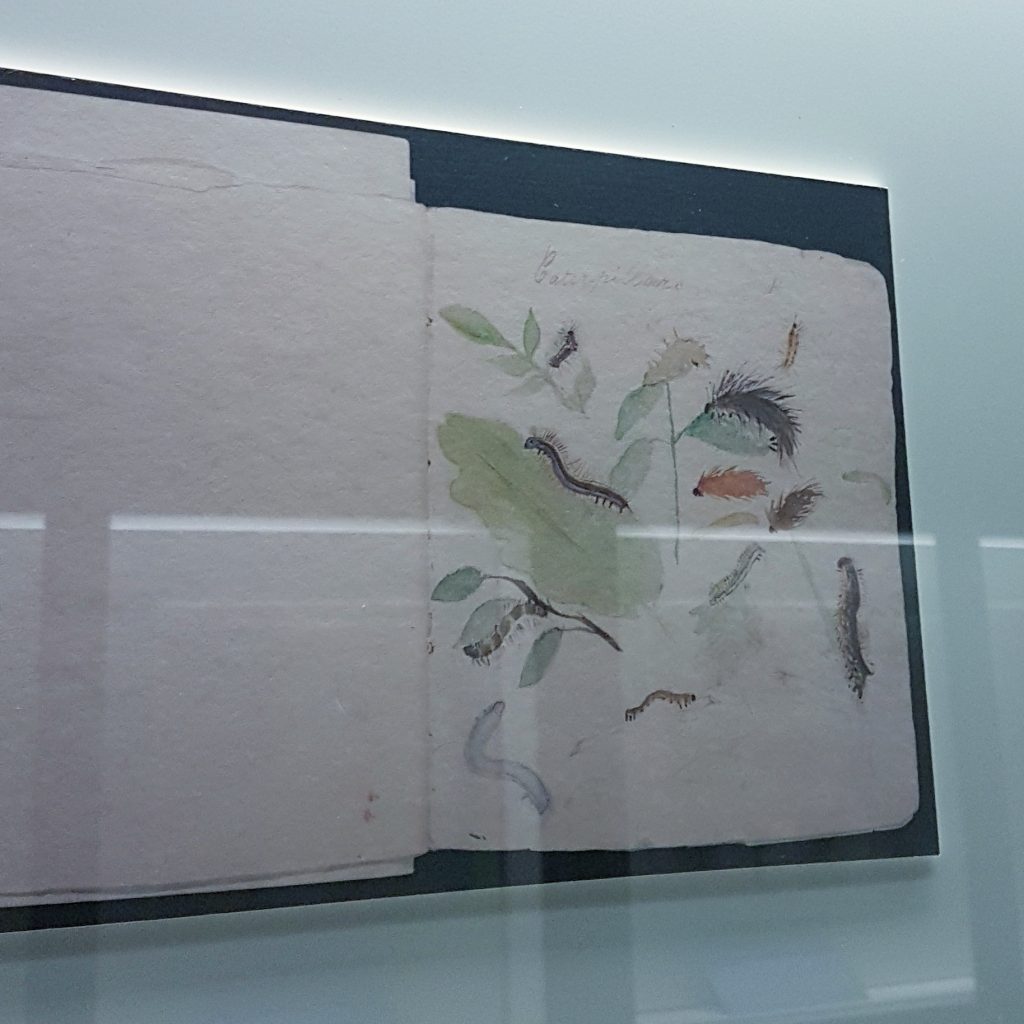
I’ll be honest- caterpillars and bugs set my skin crawling, but I loved looking at these childhood sketches. It could be avoidance of the bugs, but I particularly enjoyed the leaves. No, there isn’t a great amount of detail in them, but you still get a feeling for their shape and depth and movement. In childhood, most of us are learning how to write clearly and legibly, and Beatrix Potter was cataloguing the natural world.

I also very much enjoyed all of her adult sketch work. I’ve never thought about it before, but using the alphabet as a basis for practice is incredibly smart. The little bun poking out from the W is too adorable! I haven’t looked at the Peter Rabbit books in quite a few years now, and even seeing these brought it all back to me.

The exhibition included a few of her letters to friends in the 1890s, and I found them fascinating. Not so much in the content of the letter, but rather in the decorations. Although it was written in 1894, the drawing style is still similar to what we see in her earlier sketchbooks. And I could be wrong, but I believe she wrote the letter in ink and then sketched in pencil afterwards. People are shocked that I hand-write a basic card in 2019, and she was drawing for her friends in full letters?? Oh, how we have fallen as a society.

I fell in love with this teeny post box and matching letters! Although her sketches are beautiful, I love that she went to the length of creating this. She created this set “to amuse her child friends. Potter wrote miniature letters and greeting cards, sometimes making post boxes, and mail bags to accompany them. The letters folded and fastened to resemble envelopes complete with imitation “Penny Red” stamps. Some are written as though between her book characters, while in others- often Christmas greetings- the character addresses the child”. (Info card in exhibition) So, not only could she draw spectacularly, she could draw in miniature. And had entire correspondences as her characters. What have I been doing with my life?! I am just thankful that someone knew to save it for the future.

And what would the Peter Rabbit exhibition be without rabbits? We all need to hustle when it’s blowing and snowy, and rabbits are just the same. The footprints and the tail holes in the jackets and the thatched roof details, Potter thought of everything. This particular picture is one of four that depict a rabbit Christmas party, given to her aunt (Lucy, Lady Roscoe). It is such an impeccably well-thought out gift, I am very impressed on the Christmas front alone. I will be snooping around for the other three images in the collection come holiday season. Watercolour with pen and ink is my favourite medium, so I’m particularly grateful I was able to see this piece. (Note to self: find a Beatrix Potter paint by numbers…)
Overall, the Beatrix Potter’s Art: ‘drawn with design’ exhibition at the Victoria and Albert Museum is quietly perfect, and certainly worth a visit. Are you going to be visiting Peter Rabbit and friends?
Cheers,
The Historian
Facebook | Twitter | Instagram | Pinterest | Bloglovin’