London is spoilt for royal history. There are the names left by palaces long gone, cathedrals used for coronations, and fortresses left standing after centuries. While the Tower of London and Buckingham Palace are best known as London’s palaces, there are others that survive. Queen’s House, Greenwich is a smaller formal royal residence that is rather aways out from the City of London proper. However, although it is small, it is impressive and is more than worth the trip. These are the 5 reasons that you should visit Queen’s House in Greenwich, and to discover this little piece of royal history.

The History of Queen’s House, Greenwich
Greenwich Palace was originally built on the banks of the Thames by Humphrey, Duke of Gloucester in 1447. Originally only featuring a defensive tower and a court house, it was enlarged by Margaret of Anjou in the mid fifteenth century, and was known as the Palace of Placentia. (You will find it mentioned as such under Henry VIII and Elizabeth I.) The Palace fell into disrepair during the Civil War in the seventeenth century, and was demolished by Charles II. However, the Queen’s House was built between 1616 and 1635, and survived. It stands now as part of the Royal Museums Greenwich, along with the Royal Observatory, Cutty Sark, and the National Maritime Museum.

1. The Journey
If you are a visitor to London, or just don’t explore that often, the journey to Greenwich can be quite fun in and of-itself. The easiest way to to get to Greenwich is to take the DLR to Greenwich DLR station. The DLR (aka Docklands Light Rail) is a part of the Undeground system, even though it is not actually underground! It is an automated above ground train (no conductor!) that was built in the late 1980s to better serve the Docklands area. It is quite bright, you will have some wonderful views of the Thames, and will most likely have far more space than a regular Tube train. A bit of a warning: it is roughly a ten minute walk from the station to the Queen’s House, but it is quite a lovely walk. Greenwich is a gorgeous neighbourhood, and needs exploring.

2. Greenwich Park
You will notice as soon as you arrive at Royal Museums Greenwich and walk through the gates that you are at a very large, green park. There are paved paths criss-crossing the park, but many a pupper (and owner) were playing on the grass. Greenwich Park is one of London’s Royal Parks, and at 183 acres, you will have more than enough room to walk. We were visiting during the day on a Tuesday, and still saw many people there. You can stand on the Prime Meridian and then make your way up to the Observatory for one of the best views of London.

3. Inigo Jones’ Incredible Work
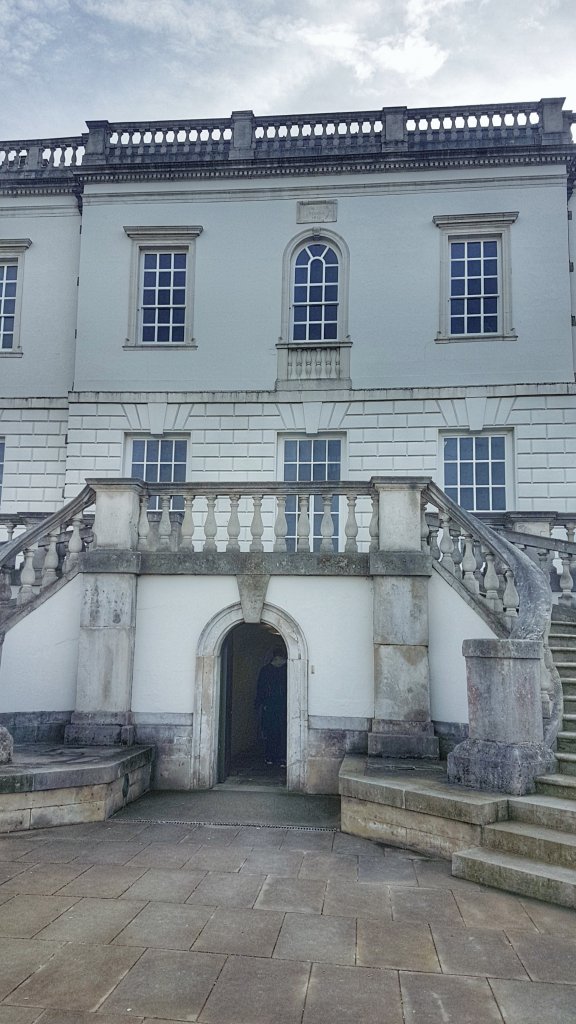
Inigo Jones is one of my favourite architects. Known as the first notable English architect of the early modern period, he introduced Classical Renaissance architecture to Britain. Born in 1573, Jones became the Surveyor General of the King’s Works for James I in 1613. In 1615 he began work on the Queen’s House, Greenwich for Anne of Denmark. Sadly, Anne died in 1619 and work stopped, but was resumed in 1629 for Charles I’s wife Henrietta Marie. This building is so important because it was the first consciously built Classical building in England. It may not be the largest building, but it is quite stunning in its simplicity, and still will catch your eye today.

Jones was also responsible for the layout of Covent Garden, as well the breathtaking Banqueting House. Although his career (along with many) was largely ended by the Civil War in 1642, his work is still seen across London today. And he was notably followed as Surveyor General by the impressive Sir Christopher Wren, who also left his mark all over London.
Interested in more book previews, period dramas, royal news, and more? You can subscribe to my biweekly substack newsletter here: https://anhistorianabouttown.substack.com/!
4. Royal Portraits
If you are finding your way to Queen’s House, Greenwich, it is probably for one of a few reasons. Either you want to see the architecture and history of the house, or the impressive collection of artwork. (Or both, like me!) Much of the artwork at Queen’s House is on a maritime theme, as one might imagine. However, there is also a spectacular collection of royal portraits. While the Royal Collection Trust may have more, I’ve never seen so many royal portraits in one place.

I think that without a doubt, many of the visitors to Queen’s House, Greenwich are there to see the Armada Portrait. There are three separate versions of this life-sized portrait of Elizabeth I, with Royal Museums Greenwich acquiring the Drake portrait in 2016. Painted after the Armada victory in 1588, the portrait depicted Elizabeth with countless symbols of her power and victory. (And yes, you do not have to pay to see the Armada Portrait!)

I personally loved seeing all of the Stuart portraits. An oft-forgotten dynasty for their Tudor cousins, they aren’t given the attention they deserve. This is Henry Frederick Stuart, Prince of Wales, the oldest son of James VI/I and Anne of Denmark. Sadly, he died in 1612, leading to his younger brother taking the role of heir (the future Charles I). He is a royal I’ve been wanting to learn more about, so I loved seeing his portrait.

And without a doubt, Elizabeth Stuart’s portrait was a highlight for me. She would eventually go on to become the Winter Queen, Queen of Bohemia, and her grandson George I would take the throne upon Anne’s passing. In this portrait, she was only 7 years old, but already held a privileged position at court. Although Elizabeth did not study Greek and Latin like her brothers, she did study religion and history, which served her well as Queen of Bohemia. (It turns out that Bohemia would be embroiled in religious wars…) This portrait was painted in 1603, the year that her father ascended the English throne.

5. The Tulip Stairs
I’ve already chatted about the Tulip Stairs in an earlier history bite, but I absolutely had to include them here. Although they are really, really pretty to look at (COME ON, THEY HAVE FLOWERS.), they are also incredibly functional. According to the information at Queen’s House, ““are the first centrally unsupported stairs in England, copying a Venetian model. The stone treads lock perfectly into each other and the wall, requiring no central structure and creating the famous upwards view. The striking wrought-iron rail has been restored to its original smalt blue. It has long been described as showing tulips but they are probably lilies, the royal flower of France, in compliment to Henrietta Maria”.

You wouldn’t know from first looking at them that they are an architectural marvel, but it makes them even more impressive. In the 1960s, it is reputed that a few ghosts were seen hanging around the Tulip Stairs. (There are videos if you would like to see for yourself.) No ghosts were seen on my sunny Tuesday morning trip, however!
Have you been to Queen’s House, Greenwich? And what is the best hidden gem you recommend to people?
Cheers,
The Historian
Facebook | Twitter | Instagram | Pinterest | Threads

1 thought on “5 Reasons to Visit Queen’s House, Greenwich”