Although I focus on women’s history for much of the year, I obviously have to put women from history in the spotlight during Women’s History Month! (Remember, we celebrate Women’s History Month in October here in Canada!) And because it is Style File Friday, we are looking to some of the most talented women in fashion history. While the business and industry of fashion has long been dominated by men, there are several women who have made their mark. These are 5 female designers that you should know!
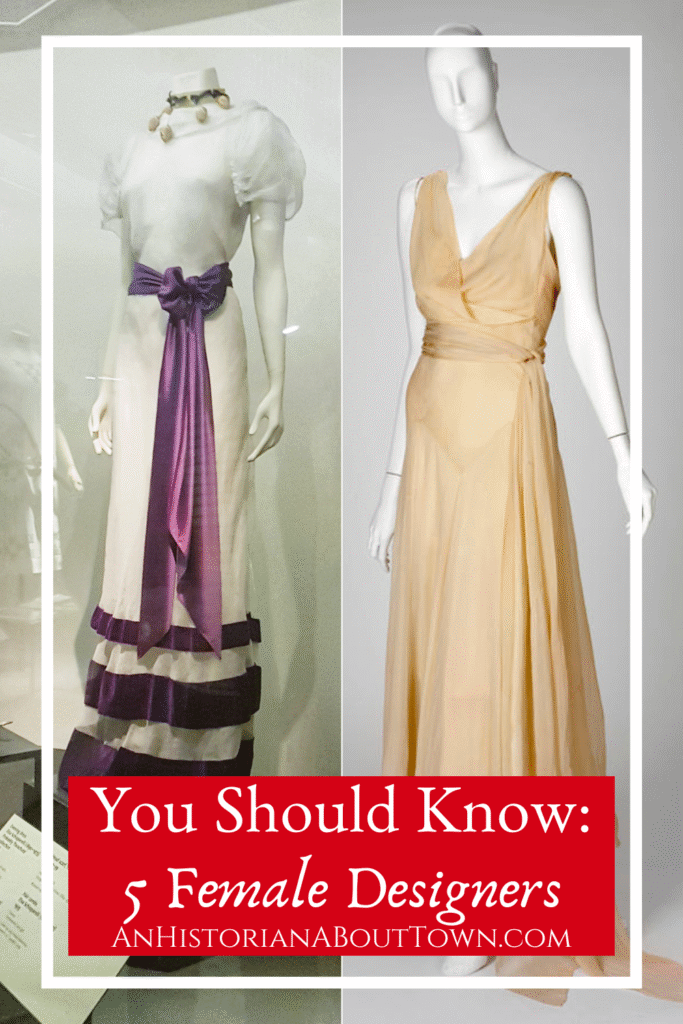
5 Female Designers You Should Know
There are many other female designers than these 5, but I wanted to focus on some of the earlier names in fashion history. As always, you will note that Coco Chanel is not on the list, she is purposefully left off. (She and her house have a very problematic history, and neither the house or the public as whole acknowledges.) I have another series for more modern designers planned for next year, so stay tuned!

Madeleine Vionnet
Although Vionnet was a French designer whose work dominated in Paris and beyond, she actually moved to London to start her training. Born in the 1870s, she learned the then-common skill of copying designs for her employer, thus getting the opportunity to study all sorts of designs. By 1912 she had opened her own house, but it unfortunately closed during the First World War. She reopened in 1923 and quickly expanded to the US market where she sold ready-to-wear garments.
Why do we know Vionnet? The bias cut! Vionnet pioneered the bias cut, a particular way of cutting fabric diagonally across the grain, making for an exceptionally fluid piece of fabric that drapes beautifully. And in addition to the bias cut, she spent much of her time working on copyright issues for designers, as well as working conditions.
Want to know more about Madeleine Vionnet? Check out her Style History!

Jeanne Lanvin
Lanvin is the oldest French fashion house in operation today, and that would not be possible without Jeanne Lanvin! (Hermès and Louis Vuitton are both older but did not start out as fashion houses.) Lanvin trained as a milliner and in 1889, she opened her own millinery shop. However, by 1893, she had broadened her business horizons and opened a fashion house. Because her hats were exceptionally popular with aristocrats and the women moving throughout society, she had a built in client base when she moved into garments.
Jeanne Lanvin was known for several things. Firstly, she was very popular with the Bright Young Things and the house became even more popular in the 1920s. Secondly, Lanvin went so far as to open her own dye factory, with blue dyes in particular a major focus. (You will still see these blue dyes today.) Thirdly, she opened several different departments, including children’s, men’s, interior, and fur.
Want to know more about Jeanne Lanvin? Check out her Style History!

Ann Lowe
Ann Lowe has only really come into prominence in the last five or so years, which is a true shame. She was the designer behind Jackie Kennedy’s iconic wedding dress for her 1953 wedding to JFK but that only came out several years later. She also created the gown that Olivia de Havilland wore in 1946 when she won the 1946 Oscar for Best Actress, but her name was not shared, then either. Her gowns often featured classic silhouettes and incredible embroidery work.
Lowe grew up in Alabama where her mother and grandmother were both seamstresses. They were both often chosen to make gowns for weddings and large social events for women in the state, and Lowe was able to quickly learn what women looked for in their dresses. Sadly she struggled with the financial side of the business and was forced to close her shop in the 1960s, but her incredible legacy has gained new life.
Want to know more about Ann Lowe? Check out her Style History!

Lucile
Interestingly, Lucile was an exceptionally popular designer AND was a massive name in the news but is rather in the shadows now. Lucile, born as Lucy, began her design business are divorcing her husband. She had long enjoyed fashion and needed a way to support herself and her daughter- enter Lucile. She opened the Maison Lucile in 1893 and quickly became incredibly popular. Her draped and layered gowns were often in lighter, pastel colours and were popular with London ladies. In the 1910s, she began expanding and soon had stores in Paris, New York, and Chicago. She is known for introducing models (aka mannequins) and what we know as cat-walk shows!
In her personal life, she was known as Lady Duff Gordon, and happened to be one of the survivors when the Titanic sank. Notably, Lucy, her husband, and her assistant made it off the ship in a 40 person lifeboat that was only carrying 12 people. They were called on to give testimony in the inquiries following the sinking, and the couple were under intense scrutiny in the press. (There were major questions about whether or not they had paid staff to leave without more people.)
Want to know more about Lucile? Check out her Style History!

Elsa Schiaparelli
Elsa Schiaparelli is one of the most fascinating figures of the 29th century to me, and I don’t know how more people are not interested in her. Born in Rome in 1890, Schiap was a dramatic and creative child from a very young age. She actually fell into designing when she was in Paris and having nothing to wear to a ball, created her own dress. Schiap launched her first collection in 1927, but it was her very playful and creative designs that blew up in the 1930s. She was creative with her use of fabrics and in design, and often the outright absurd. You’ve probably her seen her hat that looks like a shoe…
Schiaparelli and her house are still known for her avant-garde and creative designs. Her work with artists like Salvador Dalí brought a new element to fashion that we still do not see that often to this day. Her infamous Lobster dress featuring Dalí’s art was seen across the world on the also infamous Duchess of Windsor, an emblem of the house. She also worked Jean Cocteau to create her rose vase evening coat, another iconic piece!
Want to know more about Schiaparelli? Check out her Style History!
Who are your favourite lesser-known female designers?
Cheers,
The Historian
Facebook | Threads | Instagram | Pinterest