The last weekend of May is one of my favourite weekends of the year- it is Doors Open Winnipeg! Doors Open is an event that originally started in Europe (I believe in Edinburgh) in 1990, and first happened in Canada in 2000 (in Toronto). It is a spring mainstay here, and as an historian, I love it. If you aren’t familiar with it, different heritage sites and museums open their doors for free to the public for this weekend. This year, I was finally able to cross off a bucket-list item. For Style File Friday, I’m going to be chatting about visiting the Costume Museum of Canada.

What is the Costume Museum of Canada?
Admittedly, you don’t think of Winnipeg when you think of fashion history. (Or most people don’t.) They think of the V&A in London, the Met in New York, the Kyoto Costume Institute in Kyoto, the Fashion Museum in Bath, etc. However, we do have an incredible museum here in the middle of the Canadian prairies.
The Costume Museum of Canada and its collections date back to the mid-twentieth century.
The collection of 35,000 artifacts is stored in Winnipeg and includes men’s women’s and children’s clothing, accessories and miscellaneous accoutrements. One of the earliest artifacts is a blue and white silk taffeta dress with matching shoes circa 1765.
The museum has its roots in Dugald, Manitoba with the work of the Women’s Institute who began with fashion shows in 1953 and then opened a museum in 1983. In 2007 the museum was relocated to Winnipeg.
It is run by volunteers, an incredible feat given just how large their collection is.
Costume Museum of Canada Highlights
I thought that I would share some of my favourite highlights from the Doors Open exhibition today. Interestingly, they have some replicas in the collection that they had on display. Because they still host fashion shows to raise funds, they need pieces that they are able to wear (more on that below). Not only does it provide a few more durable pieces, it also allows the museum to support makers who can create these replicas.

c. 1765 Robe à la Française
This is the oldest piece in the Museum’s collection and dates back to the last quarter of the eighteenth century. (That is pretty impressive given that Canada’s formal government wouldn’t be established for a century.) It was brought to Canada in 1873 from Belfast, and has survived in impeccable condition.
Firstly, I am always a fan of the robe à la française, as I am always drawn in by the sack back design. (Don’t ask me why, but I love the falling pleats on the back of the gown.) Secondly, the floral design is actually woven into the fabric rather than embroidered on afterwards, which I also think it is gorgeous. (I know many people disagree, but I often think that embroidery can look heavy.)

1887 Opera Cloak
This is a surviving opera cloak from 1887, and would have been worn by a wealthier woman who was… attending the opera. While we are all about the “day to night”, versatile pieces of clothing now, the nineteenth century saw many very specific garments worn. It would have been worn with a matching silk brocade gown but it sadly did not survive.
They did include a replica version of the cloak in the exhibition (sadly my photo wasn’t great) which serves to highlight why making replicas can be so helpful. Not only are volunteers able to wear the replica cloak in the fashion show, we are able to better see what it would have looked like when worn in the 1880s.
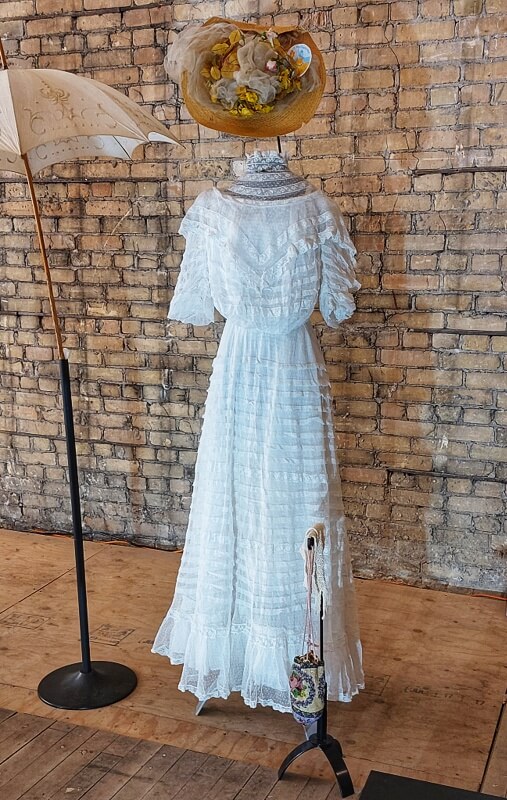
c. 1905 to 1910 Summer Garden Party Dress
Many of the items included in the Doors Open exhibition are what I like to call “Anne Shirley” fashion, ie. it would not be odd to see someone in Anne of Green Gables wearing it. This floor-length gown was made of voile (fine white lawn) and lace, making for an incredibly light gown. It would have been worn at an afternoon event.
The exhibition information highlighted that “we often see these white gowns depicted in European outdoor artworks, especially by the early modernists”. What is incredible to me about these gowns is that we often see them surviving in quite a bright and white state. It took money, time, and resources to ensure that your white clothing stayed white, and speaks to the status of the owner.

1926 Black Beaded Flapper Dress
This black dress from 1926 stands out in the Costume Museum’s collections for a few reasons. Firstly, it is in remarkable condition- the beading is still exquisite. And secondly, it is an original garment that volunteers are able to wear in the fashion show. As I mentioned above, the Museum has many replicas that people can wear when needed. However, when this piece was donated, it was stipulated that it not be held in the collections proper so that people could wear it. (I know that many fashion historians will be shocked at that, but it is very much in line with the donor’s wishes!)
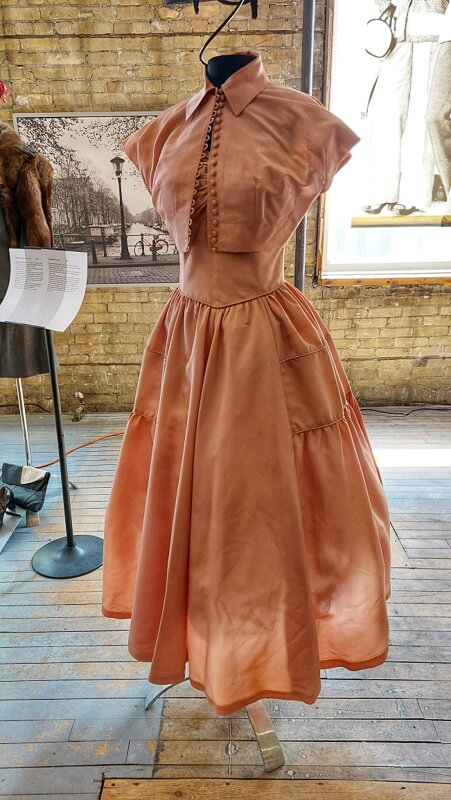
c1953 Pink Taffeta Party Dress
This cocktail dress is very much influenced by Dior’s New Look, so of course I had to include it here. We see the trademark nipped-in waist contrasting with full skirt (with crinolines), as well as the silhouette of the shoulders. Although this is over 5 years after the New Look first premiered in Paris, it is important to remember that fashion trends take time to travel and even in 2023, we still get things months (and even years) later on the prairies!
Have you visited the Costume Museum of Canada? What is your favourite piece here?
Cheers,
The Historian
Facebook | Twitter | Instagram | Pinterest