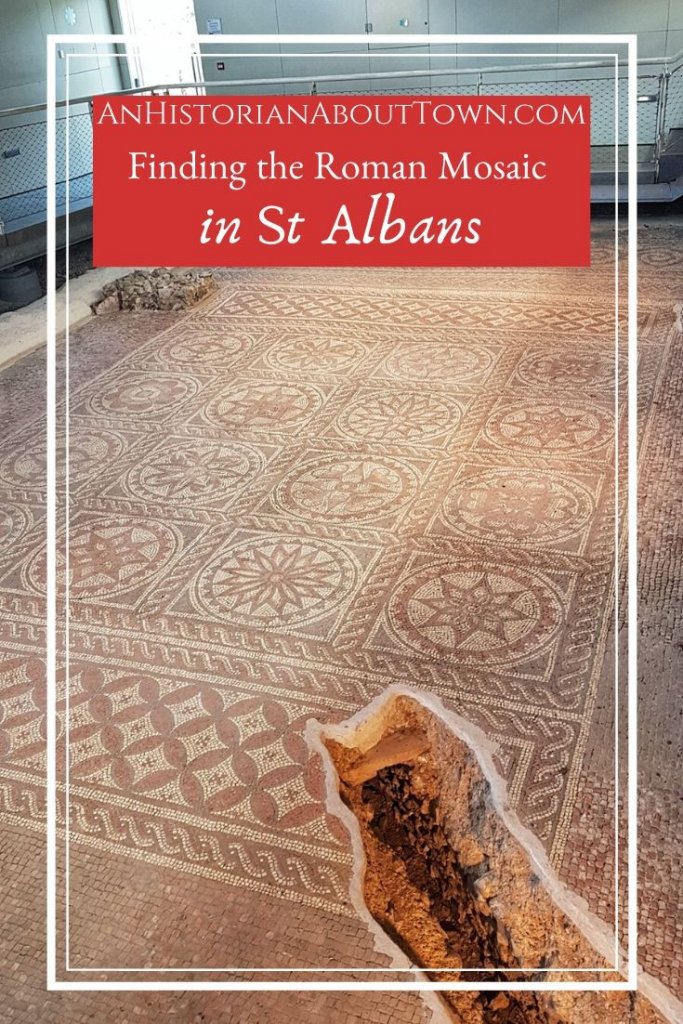
I am quite grateful that I have family just outside of London, as they wonderfully let me stay with them! And even better, they introduce me to all of the local history hot-spots. They are quite close to St Albans, which is rich with history from the Romans to the Tudors (and later). One of my favourite discoveries on my last trip was a Roman townhouse. I know that normally I skew later, but I found this absolutely fascinating. The Roman Mosaic in St Albans is nearly 2,000 old, and the perfect window into life in Roman Britain!
If you haven’t already, quickly read my post on the Roman Walls in St. Albans! St. Albans stands on the site of Verulamium, a Roman town just outside of London (in Hertfordshire). Although you might not notice it right away, you can actually see the remnants of Roman Britain all over the UK. (You can actually see some of the Roman walls right by the Tower of London.) Fun (or not so fun) fact: Boudicca actually ordered the town to be burnt to the ground in 61 AD. However, the town regrouped and continued to grow. And yes, there was actually a St. Alban- he was a Roman patrician who was beheaded in the third century. It is the perfect place to dig into Roman Britain, though.
The Roman Townhouse
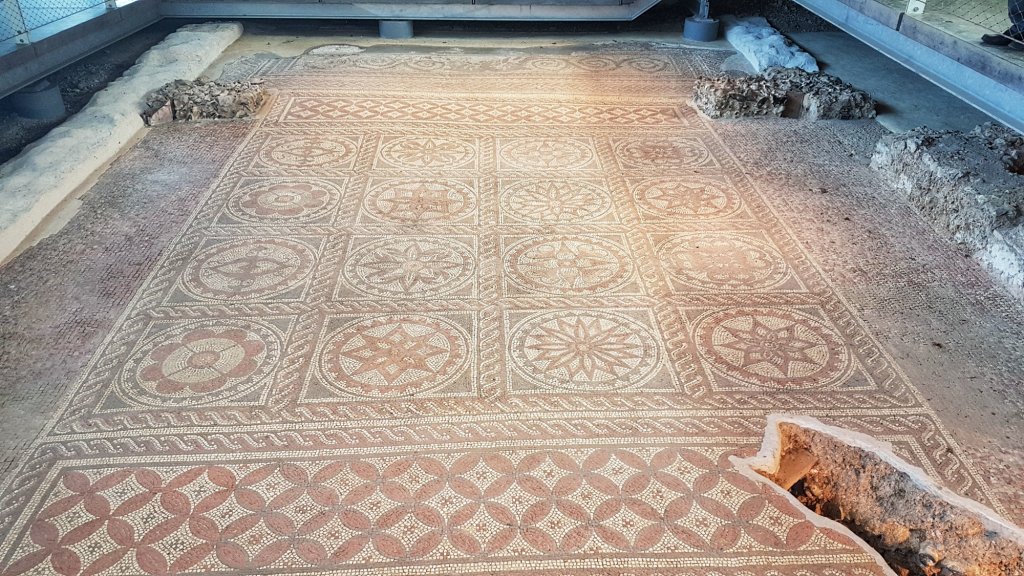
Sir Mortimer and Dr.Tessa Wheeler and Dr. Norman Davey carried out excavations in Verulamium Park in the 1930s, and this was one of their biggest discoveries. The room that you see surviving would have been just one of 30 rooms. And this wouldn’t have been a unique house; according to information there, “It was just one of many large masonry houses built in Verulamium around this time, after a catastrophic fire destroyed many of its earlier buildings”. Obviously, this is the only surviving room, but the sheer size of it gives you an idea of the size of the house. According to Explore St Albans, the surviving room “formed part of the reception and meeting rooms of a large townhouse. The preserved section was part of a suite that originally extended almost twice the surviving length of the room.”
I have to say, I appreciate that they have put a modern building over top of it. The choice to leave the ruins where they were, rather than move them to a museum or elsewhere seems to be a good one in the long run!
The Roman Mosaic in St Albans
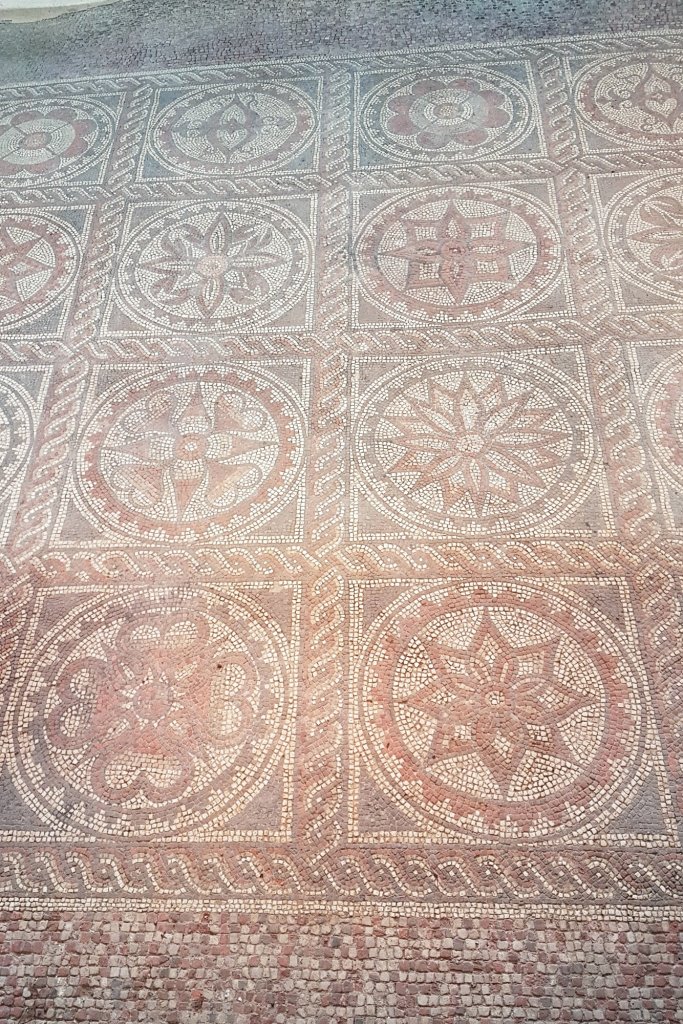
The Roman mosaic is actually quite incredible to see in person. (Especially if you ever watch HGTV and hear them whining about “complicated tile patterns”.) Thousands and thousands of tiles together, in an intricate and beautiful pattern. I thought that including info with the mosaic was wonderful, also- there is a lot to learn if you are interested! The little cubes that make up the mosaic are called tesserae, and there are 220,000 of them in this mosaic floor. “The main mosaic, like most at Verulamium, is geometric in design, and similarites with those at Colchester suggest a single workshopw as recognisable. The ‘flower’ designs are typical of Verulamium mosaics.” (Site info)
Yes, it is dulled in colour after nearly 2,000 years and being covered for who knows how long. However, it would have been amazing to see when it was first laid, and the almost technicolour effect. They actually know quite a bit about the colours, as well. The larger tessarae, that you can see around the edges of the room, were cut from old and cast-off roof tiles. The black/grey, white, and buff stones were specifically chosen for solely this floor. (I don’t know how archaeologists know this but I find it fascinating!) The size and design can also tell us a lot. Given that it was a sign of serious luxury, it probably would have belonged to an aristocrat or government official.

The Hypocaust
If you are like me, your first question will be, “what is a hypocaust?” So, a hypocaust is defined as “a hollow space under the floor of an ancient Roman building, into which hot air was sent for heating a room or bath.” Yes, the Romans had in-floor heating. (Take that, HGTV!) According to the information there,
The hypocaust was stoked from a small roughly built room outside the main house, and the stokehole of its furnace is marked on the floor… Heat from a wood or charcoal fire passed through flues laid in an X-shaped pattern beneath the mosaic- one section has collapsed and the channel below can be seen. The fire was probably kept very low, but constant, to heat the masonry and not just the flues.
From the underfloor flues, the hot smoke passed up concealed vertical box-flue tiles at the corners of the room. These would have acted like pipes, taking the heat through the walls, into the roof space and out through the tiles. Not much heat was wasted.
While it is a shame that part of the mosaic fell through, it is quite cool to actually be able to see down into the flue. The Ancient and Classical world invented/devised far more than many of us give them credit for, and this is the perfect example. What really struck me is the efficiency aspect. While we are working to regain efficiency in our household processes and appliances, Roman Britain had mastered it.
Have you seen the Roman mosaic in St Albans?
Cheers,
The Historian
Facebook | Twitter | Instagram | Pinterest | Bloglovin’

I lived in St. Albans for 4 years from 1997 to 2001. I visited the museum several times and noticed a mosaic that had a sign saying that the mosaic had an intentional flaw. Romans thought that only God was perfect so they made a small flaw in the mosaic. I would like to know if I remember correctly. I was trying to explain it to my pastor but forgot the exact wording. I am an American who loves British history and St. Albans. Thank you for your time.
Woooow! I have been to St Albans a few times but never seen that amazing mosaic. It’s kind of mad to think that people would have been able to wander on the tiles with bare feet and not been chilly!
Fab post lovely!
Aww, thank you!! If you are back in St Albans, definitely head there 🙂 The mosaic is amazing, and the park is just lovely, too! (Although, bizarrely there are Canadian geese there, so you might need to dash!)
Wow, that’s a pretty mosaic. I’m glad the builders decided to keep it as is when they built on top of it. 🙂
I know!! It isn’t the most common choice for the early 20th century, but I think it’s the only reason it still exists for us today!