With Women’s History Month continuing on, it is time to feature another fascinating woman from history. I think that the gender divide in ballet is fascinating; it largely remains a female-led field. (I do think it greatly explains why it is so often dismissed by both athletes and the general public.) In the past, I’ve shared some notable figures in ballet- in 2022, May was Margot Fonteyn month on the blog, and I chatted about Ninette de Valois for Women’s History Month 2022. Today I will be covering the life and career of Dame Alicia Markova, the first Jewish British prima ballerina!

Alicia Markova’s Childhood
Lilian Alicia Marks was born in Finsbury Park, London to Arthur and Eileen Marks. She and her four sisters spent much of their time with their paternal great-grandfather, Abraham Marks, who worked in theatre costuming and the girls often created their own plays and productions.
Doctors recommended that Lilian start dancing to help with her weak knees and flat arches when she was eight. Although she was a fragile child who was often sick and was quite shy, she took to dance immediately.

Markova’s Early Dance Career
Like Fonteyn and several other notable English dancers of this period, Lilian studied under Serafina Astafieva, a former Russian ballet dancer and aristocrat. When she was thirteen, Serge Diaghilev spotted her and invited her to join his company, the Ballets Russes, which was in Monaco at the time. She was known as the “Child Pavlovna” (a nod to the famed dancer Anna Pavlovna), making it easy to see why Diaghilev scouted her.
Given her young age, many roles had to be created specifically for her. This is a good thing for ballet dancers; the goal is typically to have roles created on you. Not only had she reached a significant career milestone as a teenager, she was also able to study under Enricho Cecchetti (creator of the Cecchetti school) and Nicolas Legat (another Russian school of ballet). She also worked with choreographers and dancers like George Balanchine and Bronislava Nijinska.
Notably, Diaghilev changed her name from Lilian Marks to Alicia Markova. For much of the twentieth century, a Russian name was an asset for a ballet dancer.
A Return to England
After the Ballets Russes closed in 1929 following Diaghilev’s death, Markova returned to England. She worked with several companies while in the UK; she was a principal dancer for The Ballet Club which would go on to become the Rambert Dance Company, one of the oldest dance companies in the UK. Notably, she danced at the Vic-Wells Ballet (which would become the Royal Ballet in the 1950s) from 1931 to 1935. Again, as a leading dancer, she continued to have roles created on her; you can still see some of these roles. In 1933, Ninette de Valois appointed her as Prima Ballerina of the Vic-Wells Ballet. (She was succeeded in this role by Margot Fonteyn.) This was a notable moment in ballet history as she was the first Jewish British principal ballet dancer.
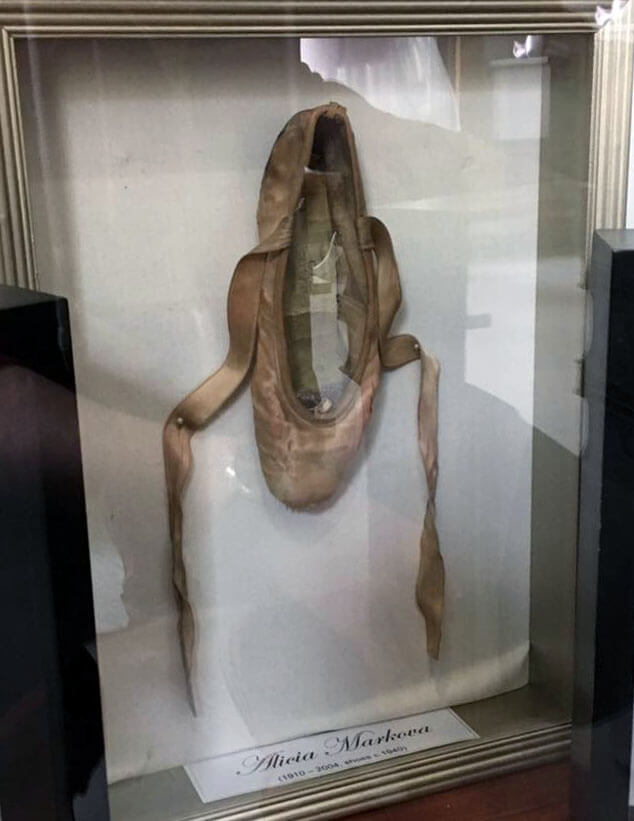
Back On The Road Again
In 1935, Markova and fellow British dancer Anton Dolin founded the Markova-Dolin Company and toured the UK together. She then joined the newly formed Ballet Russes de Monte Carlo as their principal dancer. She toured the US extensively with the company, and then in 1941 she joined the Ballet Theatre (which would later be known as the American Ballet Theatre) as a principal dancer.
Markova and Dolin reunited in 1948 in the UK and formed what became the Festival Ballet in 1950.
The English National Ballet
The Festival Ballet was created to mark the Festival of Britain, a national exhibition to mark the centenary of the Great Exhibition of 1851. This company was specifically created to bring ballet and dance to audiences who might never otherwise have the chance to see it. Markova served as Prima Ballerina for the company for two years, and continued to dance with the company on and off for several years. She also choreographed for the company for several years. The company would be renamed the English National Ballet in 1989, and remains one of five major ballet companies in the UK.

Retirement
In her retirement from dancing, Markova served several different roles. She was the director of the Festival Ballet, the Vice-President of the Royal Academy of Dance, and a Governor of the Royal Ballet. She also continued to teach at schools across the world, and to coach dancers in her previous roles.
Markova passed away in 2004 at the age of 94 in Bath. She is still recognised as one of the leading dancers of the twentieth century.
Prima Ballerina Assoluta?
Interestingly, Markova is cited by the English National Ballet as a Prima Ballerina Assoluta, but we have no information on which company or nation gave her this title or when. (This title may be given by a company, or by a government.) This is the highest title a female dancer can receive and only sixteen dancers total have received it.
Further Readings on Alicia Markova
Dolin, Anton. Alicia Markova: Her Life and Art. New York: Hermitage House, 1953.
Harwood, Rebecca Kate
Last updated June 23. “Alicia Markova.” Jewish Women’s Archive. Accessed March 2023. https://jwa.org/encyclopedia/article/markova-alicia.
Were you familiar with the life and career of Dame Alicia Markova?
Cheers,
The Historian
Facebook | Twitter | Instagram | Pinterest