As soon as Bridgerton aired, I knew that it would be the perfect topic for the blog. (And given my stats, you lovely readers agree!) And I pretty much immediately knew that I would need a bit of help covering it. Although I do love the Regency period, it’s not my area of academic study, and in spite of how relatively short it was, it was a fairly complex time in society. So, I was thrilled when Dr. Lizzie Rogers from History Lizzie agreed to do a guest post for me! Lizzie is more than well-versed in the Regency, and has the most fascinating blog, she is the perfect person to demystify the Regency period for us. And given that Bridgerton’s second season has been confirmed, there couldn’t be better timing. So, let’s dive into the ins and outs of being a Regency debutante with Lizzie!
The Ins and Outs of being a Regency Debutante
Lizzie Rogers
Now many of us have (binge-)watched Netflix and Shondaland’s new series, Bridgerton, based on the books by Julia Quinn, we’ve been introduced to many aspects of Regency London high society. But what takes the centre stage is the spectacle of the season: young women coming out and entering society, and the accompanying pressure of making a good match. We followed the fictional Daphne Bridgerton, the diamond (as labelled by Queen Charlotte) of the ‘bon ton’, as she navigated her first season. And, whilst Daphne’s journey was definitely of the fictional, highly dramatized variety, the real era which Bridgerton situates itself in was as precarious as Lady Whistledown’s Society Papers would have us believe.
What was the season?
And understanding the season is probably a very good place to start. The season corresponded with the sessions of government in the Houses of Parliament, which would run from November to June each year. The elite would descend upon the capital, bringing with them their families, building fashionable townhouses or taking lodgings and contributing not only to the country’s politics, but its culture. Because of this arrival of fashionable members of the elite, social and cultural institutions grew. In Bridgerton, as well as in other period dramas such as Poldark and Harlots, we see the theatre, the opera and the pleasure gardens that became staples of entertainment and culture.
It’s also important to remember that the season was not endemic to the Regency but had grown out of political tensions with the monarchy in the late seventeenth century which saw legal stipulations for the nobility to have a parliamentary presence. The elite effectively had to be in the capital keep royalty in check.
And so, from what began as a seasonal move of political importance, grew the fashionable society we see Daphne Bridgerton enter.

What a debutante could expect
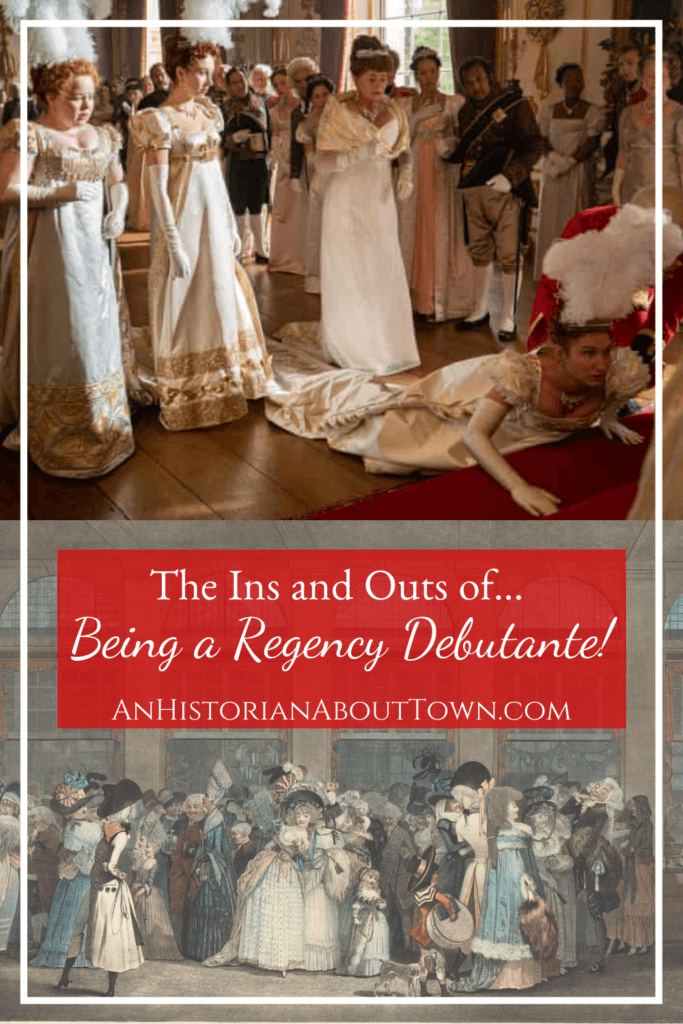
Like Daphne, elite young women, usually when they were around sixteen years old, would come out to society with a presentation to the monarch at court. George III founded Queen Charlotte’s ball in 1780, which was where this might happen. Eligible bachelors and their families would be watching the presentation of women, and mothers of debutantes would be doing the same, eager to make good matches for their daughters.
In general, a young woman with sisters would hope to be married before her younger sisters were presented to society. Hence Lady Catherine de Bourgh’s horrified reaction in Pride and Prejudice when she learned from Elizabeth Bennet, the second of five girls, that her younger sisters were out in society as well.
“All! – What, all five out at once? Very odd! – And you only the second. The younger ones out before the elder are married! – Your younger sisters must be very young?”
“Yes, my youngest is not sixteen. Perhaps she is full young to be much in company. But really, Ma’am, I think it would be very hard upon younger sisters, that they should not have their share of society and amusement because the elder may not have the means or inclination to marry early…”
Jane Austen, Pride and Prejudice, Chapter 29
Surely a very different attitude to Eloise Bridgerton, Daphne’s younger sister, who is desperate for her older sister not to marry so that she might avoid having to enter society, and by extension the marriage market, herself.

Attending balls
Some of the most mesmerising scenes in Bridgerton (and indeed, for me, in any Austen period drama) are those of the balls and parties. Being seen at events was important, and there were plenty to attend, with many eligible bachelors present.
These could be private balls, or those held in public spaces. There were also exclusive members’ clubs. For instance, Almack’s was one such club that was widely regarded as the best in London. Admittance was given from the seven patronesses, who would scrutinise everybody wanting to enter the premises, and then give them a voucher to attend. The club was on King Street and had a huge ballroom in which the committee held a ball and supper every week. Almack’s was considered exclusive but sometimes rather dull: mothers would parade their eligible daughters in such a way that it became famous for being a marriage market. It did liven up after the introduction of the waltz in 1814, but a young lady could only dance a waltz if granted permission from one of the seven patronesses.
Dance cards filled in at balls could keep track of all the dances that would take place during the evening and whom one’s partners were for each one. Too many dances couldn’t be partaken in with the same partner in one evening, for fear of courting gossip. This is just like in Pride and Prejudice when Mrs Bennet bragged about Jane dancing so much with Mr Bingley, and his attentions on her, which led to raised eyebrows from other dance attendees upon more than one occasion!
The evening altogether passed off pleasantly to the whole family. Mrs Bennet had seen her eldest daughter much admired by the Netherfield party. Mr Bingley had danced with her twice, and she had been distinguished by his sisters. Jane was as much gratified by this, as her mother could be, though in a quieter way.
Jane Austen, Pride and Prejudice, Chapter 3
Young ladies would hang their dance card from their wrist, to which would be attached a little pencil to fill it in. They were souvenirs to keep of each ball: though, in the case of a debutante who perhaps wasn’t as successful in courting admirers, they might be something to quickly dispose of.

Making a match
It’s a common misconception that love and freedom of choice seldom came into question when choosing a match during the early nineteenth century, but the elite did have other things to contend with when finding a spouse: namely, wealth.
Young women brought dowries to a marriage, which could very much help their position in the marriage market: hence why we see the Featherington girls’ hopes for the season go up in smoke when it emerged their father had lost their dowries. Securing a family dynasty, financially and with an heir, was incredibly important, so often money became a huge swaying factor, even though it was becoming increasingly common to marry for love.
Remember in Sense and Sensibility when Willoughby rejected Marianne Dashwood, who has very little money, for a rich bride he did not love as he has no financial security himself? Yet Edward Ferrars stuck to his word in offering marriage to Lucy Steele even though his mother cut him off – and eventually ended up happily married to Elinor Dashwood, despite there being little financial advantage.
“Mama, the more I know of the world, the more am I convinced that I shall never see a man whom I can really love. I require so much! He must have all Edward’s virtues, and his person and manners must ornament his goodness with every possible charm.”
Jane Austen, Sense and Sensibility, Chapter 3
Even if courting, it was very important that a couple still behave very formally to each other whilst under public scrutiny. In Bridgerton, we always see the Duke of Hastings, and her ill-fated other suitor Prince Frederick of Prussia, refer to Daphne as Miss Bridgerton: to refer to her by her first name would seem improper. In Sense and Sensibility, Elinor’s observance that Willoughby referred to her sister as Marianne, rather than Miss Dashwood, confirmed the idea in her mind that the two must have been secretly engaged. Their constant whispering to each other in company further cemented this. Small rules, like this, would carefully govern a young couple’s conduct.
Once a proposal had been made, the banns had to be read or a special licence had to be procured – like the one Daphne and Simon apply directly to Queen Charlotte for in Bridgerton, as they could not get one from the bishop. Weddings could be small or lavish affairs, including a wedding breakfast to follow the ceremony, which would have most likely occurred in the morning. This may have been it, or the revelry could last the whole day and into the night, with dancing and celebrations occupying the guests and special couple much in the same way that we know of weddings today.

Entering and enduring society
So, as we have seen, a young woman coming out into society during the Regency period was governed by many societal rules and expectations. The primary goal was often making a good match for a husband – and guarding the best possible reputation the whole way through navigating the season and the marriage market. Though rumour could get the better of some young women. Scandal and gossip characterised Georgian and Regency society as much as politeness and civility did, and other people revelled in it.
You only have to look at the Prince Regent’s secret and unofficial marriage to Maria Fitzherbert, or Georgiana, Duchess of Devonshire’s affair with Charles Grey, or the scandalous divorce between Lady Seymour Worsley and Sir Richard Worsley, to understand some of the things that went on by those who were an integral part of the real ‘bon ton’. Though we tend to think of eighteenth- and early nineteenth-century society as one of strict rule and regulation, plenty of things contravened it and challenged those who operated within it: which we were treated to plenty of during season one of Bridgerton.
Bibliography and further reading:
Roy & Lesley Adkins, Eavesdropping on Jane Austen’s England. (Abacus, 2014)
Venetia Murray, High Society in the Regency Period: 1788-1830. (Penguin Books, 1999)
Amanda Vickery, The Gentleman’s Daughter: Women’s Lives in Georgian England (Yale University Press, 1998)
Hannah Greig, The Beau Monde: Fashionable Society in Georgian England (Oxford University Press, 2013)
Annabel Sampson, ‘Inside the Season’, Tatler, 25th December 2020. Find it here: https://www.tatler.com/article/what-was-the-london-season-society-balls-debutantes-bridgerton
Kristen Richardson, ‘It’s easy to dismiss Debutante balls, but their history can help us understand women’s lives’, Time Magazine, 25th November 2019. Find it here: https://time.com/5737250/debutantes-history/
Linore Rose Burkard, ‘Exploring the Regency Debutante’, Jane Austen Centre Blog, 20th June 2011. Find it here: https://janeausten.co.uk/blogs/arts-and-entertainments/the-regency-debutante
And for the podcast lovers out there, BBC History Extra’s Podcast featuring Emily Brand: https://www.historyextra.com/period/georgian/regency-era-period-everything-wanted-to-know-emily-brand-podcast/
♠
Dr Lizzie Rogers is a historian of the long eighteenth century. Her research interests include elite women, collecting, curiosity, the Enlightenment and the English country house. In October 2020, her PhD was conferred from the University of Hull, where she also completed her BA and MRes, specialising in History of Art and Gender History. She also researches, writes and speaks on museums, Jane Austen, art and reading, and has recently been featured on the Hack History and Sistory Untold podcasts, the latter exploring the relationship between Jane and Cassandra Austen. Find her blog at www.historylizzie.co.uk.
You can read Lizzie’s Bridgerton review here: https://historylizzie.co.uk/2020/12/29/review-why-you-need-to-binge-watch-bridgerton-immediately/ !