If you are anything like me, when you think of the Great Depression, you think of newspaper shoes and potato-sack dresses. For some reason, I always imagined that fashion essentially stopped. However, the Bata Shoe Museum thoroughly dispelled me of that notion. In Want: Desire, Design, and Depression Era Footwear, there are items that show mending and wear, and items that show luxury and wealth. Although it’s a small lens, it gives you a very different view of the 1930s. So, today I’m sharing three of my favourites summer shoes from the Great Depression at the Bata Shoe Museum in Toronto!

I thought that Want was an incredibly interesting exhibition. It spanned the Wall Street crash of 1929 to the Second World War, and really makes you think of the period in different ways. As the BSM explains, “As global economies tumbled, want proliferated—want of employment, want of security, want of escape. The desires born from want drove an explosion of cultural creativity from film to fashion. Some sought to satiate the needs of the public, others sought to distract them from the troubling times, yet others hoped that by stoking desire and encouraging consumption the economy could be redeemed.” Also, given that we are undoubtedly heading into another global recession, it seems poignant timing to look back at the summer in the Great Depression.

1930s Pink and Gold Sandals
These unusual evening shoes feature a number of interesting details. Low heeled evening shoes were quite popular in the 1930s but few had the elegant faceting seen here. The gilt-kid applique work also adds visual interest to this pair. (Exhibition Info)
These are not anything I was expecting for shoes from the Great Depression. Although they are a very specific colour pairing, I could see these sandals being worn today. The twist detail and the stitch pattern on the heel are both quite interesting to look at. I would guess that fast fashion today would eliminate details like that in favour of price, so it surprised me to see them on a pair of shoes from the 1930s during a depression. They are European (from an unknown maker), so it does make me wonder if they were made or purchased in a country that wasn’t as badly hit. Shoes like this do tell me that there were some parts of society that were going to events and places that required nicer footwear.
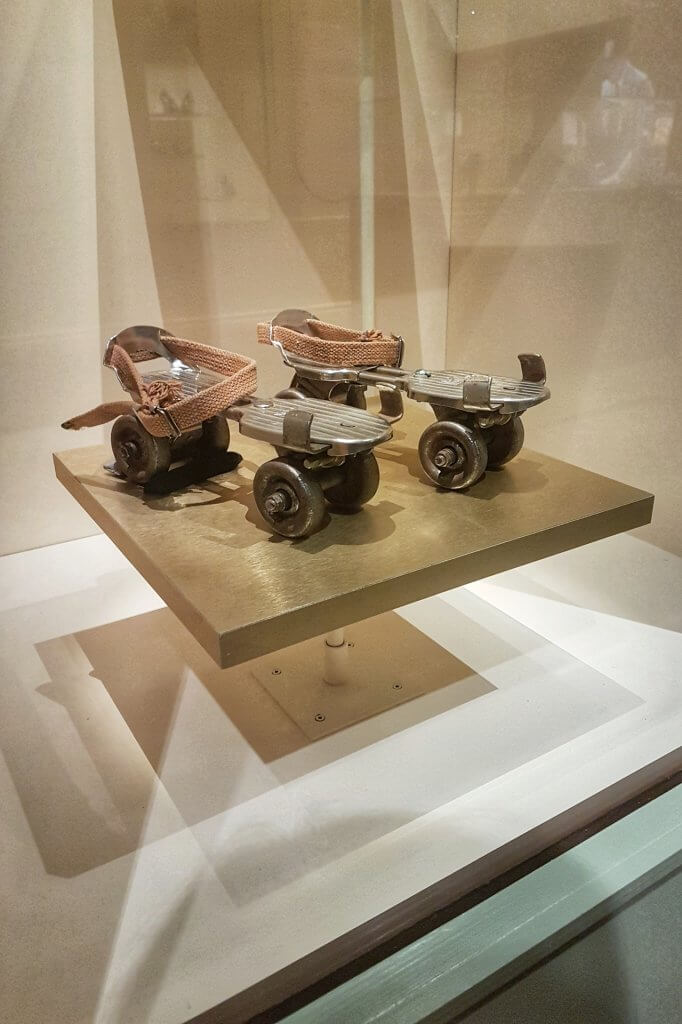
1930s Roller Skates
Although roller skates were invented in the eighteenth century, they were not popularized until the nineteenth century when a roller-skating crazy swept across Europe and North America. In the 1930s, another roller-skating craze swept hit and everyone was swept up in the fun. Ginger ROgers and Fred Astaire even did a roller-skating movie called Shall We Dance in 1937. Roller skates in the 1930s featured metal wheels and could be adjusted to fit a wide variety of shoe sizes. (Exhibition Info)
I will not lie, I was not expecting to see any sort of recreational footwear at all in Depression-era exhibition. It was included in the collegiate section, which looked at the young women in Canada and the US who entered university during the 1930s and 1940s (along with a fantastic pair of saddle shoes). BSM noted in particular that “[u]niversity students in North America were overwhelmingly white, privileged, and Christian, and the finding of ‘better’ marriage partners so that ‘better’ children could be raised was motivated by problematic ideologies”. (Exhibition Info) Yes, these unassuming roller skates indicate a much darker past!
In sheerly practical terms, I can see these being a practical choice during a depression. They are adjustable and incredibly durable, meaning that you could continue to use them and pass them on for years and years. Other than the ankle straps, you really wouldn’t have much repair work to do. (I’ve also noticed these style roller skates on social media and here in Canada again- maybe they are making a come back?)
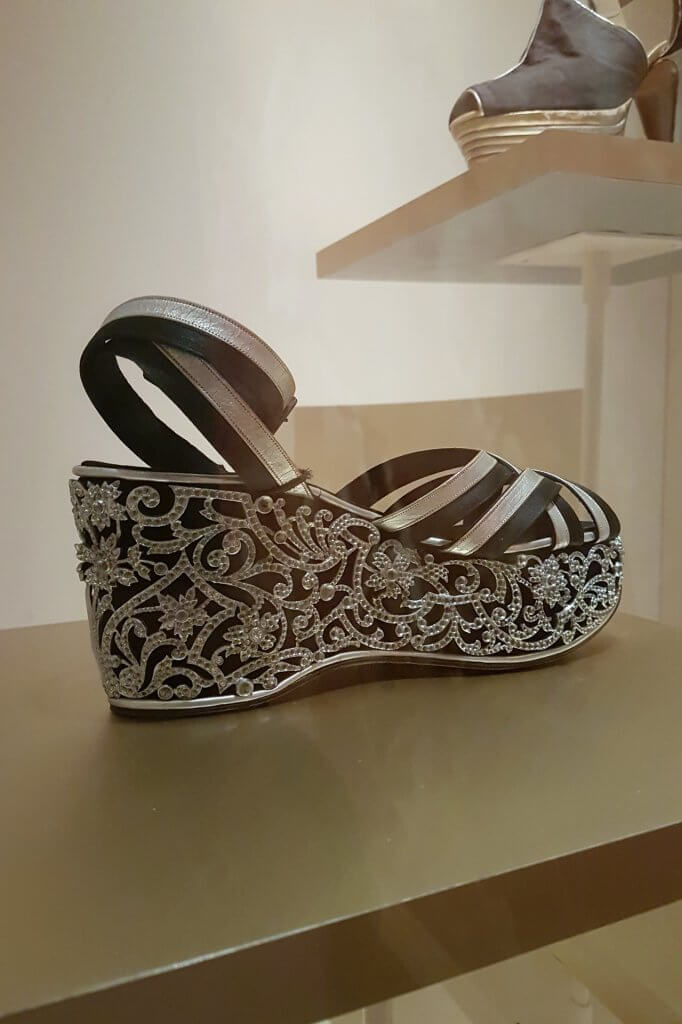
1939 Silver Filigree Ferragamo Platform Sandals
Ferragamo lavished this platform sandal with highly ornate silver filigree. In the 16th century, upper-class Spanish women’s chapines were frequently decorated with precious metals and gems. This platform, likewise, was only for the wealthy as they were priced at $100 USD in 1938. (Exhibition Info)
Perhaps it is just the work of their marketing team, but for the longest time, I thought Ferragamo was a relatively new designer. How wrong I was! These sandals are the anti-thesis to the Great Depression if there ever was one. These shoes would cost nearly $2000 USD in today’s money, which is a staggering sum for most of us. I think that this exhibition really emphasised that recessions don’t hit everyone. I always think of the tumbleweeds and empty plates, but the 1% rarely feel recessions. I do have to wonder what the people who bought and wore shoes like these thought during the Great Depression, and if they understood the true reality for the average person (or if they cared). Yes, these are gorgeous summer shoes that I’m sure were adored. But how do you reconcile that with a global recession? A question I think we will be asking in the years to come…
What do you think of these summer shoes from the Great Depression?
Cheers,
The Historian
Facebook | Twitter | Instagram | Pinterest | Bloglovin’

Those Ferragamo wedge sandals are just beautiful! I could very much see those in shops today, and if I could afford them, would probably buy them! And no, I don’t think the vast majority of them would have cared, I expect some might have used their wealth to help those in need, but most probably wouldn’t have noticed. Much like today.
I sadly think you are correct- even when looking at the holiday season, it is so often those who barely have anything to give making the biggest donations (in all senses of the word). And if they were for sale, I would absolutely buy them!!