For Style File Friday this week, we have a real treat! Megan Hunt, an historian who works in the history of medieval history, has written a fantastic guest post. We are going to be exploring the history of 14th century fashion and some of the most notable trends of the century. Without any waiting, here is: Threads of Time: A European Fashion Journey to the 14th Century!

Threads of Time: A European Fashion Journey to the 14th Century
14th-century Europe witnessed a rich tapestry of fashion, marked by distinctive garments that reflected societal trends and cultural shifts. As we step into the wardrobe of medieval Europe, we encounter a fascinating array of fashion that transcends mere attire, offering glimpses into the societal intricacies, cultural influences, and the evolving tastes of the time. From the extravagant houppelandes that billowed with grandeur to the practical yet socially significant braies, the versatile kirtles reflecting personal expression, and the iconic poulaines that adorned the feet with flair – each element tells a story. Join me on this journey as I unravel the layers of 14th-century fashion, exploring the threads that wove together elegance, practicality, and the timeless allure of medieval style.

Houppelandes
The houppelande, a hallmark of 14th-century fashion, was more than just an outer garment; it was a statement of style. The loose, flowing sleeves and voluminous silhouette made it a distinct choice for both men and women. Craftsmanship was crucial in its creation, with luxurious fabrics such as silk, velvet, and brocade favoured by society’s wealthier individuals. The houppelande’s allure was not only in its material but also in its intricate decorations. Elaborate dagging, contrasting fabrics, and fur trims added a touch of extravagance.
Regional variations reflecting cultural aesthetics emerged in houppelande styles during the 14th century. The silhouette evolved with exaggerated sleeves, reaching its height in the mid-14th century, as seen in Charles V of France’s depiction in Jean de Vaudetar’s bible (c.1372). The Codex Manesse, from the early 14th century, also illustrates the houppelande’s versatility, depicting individuals engaged in various activities like hawking on horseback. Attire lavishness depended on the occasion, influencing fabric and decoration choices.
With its luxurious materials and evolving styles, the houppelande remains an iconic representation of medieval fashion.
Braies
Braies, functioning as essential undergarments, were a practical necessity in the medieval wardrobe. Worn predominantly by men, these loose-fitting breeches-like garments played a crucial role in maintaining hygiene and comfort. Made from linen or other lightweight fabrics, braies extended to the mid-calf or ankle, contributing to the layered aesthetic of medieval clothing.
The practicality of braies can be found in the Luttrell Psalter, where two working-class men are threshing sheaf in fields.
Beyond their utilitarian purpose, braies became a canvas for social distinctions. The quality of the fabric and craftsmanship reflected the wearer’s social status. Wealthier individuals adorned themselves with finer fabrics, emphasising their elevated societal position.
The significance of braies extended beyond their concealed role, influencing the overall structure of medieval attire.
![Two men threshing sheaf,[Lower margin] Marginal drawing of two men threshing a bound sheaf with flailsImage taken from Luttrell Psalter. Originally published/produced in England [East Anglia]; circa 1325-1335.](https://anhistorianabouttown.com/wp-content/uploads/2023/12/Two-Men-Threshing-Leaf-in-Luttrell-Psalter.jpg)
Image taken from Luttrell Psalter.
Originally published/produced in England [East Anglia]; circa 1325-1335. Shelfmark: Add. 42130
Cotehardies
The cotehardie, known alternatively as the kirtle, epitomised versatility in medieval fashion. Worn by both men and women, the kirtle featured a snug fit through the torso and waist, with a fitted bodice often fastened at the front. Its distinguishing feature was a full skirt that added grace and elegance.
The kirtle became a canvas for self-expression, with elaborate decorations like dagging, embroidery, and the use of precious metals. These embellishments not only showcased the wearer’s personal taste but also indicated their social standing. The kirtle, acting as a foundational layer, contributed to the layered aesthetic of medieval ensembles. Women’s kirtles often featured wider skirts, while men’s versions leaned towards a more tailored silhouette.
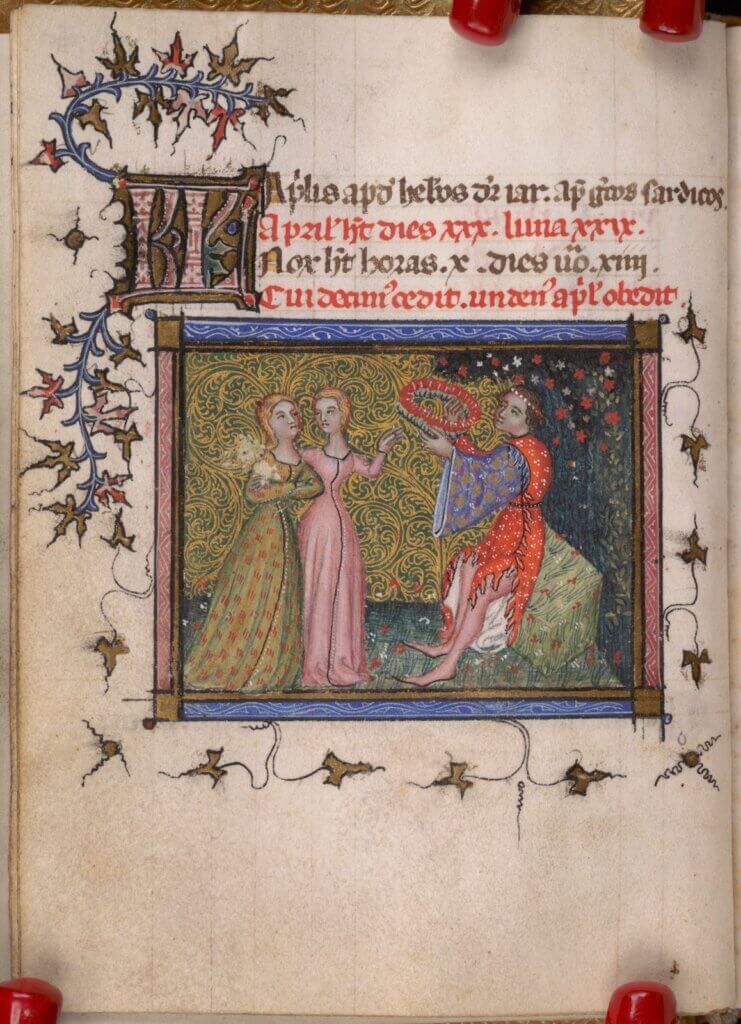
In 14th-century manuscripts, such as the Officium Beatae Mariae Virginis in the New York Public Library Digital Collection, cotehardies were commonly depicted. In an April calendar illustration, women on the left wear cotehardies with cinched waists and floor-length fabric, indicating high-class status. One woman’s patterned cotehardie suggests a luxurious material, possibly brocade or embroidery.
This adaptability made the kirtle a staple in the evolving fashion landscape of the 14th century.
Poulaines
Footwear in the 14th century took on a distinctive and iconic form with the poulaine, also known as crakows. Everyone will probably recognise illustrations of this outrageous footwear as it has become something satirical. The exaggerated, pointed toe of these shoes created a silhouette that was both fashionable and, at times, impractical. Crafted from leather or fabric, poulaines were fastened with a latchet across the instep, providing both style and functionality.
The length of the pointed toe became a visual indicator of social status, with longer toes signalling greater affluence. Both men and women embraced the poulaine, adding a touch of flair to their ensembles. The extreme style of the poulaine reached its zenith in the 14th century, with toes gradually elongating to exaggerated lengths.
The Tacuinum Sanitatis manuscript, a medieval health handbook, features remedies primarily rooted in botany. However, the ‘Drunkenness‘ illustration caught my attention. It portrays men around a table engaged in drinking, with noticeable poulaines. The length of these poulaines, though not as extravagant, suggests a working or possibly middle-class status for the depicted men.
Outside of the manuscripts, we have also excavated remnants of poulaines (or crakows) in England. Now housed in the MET, it shows a real-life example of this fashion trend rather than drawings.
However, practicality eventually prevailed over fashion, leading to the decline of this distinctive footwear – perhaps it will come back into fashion one day? Who knows!
Conclusion
With these four clothing examples and brief descriptions, I have barely scratched the surface of the beautiful world of 14th-century clothing and fashion. However, just from this overview, the style of the 14th century was clearly a dynamic expression of cultural and societal trends, as reflected in the houppelandes, braies, kirtles, and poulaines. Collectively, these elements of fashion shaped the visual landscape of the time, leaving an enduring legacy that continues to captivate our imaginations today.
References
- Alexander, Jonathan, and Paul Binski. Age of Chivalry, Art in Plantagenet England, 1200–1400. Royal Academy/Weidenfeld & Nicolson, 1987.
- Chambers, Mark, and Louise Sylvester. “Lexicological Confusion and Medieval Clothing Culture: Redressing Medieval Dress with the Lexis of Cloth and Clothing in Britain Project.” Everyday Objects: Medieval and Early Modern Material Culture and Its Meanings, Ashgate Publishing, 2010, pp. 71–84.
- Crowfoot, Elizabeth, et al. Textiles and Clothing c. 1150 -c. 1450. Museum of London, 1992.
- Davis, Nicola. “Medieval Fashion for Pointy Shoes Linked to Rise in Bunions.” The Guardian, 2021, https://www.theguardian.com/science/2021/jun/11/medieval-fashion-for-pointy-shoes-linked-to-rise-in-bunions.
- Favier, Jean. Gold and Spices: The Rise of Commerce in the Middle Ages. Holmes and Meier, 1998.
- Howell, Lauren. “Early Gothic-13th & 14th Centuries.” Illinois State University, 2012, https://web.archive.org/web/20120809235916/http://www.cfa.ilstu.edu/lmlowel/THE331/MiddleAges/EGothicreview.html.
- Koslin, Désirée, and Janet E. Snyder. Encountering Medieval Textiles and Dress: Objects, Texts, and Images. Macmillan.
- Laver, James. Costume and Fashion: A Concise History. Oxford University Press, 1983.
- Netherton, Robin, and Gale R. Owen-Crocker. “The Tippet: Accessory after Fact?” Medieval Clothing and Textiles, vol. Volume 1, Boydell Press, 2005.
- Newman, Paul B. Daily Life in the Middle Ages. McFarland & Co, 2001.
- Ribiero, Aileen. Dress and Morality. Batsford, 1986.
- Scott, Margaret. Medieval Clothing and Costumes: Displaying Wealth and Class in Medieval Times. The Rosen Publishing Group, 2004, https://archive.org/details/medievalclothing0000scot.
- Singman, Jeffrey L., and Will McLean. Daily Life in Chaucer’s England. Greenwood Press, 2005.
- Thornbury, Walter. “The Costume of English Women from the Heptarchy to the Present Day.” The Art Journal, vol. 2, 1876, pp. 173–77, https://www.jstor.org/stable/20568908.
- Tortora, Phyllis G., and Keith Eubank. Survey of Historic Costume: A History of Western Dress. Fairchild Books, 2005.
- van Brunt, Nancye. A Concise History of Underwear from Ancient Times to 1918. 1990. Morehead State Theses and Dissertations.
♠
Who is Megan Hunt?
Hi, I’m Megan – a recent graduate of the History MRes program at the University of Leicester. My academic journey has focused on the intricate world of medieval clothing, providing unique insights into historical societies through clothing and material culture. Before that, my undergraduate degree in Contour Fashion, specifically corsetry, fueled my passion for history, influencing me to take that step into the wonderful world of fashion history.
I want to thank you if you reached the end of this blog post. I hope you enjoyed my condensed research about some fashionable items in the 14th century!
Feel free to hop over my own blog to see other posts I have written, as well as my portfolio of content writing work. You may be interested in other historical fashion trends I have investigated!
Website: https://megansaestheticsandstuff.com/
Twitter: https://twitter.com/megansaestheics
LinkedIn: https://www.linkedin.com/in/megan-hopper-0aa2a7209/
Instagram (Cosplay account): https://www.instagram.com/meganscosplayandfashion
Instagram (Reading Blog): https://www.instagram.com/megansreadingandsbooks/
Thank you to Megan for this fantastic post, Threads of Time!
Cheers,
The Historian
Facebook | Twitter | Instagram | Pinterest