In August, we explored some of my favourite fiction books set in Edinburgh- it can be fascinating to explore a city or place through the eyes of another person or character. However, as an historian I often gravitate towards non-fiction books. (I think that a lot of people write them off as boring when they are as-interesting or more so- more people need to give them a chance!!) This month we are heading to Paris for some arm-chair travel, for those who are interested in the City of Lights! These are my favourite non-fiction books about Paris.
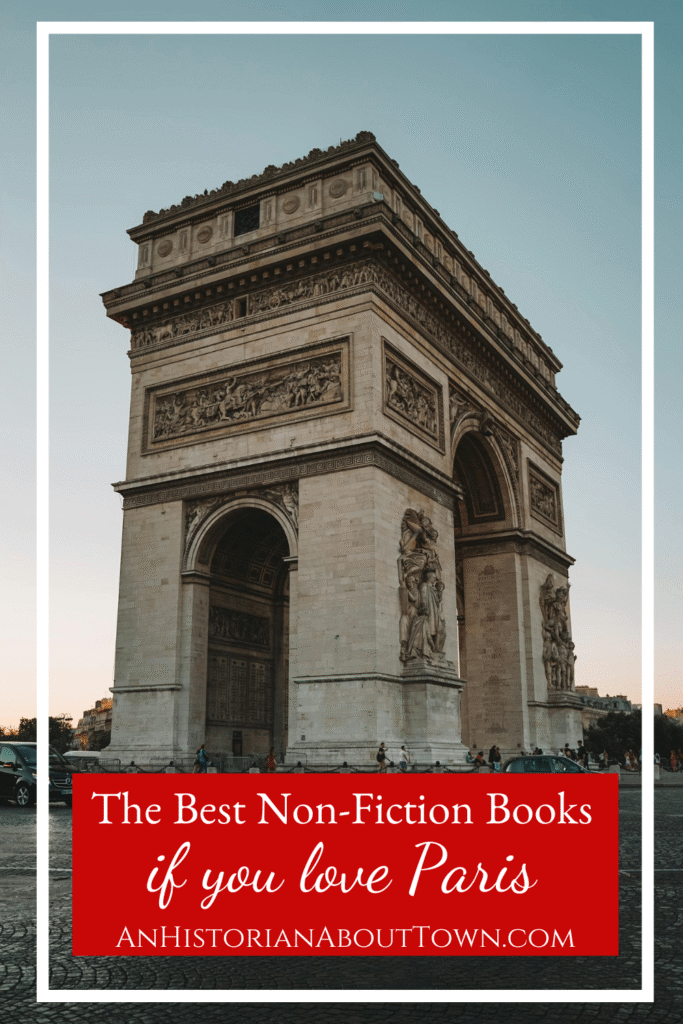
My Favourite Non-Fiction Books About Paris
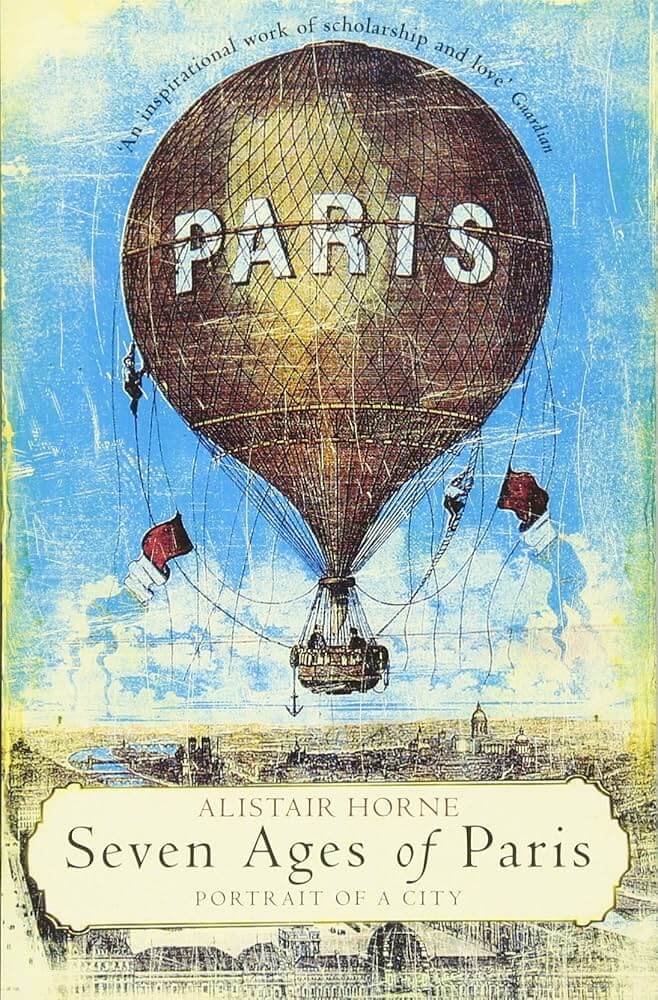
Seven Ages of Paris, Alistair Horne
In this luminous portrait of Paris, the celebrated historian gives us the history, culture, disasters, and triumphs of one of the world’s truly great cities. While Paris may be many things, it is never boring.
From the rise of Philippe Auguste through the reigns of Henry IV and Louis XIV (who abandoned Paris for Versailles); Napoleon’s rise and fall; Baron Haussmann’s rebuilding of Paris (at the cost of much of the medieval city); the Belle Epoque and the Great War that brought it to an end; the Nazi Occupation, the Liberation, and the postwar period dominated by de Gaulle–Horne brings the city’s highs and lows, savagery and sophistication, and heroes and villains splendidly to life. With a keen eye for the telling anecdote and pivotal moment, he portrays an array of vivid incidents to show us how Paris endures through each age, is altered but always emerges more brilliant and beautiful than ever. The Seven Ages of Paris is a great historian’s tribute to a city he loves and has spent a lifetime learning to know.
Why You Should Read This…
Paris has been the site of human activity dating back nearly 10,000 years, so it makes sense that you would need to limit your scope just a tad in a single book. Horne is known for being an expert in 19th and 20th century French history (particularly focusing on conflicts) but he pushes beyond that and covers seven major periods in Paris’ history here. It is not a fast read but if you really want to immerse yourself in Paris’ history, this is an excellent starting point.
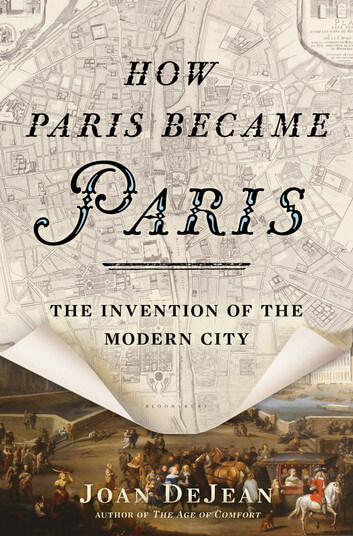
How Paris Became Paris: The Invention of the Modern City, Joan deJean
At the beginning of the seventeenth century, Paris was known for isolated monuments but had not yet put its brand on urban space. Like other European cities, it was still emerging from its medieval past. But in a mere century Paris would be transformed into the modern and mythic city we know today.
Though most people associate the signature characteristics of Paris with the public works of the nineteenth century, Joan DeJean demonstrates that the Parisian model for urban space was in fact invented two centuries earlier, when the first complete design for the French capital was drawn up and implemented. As a result, Paris saw many changes. It became the first city to tear down its fortifications, inviting people in rather than keeping them out. Parisian urban planning showcased new kinds of streets, including the original boulevard, as well as public parks and the earliest sidewalks and bridges without houses. Venues opened for urban entertainment of all kinds, from opera and ballet to a pastime invented in Paris, recreational shopping. Parisians enjoyed the earliest public transportation and street lighting, and Paris became Europe’s first great walking city.
A century of planned development made Paris both beautiful and exciting. It gave people reasons to be out in public as never before and as nowhere else. And it gave Paris its modern identity as a place that people dreamed of seeing. By 1700, Paris had become the capital that would revolutionize our conception of the city and of urban life.
Why You Should Read This…
Paris is incredibly well-known for its layout- not only for the arrondissements but also for the parks, boulevards, sidewalks/pavements, and streets. And cities and towns all over the world use Paris as an example for their own urban planning. DeJean explores the ways that the city’s iconic elements were developed and why they were developed. I think that looking at a city through a specific lens can uncover a lot, and How Paris Became Paris is a perfect example of that!
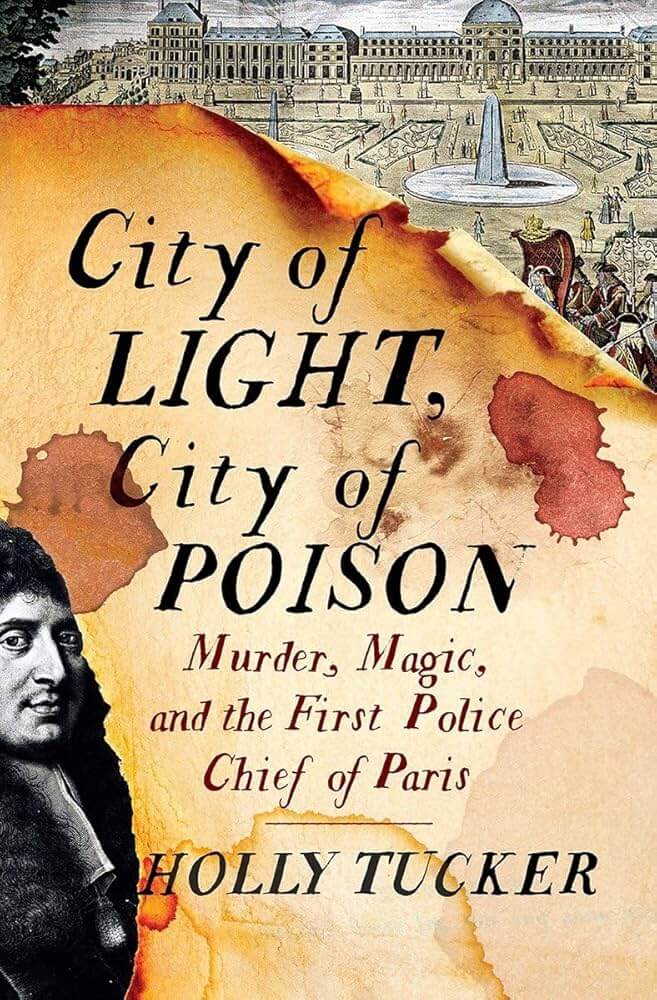
City of Light, City of Poison: Murder, Magic, and the First Police Chief of Paris, Holly Tucker
Appointed to conquer the “crime capital of the world,” the first police chief of Paris faces an epidemic of murder in the late 1600s. Assigned by Louis XIV, Nicolas de La Reynie begins by clearing the streets of filth and installing lanterns throughout Paris, turning it into the City of Light.
The fearless La Reynie pursues criminals through the labyrinthine neighborhoods of the city. He unearths a tightly knit cabal of poisoners, witches, and renegade priests. As he exposes their unholy work, he soon learns that no one is safe from black magic–not even the Sun King. In a world where a royal glance can turn success into disgrace, the distance between the quietly back-stabbing world of the king’s court and the criminal underground proves disturbingly short. Nobles settle scores by employing witches to craft poisons and by hiring priests to perform dark rituals in Paris’s most illustrious churches and cathedrals.
As La Reynie continues his investigations, he is haunted by a single question: Could Louis’s mistresses could be involved in such nefarious plots? The pragmatic and principled La Reynie must decide just how far he will go to protect his king.
From secret courtrooms to torture chambers, City of Light, City of Poison is a gripping true-crime tale of deception and murder. Based on thousands of pages of court transcripts and La Reynie’s compulsive note-taking, as well as on letters and diaries, Tucker’s riveting narrative makes the fascinating, real-life characters breathe on the page.
Why You Should Read This…
This book is for the true crime lovers, without a doubt! Police forces developed very differently across the world, with different cities approaching the task in their own way. Louis XIV tasked Nicolas de La Reynie with getting crime under control in Paris, and that came with a Hydra of problems needed to be solved. There were parts of this book that I found slightly graphic in description but I am exceptionally squeamish- I would say that most people would not have an issue with it. (And it is needed explanation in the book!)
I love that this book covers the overall history of Paris’ early “police chief”, as well as high profile incidents. If you are familiar with Louis XIV’s court, some of these episodes will be familiar!
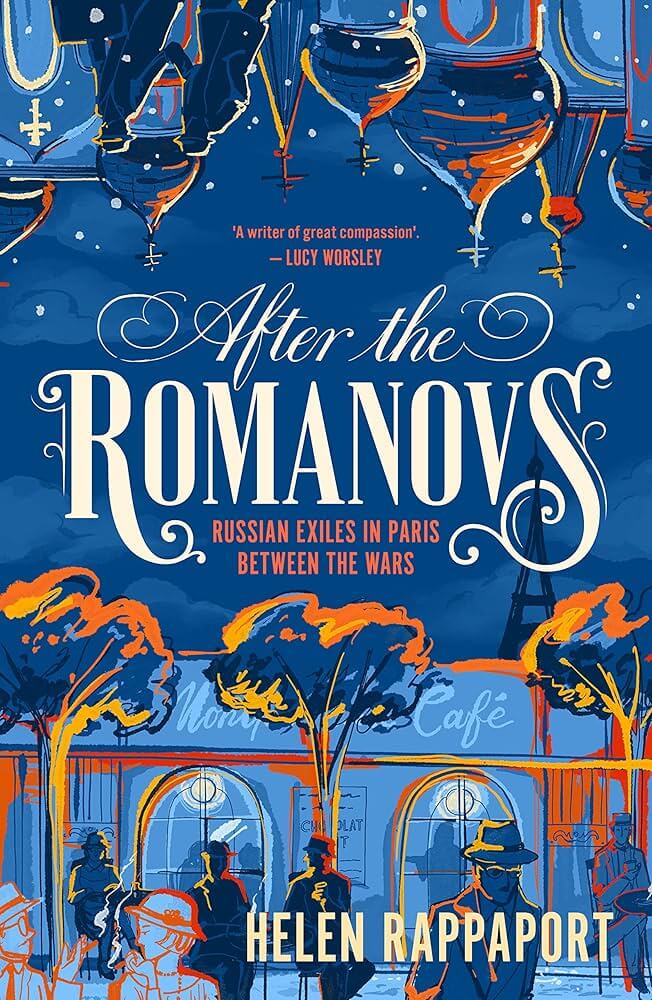
After the Romanovs: Russian Exiles in Paris from the Belle Époque Through Revolution and War, Helen Rappaport
Arriving in Paris, former princes could be seen driving taxicabs, while their wives who could sew worked for the fashion houses, their unique Russian style serving as inspiration for designers like Coco Chanel. Talented intellectuals, artists, poets, philosophers and writers struggled in exile, eking out a living at menial jobs. Some, like Bunin, Chagall and Stravinsky, encountered great success in the same Paris that welcomed Americans like Fitzgerald and Hemingway. Political activists sought to overthrow the Bolshevik regime from afar, while double agents plotted espionage and assassination from both sides. Others became trapped in a cycle of poverty and their all-consuming homesickness for Russia, the homeland they had been forced to abandon. Paris has always been a city of cultural excellence, fine wine and food and the latest fashions. But it has also been a place of refuge for those fleeing persecution, never more so than before and after the Russian Revolution and the fall of the Romanov dynasty. For years, Russian aristocrats had enjoyed all Belle Epoque Paris had to offer, spending lavishly when they visited. It was a place of artistic experimentation such as Diaghilev’s Ballets Russes. But the brutality of the Bolshevik takeover forced Russians of all types to flee their homeland, sometimes leaving with only the clothes on their backs.
Why You Should Read This…
For another focused look at Paris, I’m looking to one of my favourite historians, Helen Rappaport. This book looks at the exiled members of the extended Romanov family and the wider aristocracy after the fall of the Russian Imperial Family. Notably, many of these Russian immigrants ended up in Paris, and their story would have evolved in very different ways had they found themselves in other cities. While some continued on with their very aristocratic lives, others found themselves working jobs at all levels of society. Some even became part of socialist movements, quite the change from their lives in St. Petersburg. The book gives an interesting view of Paris, through the lens of immigrants but a very particular group of immigrants. I was not expecting to learn as much about Paris as I did!
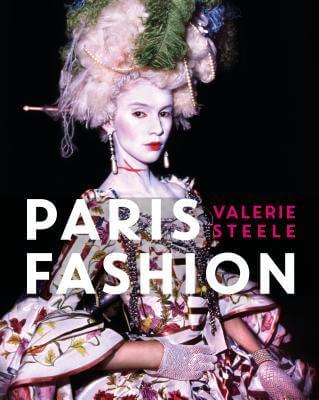
Paris Fashion: A Cultural History, Valerie Steele
Paris has been the international capital of fashion for more than 300 years. Even before the rise of the haute couture, Parisians were notorious for their obsession with fashion, and foreigners eagerly followed their lead. From Charles Frederick Worth to Gabrielle “Coco” Chanel, Christian Dior, and Yves Saint Laurent, fashion history is dominated by the names of Parisian couturiers. But Valerie Steele’s Paris Fashion is much more than just a history of great designers. This fascinating book demonstrates that the success of Paris ultimately rests on the strength of its fashion culture – created by a host of fashion performers and spectators, including actresses, dandies, milliners, artists, and writers.
Why You Should Read This…
Ah, come on now- you had to know that I would be including some fashion history here! Valerie Steele is the brilliant director of the Museum at the Fashion Institute of Technology (MFIT), and it is entirely fitting that she is the genius behind this book. Paris would not be Paris without the fashion industry and Steele has given us a very readable and entertaining book that helps place fashion in Paris’ wider history. I love that we also get to know other craftsmen, journalists, editors, society figures, and more- she understands that fashion is so much bigger than just the fashion houses. (It was originally published in 1988 but was updated in the 2010s- you will absolutely recognise many names!)
Have you visited Paris? And if you have, what stood out to you?
Cheers,
The Historian
Facebook | Threads | Instagram | Pinterest