I first visited Westminster Abbey in 2013 and unfortunately, while it was a great visit, it was also very rushed. So, on this trip, I decided that I was going to head back (despite it being £31 for a ticket now…) and truly take my time. And take my time I did- I was there for nearly two hours and enjoyed every minute of it. Unsurprisingly to many readers, I especially took my time in Poets’ Corner. I thought I would share some of the literary history at Westminster Abbey, if you happen to spot it!

Literary History at Westminster Abbey
While different cathedrals and abbeys are known for different things, Poets’ Corner is one of the things that we most strongly associate with Westminster Abbey. Even though many of these authors and poets are actually buried in other places, they are still linked to the Abbey as writers, which is interesting from an historical perspective. (If you look closely at several of the stones, you will see their place of burial listed.) Geoffrey Chaucer was the first poet to be buried in the Abbey, although it was not because he was a poet but rather because of his place of residence.
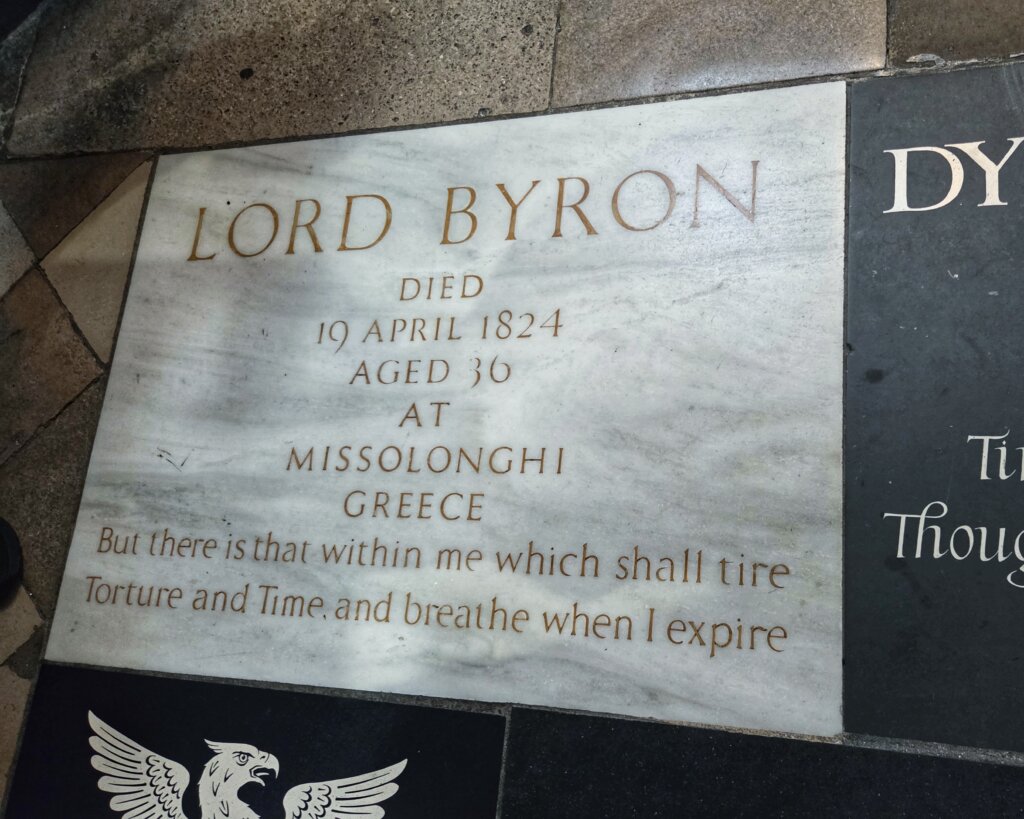
Visiting Poets’ Corner
If you follow the guided audiobook tour (narrated by Jeremy Irons, aka Scar from The Lion King), Poets’ Corner will be one of the last places that you visit. Much of the “must-see” places in the Abbey are actually quite narrow and more difficult to congregate in, so most people keep moving along. However, Poets’ Corner is a slightly more open area in the South Transept, so there tend to be larger groups. (I also noticed several private guided tours clumping up here.)
If you really want to see the burial place or memorial of a specific author, be prepared to wait a little bit. Because there are so many groups, it can be difficult to actually see the stones, as people are standing around on them. People will also gather around the more popular memorials, like William Shakespeare.
So, who can you spot in Poets’ Corner? Notably, most of the burials and memorials are for male authors but you can spot several female authors with a good eye.
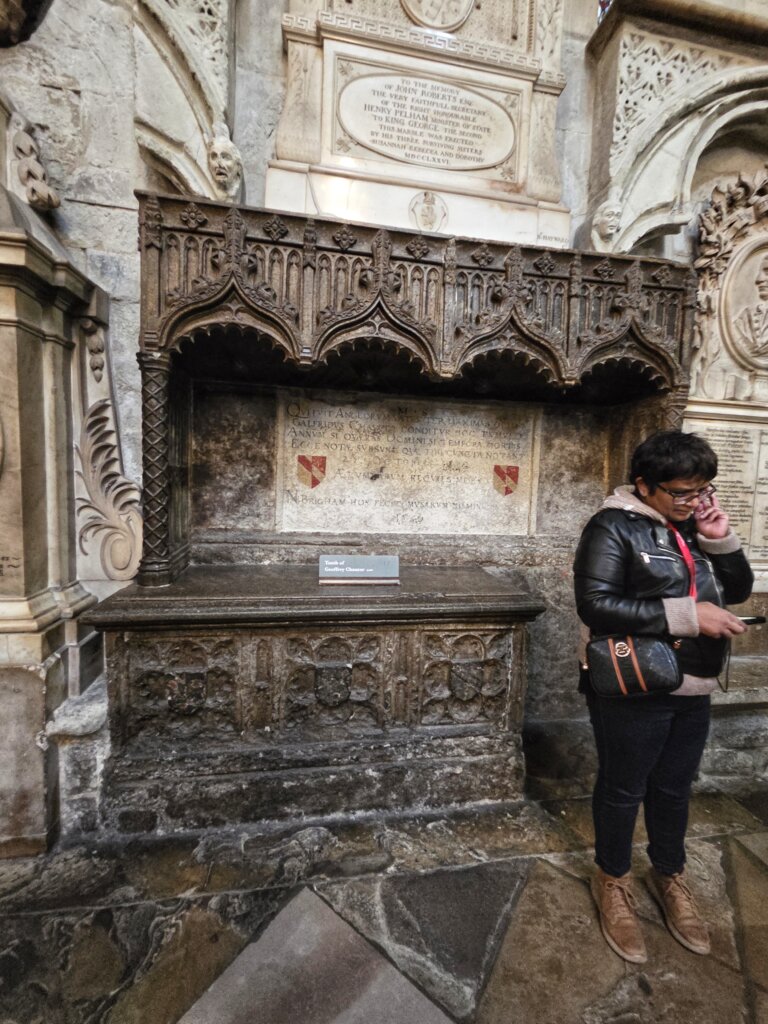
Geoffrey Chaucer’s Tomb
While people often believe that Chaucer was buried in Southwark Cathedral because the Canterbury Tales begins just down the way, he is actually buried in Westminster Abbey. He was originally buried close to the entrance to St Benedict’s Chapel in 1400, but in 1556, poet Nicholas Brigham erected the Purbeck marble tomb that we can still visit today. As someone who studied Chaucer in-depth in university, I was very interested to see his tomb. It was actually fairly plain/simple, though its size is notable. It somewhat blends in with the walls now but it is worth stopping to see.
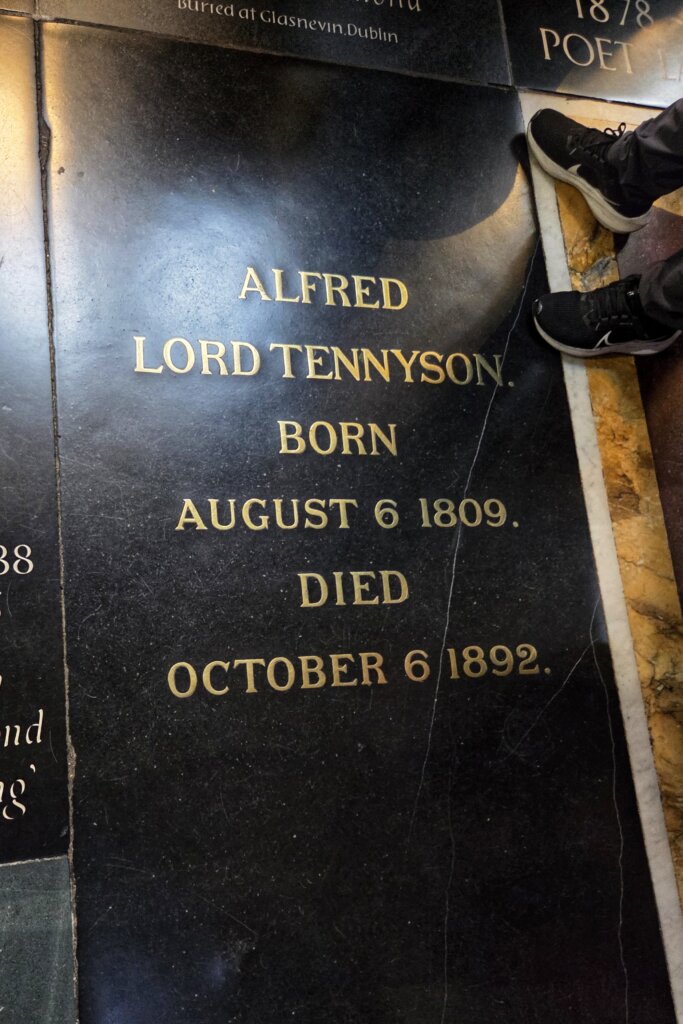
Alfred, Lord Tennyson
Tennyson is another poet who is also actually buried in the Abbey. While I am not a particular fan of poetry, I do have a soft-spot for Tennyson. He is the author of “The Lady of Shalott”, a poem that greatly inspires Anne Shirley. (That scene in the 1980s Anne of Green Gables film is one of my favourites of all time.)
Tennyson was Poet Laureate and thus was a well-known public figure- he was actually buried in the Abbey immediately following his death. And shortly thereafter, the government then commissioned a bust to be placed close to his burial stone.
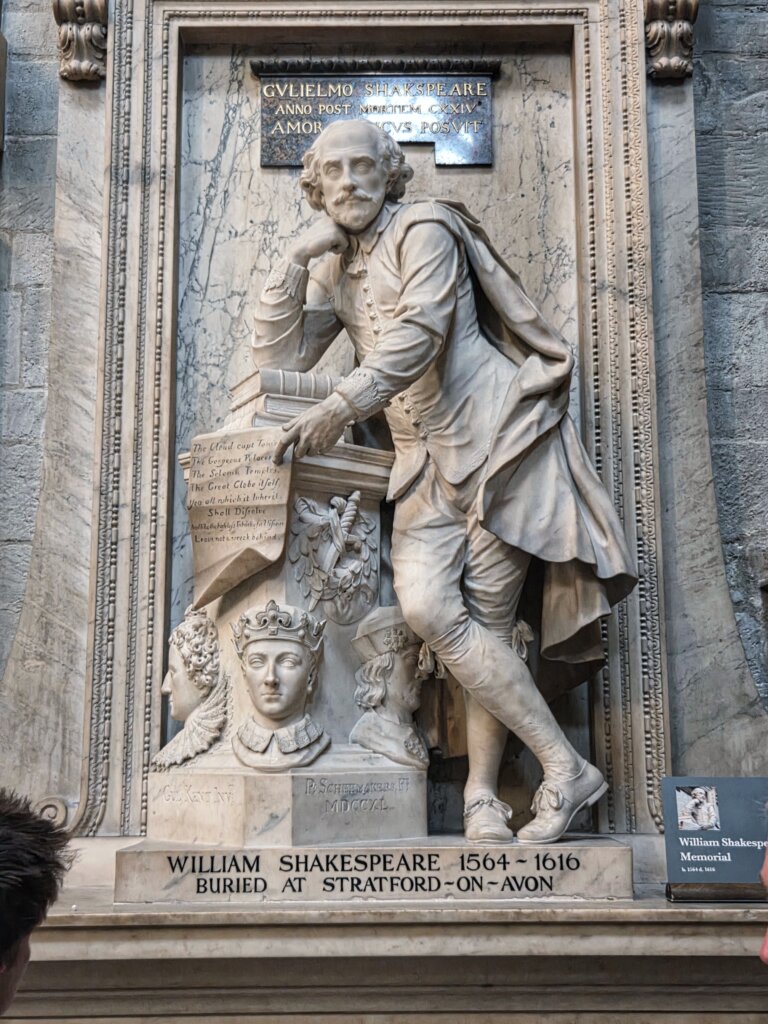
William Shakespeare Memorial
Shakespeare is actually buried in Stratford-upon-Avon. However, much like Southwark Cathedral, there is a memorial to him in the Abbey. Interestingly, this memorial was created over a century after his birth, in 1741. The Shakespeare Ladies Club, a group of aristocratic women, pushed for the memorial. Of course, the women’s role has been ignored until very recently. You will notice three heads on the bottom of the memorial, and that would be King Henry V, King Richard III, and Queen Elizabeth I.
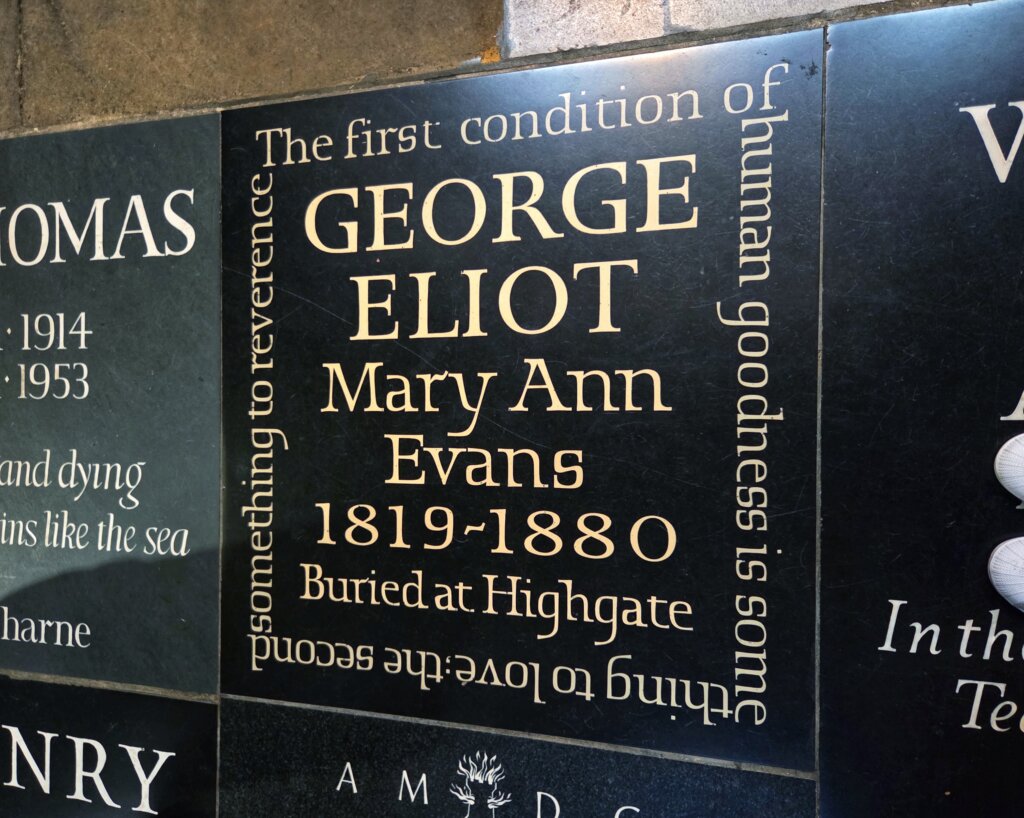
George Eliot, aka Mary Ann Evans
Notably the first female author I spotted in Poets’ Corner was the exceptionally talented George Eliot. It is a smaller, square stone, rather than one of the full length stones that many of the other authors have. It was only installed in 1980- many of the newer stones are this smaller size. Her stone does include one of her best-known quotes, a piece from Scenes of a Clerical Life.
“The first condition of human goodness is something to love; the second something to reverence.”

The Brontё Sisters
Although all three sisters share one memorial stone on the wall, I was very happy to see them represented in the Abbey. (Their stone is actually right beside the Shakespeare memorial, which seems a notable spot for female authors.)
The Brontё Society donated the Huddlestone Stone piece, fitting as the stone itself comes from Yorkshire. They originally donated the stone in late 1939. Understandably, the official dedication did not take place until 1947. Notably, the two dots above the e in their last name were not added until 2024!
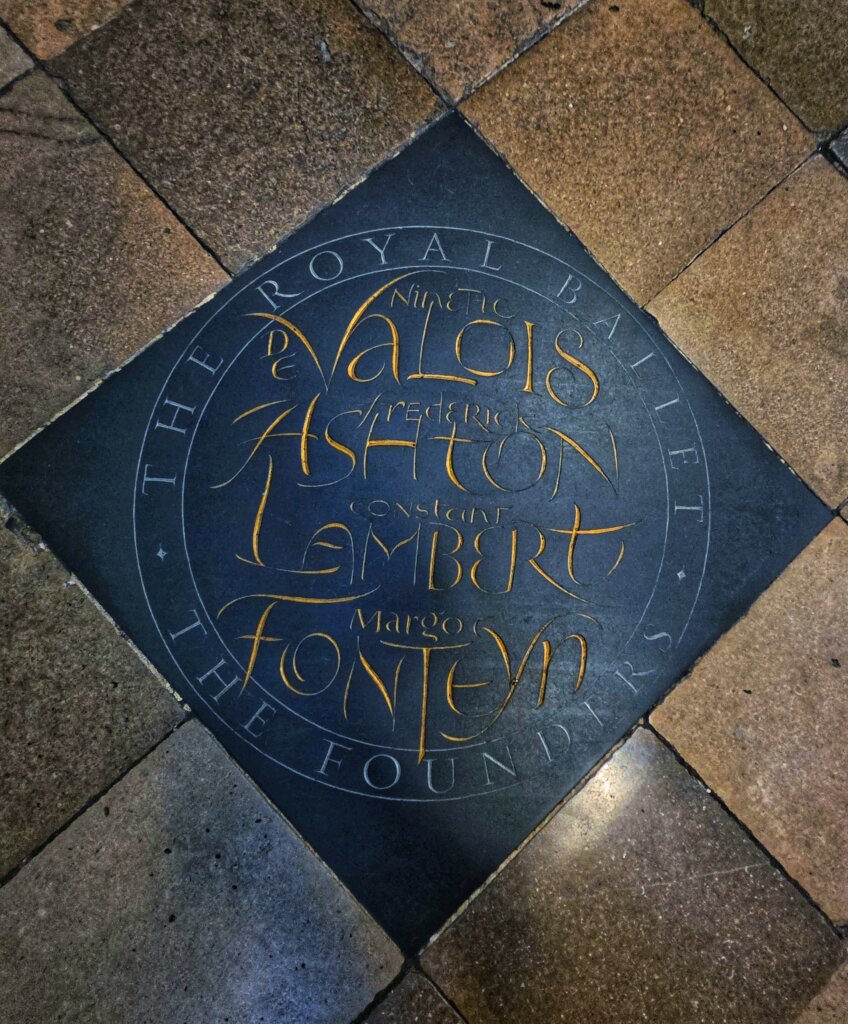
The Royal Ballet Founders
Although this stone is for dancers and musicians, it is still included in Poets’ Corner, and as a dancer, of course I had to see it. This stone looks quite different from most others and I think it is fitting. The stone was laid in 2009 as a tribute to Dame Ninette de Valois, Sir Frederick Ashton, Constant Lambert, and Dame Margot Fonteyn, the founders of what is now known as the Royal Ballet. It also stands out for being oriented as a diamond rather than as a stone.
Have you explored the literary history at Westminster Abbey yourself? If you have, which author were you looking out for?
Cheers,
The Historian
Facebook | Threads | Instagram | Pinterest