2025 was the year for Austenites- the 250th anniversary of our beloved author’s birth led to several incredible books being published,not to mention several documentaries, events, exhibitions, and more. (I don’t know if 1977 was a happening time for the 200th anniversary, but I will guess not as great…) I love that so many authors are sharing their own journeys and experiences with Austen’s works, including this book. It makes for a more personal reading experience, and leads to you examining your own. Let’s get into Jane Austen’s Bookshelf by Rebecca Romney!
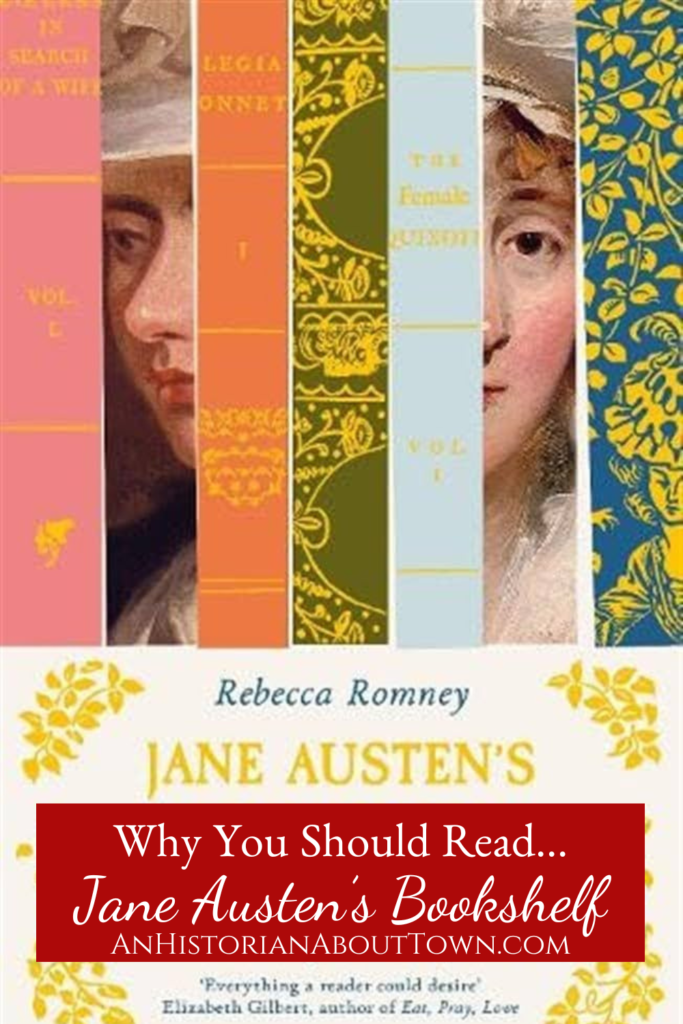
Jane Austen’s Bookshelf, Rebecca Romney
Long before she was a rare book dealer, Rebecca Romney was a devoted reader of Jane Austen. She loved that Austen’s books took the lives of women seriously, explored relationships with wit and confidence, and always, allowed for the possibility of a happy ending. She read and reread them, often wishing Austen wrote just one more.
But Austen wasn’t a lone genius. She wrote at a time of great experimentation for women writers—and clues about those women, and the exceptional books they wrote, are sprinkled like breadcrumbs throughout Austen’s work. Every character in Northanger Abbey who isn’t a boor sings the praises of Ann Radcliffe. The play that causes such a stir in Mansfield Park is a real one by the playwright Elizabeth Inchbald. In fact, the phrase “pride and prejudice” came from Frances Burney’s second novel Cecilia. The women that populated Jane Austen’s bookshelf profoundly influenced her work; Austen looked up to them, passionately discussed their books with her friends, and used an appreciation of their books as a litmus test for whether someone had good taste. So where had these women gone? Why hadn’t Romney—despite her training—ever read them? Or, in some cases, even heard of them? And why were they no longer embraced as part of the wider literary canon?
Jane Austen’s Bookshelf investigates the disappearance of Austen’s heroes—women writers who were erased from the Western canon—to reveal who they were, what they meant to Austen, and how they were forgotten. Each chapter profiles a different writer including Frances Burney, Ann Radcliffe, Charlotte Lennox, Charlotte Smith, Hannah More, Elizabeth Inchbald, Hester Lynch Thrale Piozzi, and Maria Edgeworth—and recounts Romney’s experience reading them, finding rare copies of their works, and drawing on connections between their words and Austen’s. Romney collects the once-famed works of these forgotten writers, physically recreating Austen’s bookshelf and making a convincing case for why these books should be placed back on the to-be-read pile of all book lovers today. Jane Austen’s Bookshelf will encourage you to look beyond assigned reading lists, question who decides what belongs there, and build your very own collection of favorite novels.

Why You Should Read This…
Along with Wild for Austen from Devoney Looser, I have recommended Jane Austen’s Bookshelf widely. In it, rare book dealer Rebecca Romney explores her own relationship with Austen and beyond, and it left me sitting with a lot.
While the book on its own is fascinating- and would be for anyone who enjoys Austen- I loved Romney’s honesty. She openly admits when she hasn’t read a particular novel or author, despite the author being included in our regular canon. And she admits when she doesn’t enjoy something. I find a lot of people couch their own thoughts and readings, perhaps to portray a particular image. But it was that honesty that made me like Romney even more.
The second element that I did not expect from this book (but probably should have) is that of my own collection. I have turned a critical eye to the books that sit on my own shelves and the books that don’t. For the books that I have, why am I keeping them? If they are non-fiction, it is typically for research. But for fiction, to what end? Do I love this book? Do I think I should have this on my shelf? Am I hoping to read it? And for the books that I don’t have, what books do I want to acquire? And which editions? While I am just buying regular editions (perhaps 10-20 years old), which one do I actually want? It is something I think that every reader should consider.
Is Jane Austen’s Bookshelf on your to-read list?
Cheers,
The Historian
Facebook | Threads | Instagram | TikTok