I was going to wait to write this post until I have actually seen the piece in person when I’m in London in November. However, given the popularity of The Gilded Age and how many people have been asking about all things of the period, I decided to write this post early. The Manchester Tiara remains one of the most well-known tiaras in the world, despite its noble rather than royal origins. Cartier’s exquisite work paired with the unique design make it stand out among tiaras, which is saying something. Let’s look at the history of the Manchester Tiara!

The History of the Manchester Tiara
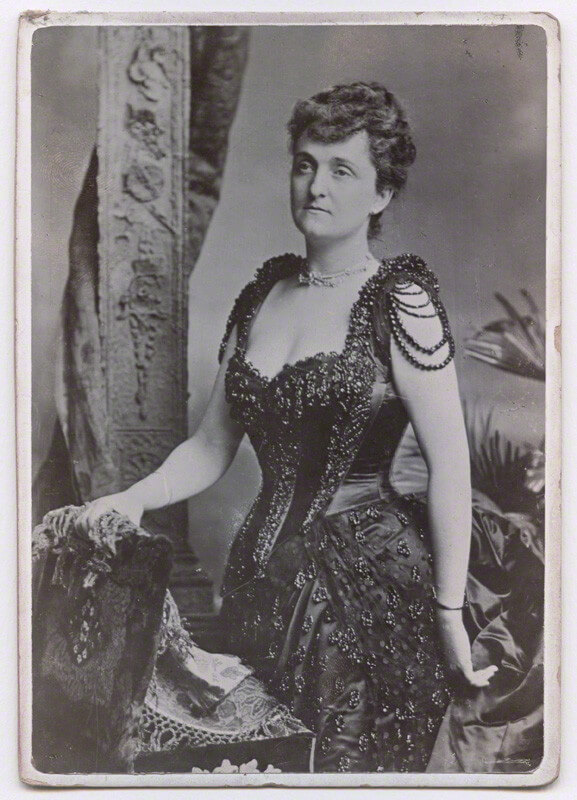
Who Was Consuelo Yznaga?
A needed clarification: Consuelo Yznaga is not the same person as Consuelo Vanderbilt. Yznaga was Vanderbilt’s godmother but they are two different people who happen to share the same first name.
Yznaga was a Cuban-American heiress who married George Montagu, Viscount Mandeville in 1876. While she acquired a title through the marriage, he acquired her dowry and made immediate use of it. The Viscount spent most of the money her family had provided on gambling, travel, and mistresses. (That’s not particularly helpful when your family has specifically sought out a marriage that will bring in funds to help with the family estate, not your gambling debt…)
Still, Consuelo was a popular guest in society. She belonged to the Marlborough House Set, King Edward VII and Queen Alexandra’s close group of friends. She also was known for her philanthropic work, focusing on issues related to poverty and health.
The Manchester Tiara
In 1903, Consuelo decided to have Cartier create a new tiara for her. She gave over one thousand brilliant-cut diamonds and four hundred rose-cut diamonds to the famous French jeweller to produce the piece. The intricate diadem features diamond set-flaming hearts and C-scrolls with floral elements. An exceptionally detailed tiara, the design is inspired by the Baroque designs found in the ironwork and gates of the Palace of Versailles.

Later Owners
The Dowager Duchess was seen wearing the tiara frequently, and we even have a surviving portrait of her with it. However, Yznaga passed away in 1909 and it was left to her son, the 9th Duke of Manchester. His wife, Helena Zimmerman- another American heiress, wore the Manchester Tiara to the 1911 coronation of King George V and Queen Mary at Westminster Abbey. The couple divorced in 1931, with the tiara remaining in the ducal property.
By the mid-twentieth century, the Monatgu family had run into serious financial issues. They sold both of the family estates: Kimbolton Castle and Tandragee Castle.
However, by the twenty-first century, the family’s financial issues had not been entirely cleared. Upon the 12th Duke’s death in 2002, the family was forced to sell the remaining jewels (including the tiara).
In 2007, the Manchester Tiara was forfeited to the government to cover the death duties. It has since been on display at the Victoria and Albert Museum in South Kensington, and has been included in the 2025 Cartier exhibition at the museum. I was lucky enough to see this tiara in November 2025 where it opens the museum, and it absolutely is the best choice to open the exhibition.

Have you seen the Manchester Tiara in person?
Cheers,
The Historian
Facebook | Threads | Instagram | Pinterest