I am back again with another new release for you. (Ahem, the perfect gift for the royal history lover in your life….) Today I’m hosting author and historian Moniek Bloks for a blog tour for Hermine: An Empress in Exile! I was quite thrilled to be invited to take part, as I didn’t know anything about Hermine before reading this. So, let’s get right into Hermine and her fascinating life! (Thank you to the author and NetGalley for providing an eARC in exchange for an honest review.)
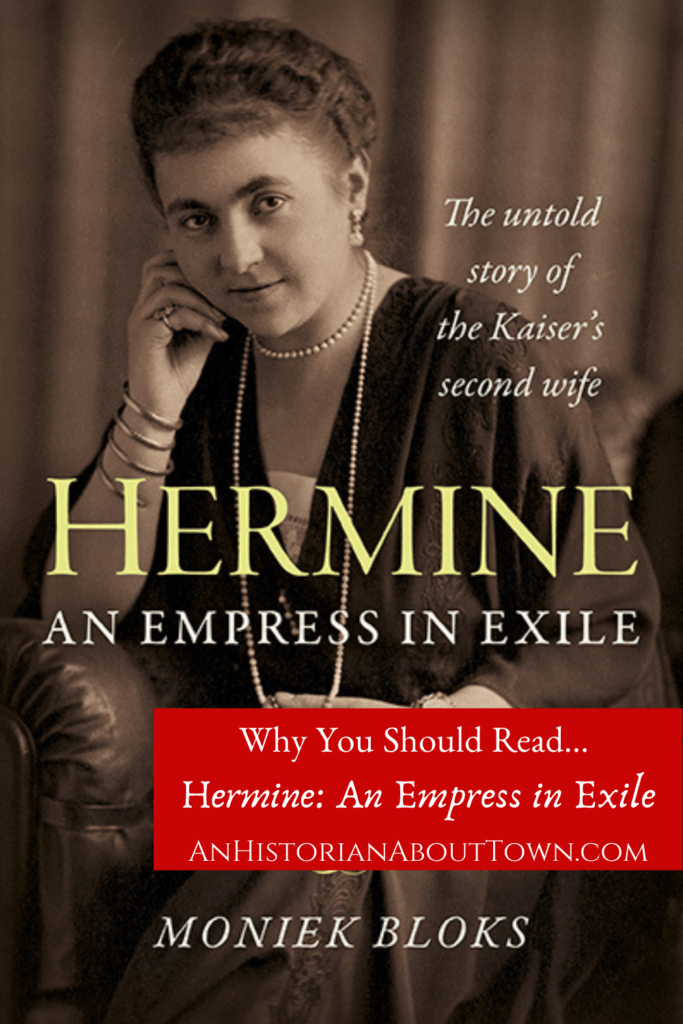
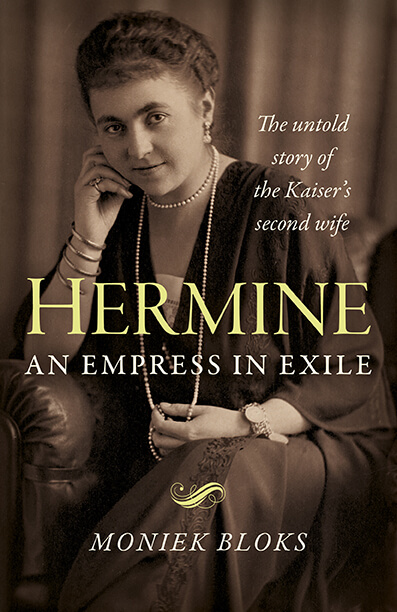
Hermine: An Empress in Exile, Moniek Bloks (11 December UK/1 January US)
Hermine Reuss of Greiz was one of the five daughters of Heinrich XXII, Prince Reuss of Greiz and his wife Princess Ida of Schaumburg-Lippe. Her childhood was overshadowed by the death of her mother in childbirth and the incurable disability of her only brother. A 13-year marriage to Prince Johann Georg of Schönaich-Carolath produced five children before her husband’s death of tuberculosis. However determined never to be married again, Hermine ended up meeting the exiled German Emperor Wilhelm II, and soon fate had other plans.
The book Hermine: An Empress in Exile will be released on 11 December 2020 (UK) and 1 January 2021 (US).
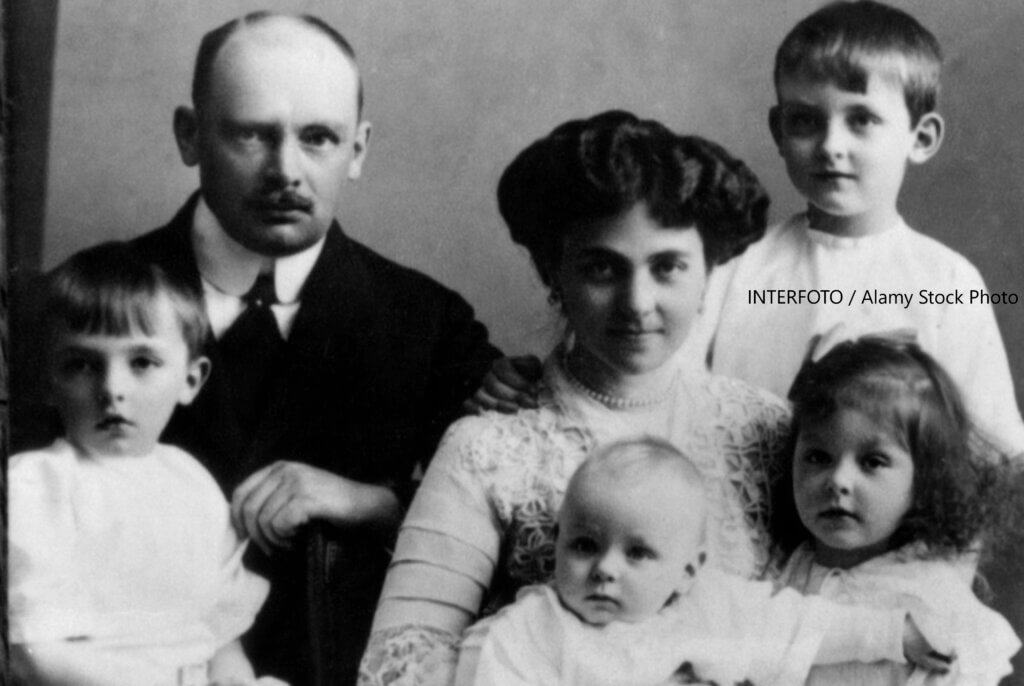
Empress Hermine and her first husband Johann Georg – A long illness
After rumours that Hermine was to marry her sister Caroline’s widower, she ended up marrying Prince Johann Georg of Schönaich-Carolath who had estates in Silesia, present-day Poland. Their wedding took place on 7 January 1907 in Greiz, followed by a honeymoon in Italy. Hermine was surprisingly brief about her first husband in the memoirs she wrote in 1927, but it appears to have been a happy marriage.
The newlyweds would spend the winters in an apartment in Berlin, as Johann Georg was a lieutenant colonel in the Second Regiment of the Dragoons there, and the summer in Silesia at Castle Saabor with her parents-in-law. Hermine quickly fell pregnant and gave birth to her first child, a son named Hans Georg at the end of 1907. Not long after, the first signs of the illness that would haunt their marriage appeared – tuberculosis.
Four more children would follow over the years, sons Georg Wilhelm and Ferdinand Johann and daughters Hermine Caroline and Henriette, the story of her first marriage became all about her husband’s long illness. “We were always together, in the garden or the fields. We roamed the woods and collected berries and mushrooms and the little ones joined us on our travels to Italian spas where my husband hoped to heal his afflicted lungs.”
Hermine, who had only briefly been able to enjoy the court life of Berlin, was forced back into retirement by her husband’s illness. They visited Berlin just once or twice a year, and Hermine was once able to chaperone Princess Adelheid of Saxe-Meiningen who, in another twist of fate, would become her future step-daughter-in-law.
Johann Georg’s health slowly deteriorated, and he moved from sanatorium to sanatorium and was often confined to a wheelchair. At the start of the First World War, he wanted to return to active duty, but he was denied this on medical grounds. Refusing to back down, he found a place under General von Wrochem until he suffered yet another bloody haemorrhage and two attacks of dysentery.
The First World War was hard on the family. While Johann Georg’s lungs were being destroyed by tuberculosis, Hermine began to suffer from a gastric disorder caused by the shortage of certain foods. She would never fully recover. During the final days of the war, Hermine gave birth to her final child, but by the time little Henriette was old enough to recognise her father, he was so ill that he was unable to hold her.
After the doctors told her what she had already – the disease was now terminal – Hermine devoted her life to caring for her husband. They travelled to the Black Forest while their children remained with their paternal grandmother in Saabor. For the last eight months of his life, Johann Georg was confined to his bed. His suffering came to an end on 6 April 1920 in the Wölfelsgrund sanitorium in the Jizera mountains; he was still only 46 years old.
Hermine was saddened by his death, but it also gave her back her freedom. She later wrote, “My new freedom enabled me to complete my education and to permit free play to my own personality. I was strongly determined never to marry again, never to surrender the precious right to be the master of my soul.”
Why You Should Read… Hermine: An Empress in Exile
This was a fascinating biography. Prior to reading this, I admit I knew nothing about her or her story. Wilhelm tends to be ignored in the period after his abdication, and I think that Hermine unfortunately gets swept up in that. However, she was a determined woman and she lived through a chaotic and difficult period in Europe. The book focuses largely on her later life, but I appreciate that- her early life is similar to many other German princesses, so I didn’t feel like I was missing anything. Her later life and death is really the interesting part for me; I was stunned to read that Wilhelm was buried in the Netherlands and that Hermine was buried with his first wife. (Yes, you read that correctly!) This is a well-written biography, and a must-read!

Moniek Bloks
Moniek Bloks is the editor of the successful blog History of Royal Women. She lives in the Netherlands and has a background in law. Her interest in historical royal women and writing began at an early age, and she has been glad to share the stories of often little-known royal women. When she isn’t writing, she is visiting castles and palaces around Europe with her trusty camera.
Will you be reading Hermine: An Empress in Exile?
Cheers,
The Historian
Facebook | Twitter | Instagram | Pinterest | Bloglovin’