As it is Women’s History Month in the UK and the US, we will be exploring women’s history throughout the centuries all month. (Although, let’s be honest- you will typically find that here anyways.) And I thought there is no better way to start off the month than to explore the lives of some of the women who played a massive role in getting women to where we are now. (It has to be said, none of these women are perfect and they should be considered as whole people.) These are 3 suffragettes you should know!
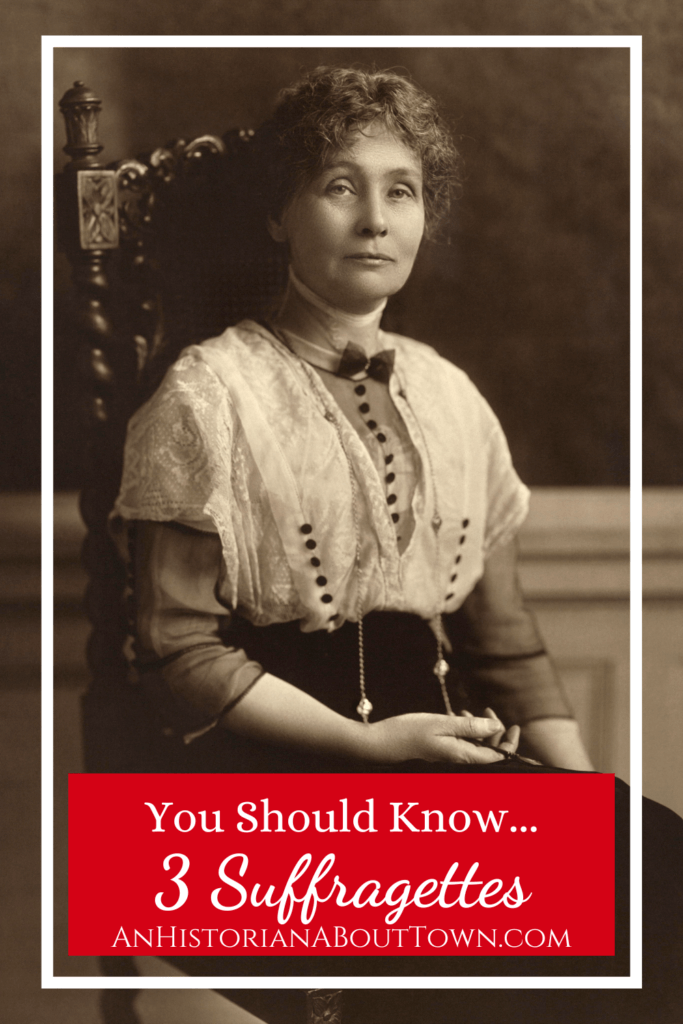
3 Suffragettes You Should Know
Before we jump in, let’s clarify one thing- what is a suffragette? Suffragettes and suffragists are often confused and people will use one term when they mean the other. A suffragist pursued women’s suffrage by largely peaceful means, ie. peaceful protests, lobbying, while a suffragette pursued the cause by through more militant actions, ie. smashing windows, hunger strikes. I would argue that both approaches were needed for women’s suffrage but a lot of people (both at the time and now) will praise suffragists for “playing nicely” and decry suffragette contributions.

Emmeline Pankhurst
You can’t really discuss the suffragettes without Emmeline Pankhurst. Born in Manchester in 1878, Pankhurst quickly became involved in the fight for women’s suffrage in Great Britain (by the age of 16). Pankhurst and her husband founded the Women’s Franchise League in 1889. The WFL was rather active, however, it folded a few years after her husband’s death.
In 1903, Pankhurst then founded the Women’s Social and Political Union, an organisation also committed to achieving women’s suffrage. However, Pankhurst believed that more extreme methods were required to achieve their goals, and the group orchestrated a “reign of terror”. They smashed windows, organised a rush on the House of Commons, and even committed a string of arsons (that left five dead and over twenty injured). The WSPU was known for going on hunger strikes after being arrested, leading to the Cat and Mouse Act being passed in 1913 (whereupon they would be released only to be re-arrested after they were able to eat and gain back their strength).
Pankhurst died in 1928, a decade after women gained the right to vote in Britain.
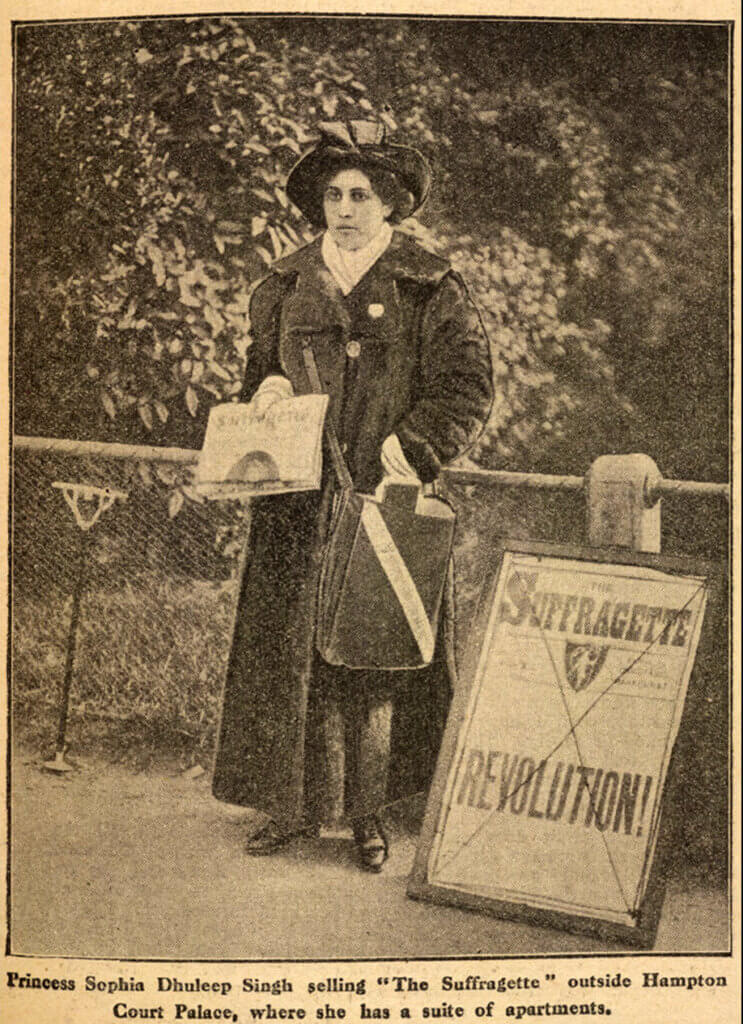
Sophia Duleep-Singh
I have shared Sophia Duleep-Singh’s story before here, but I will never not find her fascinating. Born Princess Sophia Alexandrovna Duleep Singh, she was the daughter of Maharaja Sir Duleep Singh, the last maharaja of the Sikh Empire, and was one of Queen Victoria’s granddaughters. Victoria was happy for Sophia and her sisters to become socialites and take their place in polite society, with Sophia a charismatic and entertaining young woman. After her father died in 1893, Sophia and her sisters were given a grace-and-favour apartment at Hampton Court Palace.
Sophia traveled to India in 1903 with her younger sister to attend the Delhi Durbar, a celebration of King Edward VII’s role as Emperor of India. While in India, Sophia became acutely aware of the political situation in India as a part of the British Empire, and how her family’s trajectory had changed. When she returned to the UK, she joined the WSPU in 1909, joining forces with Pankhurst to push for women’s suffrage. And as someone intimately connected with the Royal Family and their surrounding circle, Sophia was incredibly useful to the WSPU.
Singh sold many of her belongings to raise funds for the WSPU, and played a large role in the administrative side of the union. While it seems like she may be fairly tame for a suffragette, she tried to fall in front of the Prime Minister’s car so he would be forced to look at her “give women the vote sign”, and supported the group’s militant efforts (including bomb production).

Hanna Sheehy-Skeffington
Sheehy-Skeffington was an Irish suffragette (and nationalist) born in County Cork in 1877. Her father was an MP for the Irish Nationalist Party, and her uncle was a member of the Land League- from a young age, she quickly became familiar with a wide variety of tactics to push for change. (In her family’s case, for the independence of Ireland). And as Ireland was under British rule, women also did not have the vote there, either.
In 1908, Sheehy-Skeffington was one of the founders of the Irish Women’s Franchise League. The IWFL was working against multiple groups, as the Irish Nationalist Party did not believe that Irish women should have the vote, in addition to the other parties in Westminster at the time. The league rapidly grew, swelling to over a thousand members in only four years. In June of 1912, Sheehy-Skeffington was arrested with a group of suffragettes for smashing the windows of Dublin Castle (the seat of the Crown in Ireland at the time) and spent a month in prison.
Her husband, Francis, who had also founded the league, was killed in 1916 by British soldiers. Hanna refused any compensation and instead became a committed Sinn Féin member. In 1918, Irish women received the right to vote, though with several conditions. However, in 1922, the newly established Irish Free State gave both men and women the right to vote. Sheehy-Skeffington would continue to hold political positions until the 1940s.
♠
Want more women’s history? These 4 Forgotten Royal Women you should know!
When did women get the full right to vote where you live?
Cheers,
The Historian
Facebook | Threads | Instagram | TikTok