Autobiographies can be an interesting source for historians. They don’t always tell you what you want to know but rather what the subject thinks is important. The V&A Fashion Perspectives series features many autobiographies from different fashion designers. Just like the designers featured, they vary greatly. Norman Hartnell’s Silver and Gold is one of the highlights, though. Designer to Queen Elizabeth II, Princess Margaret, the Queen Mother, and more royals, Hartnell was a fascinating figure. Here is my review of Silver and Gold, including why I think it should be your next fashion read.
If you know Norman Hartnell for anything, you probably know him for designing the Queen’s gown for her 1948 wedding and her 1953 coronation. His opulent and dramatic evening gowns are held in museum collections around the world, and feature sumptuous fabrics, detailed embroidery, and sweeping shapes. He is best known for designing for various members of the royal family, as well aristocrats and socialites. The First Knight of Fashion was one of the best known British designers of the twentieth century, and he had a fascinating and full career. If you want to know more about Hartnell and his life, you can read my biography here! However, an autobiography is a whole other kettle of fish, and the insights that Silver and Gold provide really flesh out the story. So, why do I think that Silver and Gold is worth reading?

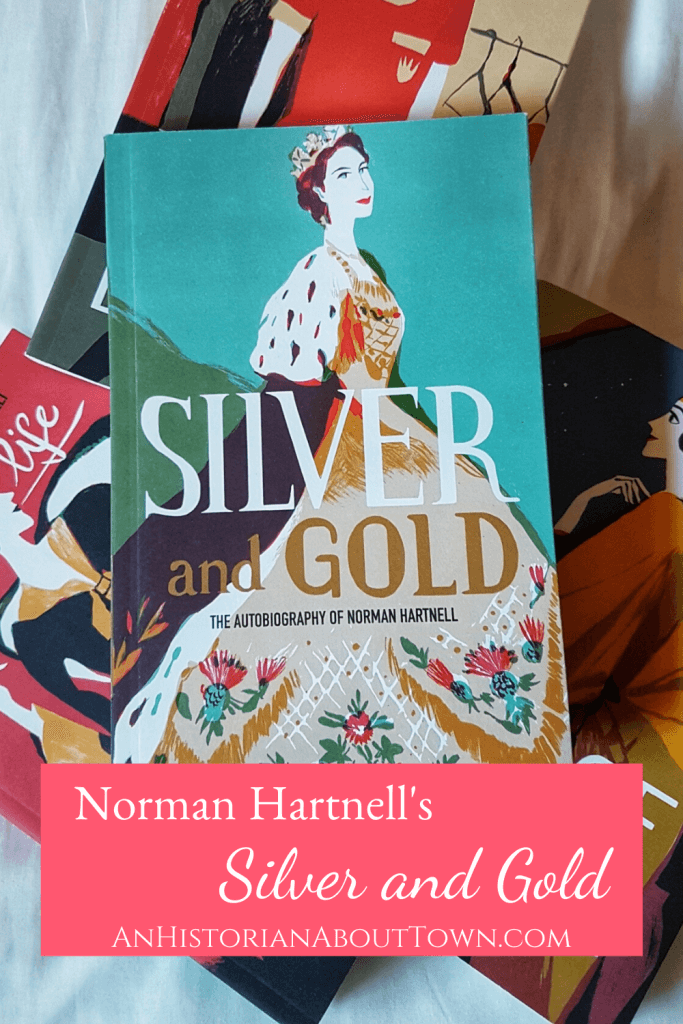
Silver and Gold: The Autobiography of Norman Hartnell, Norman Hartnell
Sir Norman Hartnell (1901–1979) was the star of London couture during the interwar years, gaining international fame as dressmaker to the British royal family. His autobiography, first published in 1955, tells the story of the creation of his couture house in 1923, his formal appointment as dressmaker to the royal family in 1935, and the most momentous commissions of his career: Princess Elizabeth’s wedding gown in 1947 and her magnificent coronation dress six years later. Best known for romantic eveningwear shimmering with beads and embroidery, Hartnell is credited with reintroducing the crinoline to world fashion through his full-skirted designs for Queen Elizabeth. Silver and Gold describes an extraordinary life with elegance and panache.

Silver and Gold Review
I’ve read several designer autobiographies, and while they are always interesting, they aren’t always useful, per se. Many give insights into the rest of their life, save for their designs. It can give context, and interesting stories, but if you are looking for information on their design career, not overly helpful. (An autobiography is always at the mercy of the subject, never forget it!) Hartnell obliges us though, and gives us fantastic insight into his design career.

I don’t understand why designers are so hesitant to discuss the nitty-gritty of design work. I’m not sure if they don’t think that readers will be interested, or perhaps that we already know, but it is often skipped. However, Hartnell explains his process in detail, in chapter eight. “Intending to draw one design I sketch firstly the head, then roughly the limbs of the figure, turning the body towards its right, so that the left hip is foremost to my view. The left hip is the focal point of nearly all draperies, clumps of flowers, panels, buddings, sashes or bows. Then the arms, one akimbo and one outstretched, to allow for the arrangement of the sleeves. Finally, I draw the feet.” (S&G) It continues on to describe the rest of the design process for this particular gown, and I really appreciated it. When looking at the different gowns I’ve seen in royal exhibitions, their design and style suddenly make a lot more sense after reading this. (Not that they weren’t always beautiful, but it is like knowing a language instead of relying on a translator, if you will.)

The White Wardrobe
Silver and Gold was written shortly after the Queen’s coronation, so it doesn’t span Hartnell’s full career. However, it does cover most of the high points, including the Duke and Duchess of Gloucester’s wedding, the White Wardrobe, the 1948 royal wedding, and the 1953 coronation. (I’m sad that Princess Margaret’s wedding dress wasn’t included, but alas alack!) He gives a lot of insight into working with the royal family, on tour wardrobes and major events, without devolving into gossip. (I’m sure there are people looking for royal gossip, but this is not the book for you.)

One of my other favourite sections was when he shared his thoughts on the White Wardrobe. King George VI and Queen Elizabeth were due to go to France on a state visit in 1939, but her mother passed away three weeks before they were due to leave. The court appropriately went into mourning but that left a question of how to dress on a state visit? Hartnell suggested white for the Queen, as there is a historical precedence for white for mourning. “
The five all-white dresses for the principal occasions stand out in my memory. One for the evening reception at the Elysée Palace had its bodice and billowing skirt composed of hundreds of yards of narrow Valenciennes lace, sprinkled with silver. For the Gala at the Opera Her Majesty wore a spreading gown of thick white satin, the skirt draped with festoons of satin, held by clusters of white camellias… It was while watching the ballet, performed by the lakeside on the Ile Enchanté, that the Queen opened a parasol of transparent lace and tulle and delighted all the onlookers. (Silver and Gold, 95-96)
The photographs from that tour really cemented Hartnell’s place in British fashion, and it is easy to see why. The Order Sartorial Splendor has a fantastic post here if you interested in seeing/learning more!
At only 140 pages with the index, Silver and Gold is quite a fast read. It doesn’t get bogged down with horrendous amounts of detail. It also doesn’t assume that you know who anyone other than the senior royals are. Because so much of his design process and work is included, I think it is a useful resource, even if you are not interested in Hartnell himself or British design. And if you are interested in any other designers, I would recommend visiting the Fashion Perspectives series!
Are you going to read Norman Hartnell’s Silver and Gold?
Cheers,
The Historian
Facebook | Twitter | Instagram | Pinterest | Bloglovin’

I had no idea who Norman Hartnell was, but his autobiography does seem interesting. His designs are beautiful & it’s nice that the book goes into his design process.