Downton Abbey has stolen many of our hearts. Highclere Castle feels like home to us, the Granthams and Crawleys are like family, and we’ve been waiting for the Downton Abbey movie. If you are like me, you’ve watched it over and over. And you may have even focused on the fashion, like me. Unfortunately, none of the Downton exhibitions have been anywhere close to me. However, I am lucky enough that I saw much of itat the Fashion Museum and V & A. These are some of my favourites of the fashion of Downton Abbey.

Downton Abbey covers a wide range of fashion history. The show opens in in 1912, and we are picking up the movie in 1927. Although 15 years may not seem like the longest period, there was an incredible amount of change. We moved from fairly restrictive Edwardian fashion to the practicality of wartime fashion. And then we find ourselves in the looser and freer flapper fashions of the 1920s. (Remember when Lady Mary got her bob? THE SCANDAL.) Because it is a grander house and an aristocratic family, the fashion isn’t as quite as dramatic as it could be. However, it is still gorgeous, and utterly fascinating. So, it is time to discover the fashion of Downton Abbey…

1908 Wedding Dress, Fashion Museum Bath
Although this dress falls outside of the Downton window, I knew I had to include this. “This silk wedding dress, embroidered with beads and designed by Lucile, was worn by Mabel Chappel when she married Robert Fuller in 1908. Lucile was Lady Duff Gordon, the leading London costumer of the day…. Lady Duff Gordon boarded the RMS Titanic in April 1912, with her husband…” (Exhibition info) While this gown was created 4 years before the series started, it certainly would have fit in the first season. You will notice that the ladies of Downton tend to be just slightly behind the trends. Given that their family seat is up in Yorkshire, it is understandable that trends tended to take slightly longer to arrive there.
Lady Duff Gordon, aka Lucile, began designing clothes after her first marriage ended, and quickly became one of the best known designers of the time. She had particular impacts on the fashion industry that we still see today. Lucile was the first designer to use professional models (known as mannequins), and she hosted the first catwalk shows in her atelier. (Also, the Duff Gordons didn’t fare too well after the sinking of the Titanic. There were rumours that they had paid the crew members on their life boat not to turn back to help more people….)

1920s Coat and Gown, Victoria and Albert Museum
This gown and coat both have a common element from 1920s fashion- an Asian influence. As the V&A section on the Bright Young Things fashion states, “[t]he fashion for rich and sensuous detail continued with… dresses embroidered in the Chinese style and evening coats trimmed with fur. The excavation of Tutankhamen’s tomb in 1922 inspired a wave of Egyptian-inspired fashions, with ostrich feather fans and accessories adorned with hieroglyphs.” (Exhibition info) While war-time clothing certainly stayed simple and utilitarian, the Bright Young Things in the 1920s went quite the other direction. And in case you didn’t know, Lord Carnarvon funded the expedition that discover that tomb. The very Lord Carnarvon who happened to be the owner and master of Highclere Castle, made famous as Downton Abbey. (If you visit Highclere now, there is an Egyptology exhibition where you can see some of Lord Carnarvon’s artefacts!)
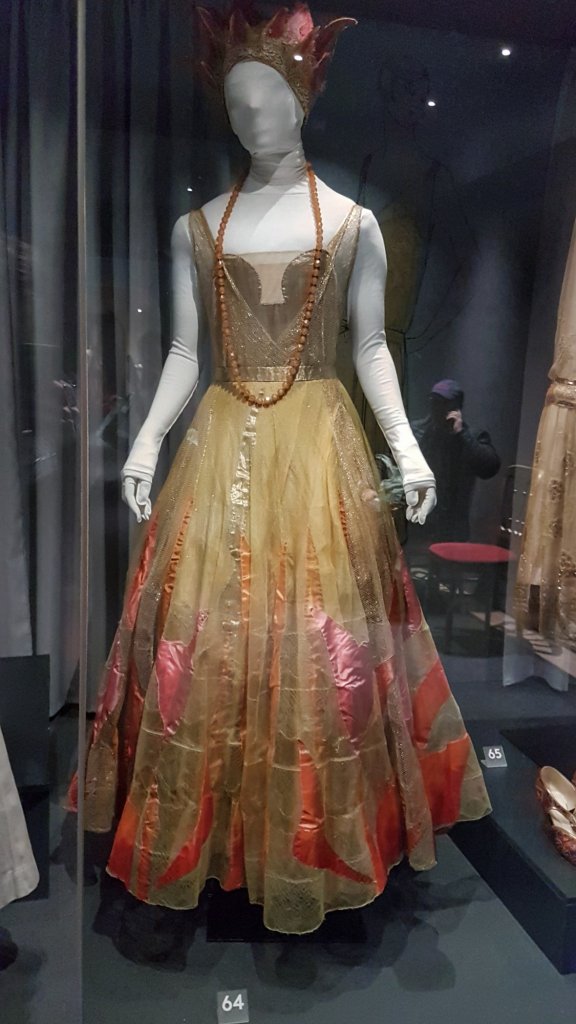
1927 Fire Fancy Dress, Fashion Museum Bath
Fancy dress, or costumes for us North Americans, had its hey-day in the nineteenth and early twentieth centuries. Aristocrats would often host elaborate costume/fancy dress parties for their friends. And they went above and beyond, with no expense spared. This particular dress is the “Fire” dress, made by dressmakers Reville and Rossiter. (If you’ve heard that name, it would be because they also made Queen Mary’s coronation gown in 1911. “Fancy dress parties were part of the whirl of Society events, popular well into the 1900s. Photographer Cecil Beaton changed his costume five times during a fancy dress party he hosted in the 1930s.” (Exhibition info) I can’t help but say, I hope we see a fancy dress party in the Downton Abbey movie.

1923 Wedding Dress, Victoria and Albert Museum
Designed by Aida Woolf, this 1923 wedding dress was worn by Flora Diamond. It is a silver lamé wedding gown with a train, in a typical 1920s style. What I find most interesting about this gown is the element of fancy dress in it. “The silver lamé fabric and metallic lace creates a chainmail effect, which along with the distinctive train, evokes a medieval style that was fashionable at the time.” (Exhibition info) As an historian, I always appreciate a nod to the past. It is also appears now to be a fairly subtle nod, but would have been more obvious at the time. Why, oh why, have we given up on costume parties with clothing like this? (NO MORE CHEAP COSTUMES, AND NO MORE PSL “COSTUMES”.)

1929 Beach Pajamas, Fashion Museum Bath
Ahhhh, why do we not wear beach pajamas anymore? Yes, these pajamas are from 1929, so slightly outside of the Downton period, but I would like to think that Lady Mary would embrace her inner fashionista and don these on a trip to the beach with George. They consist of a sleeveless top, a jacket, and panelled trousers made of embroidered silk. While I can’t imagine that silk is a practical fabric for going to the beach, it probably wasn’t a concern of the owner. And just think- you wouldn’t have to worry about a sunburn or overheating while wearing these!

1927 Beaded Dress, Fashion Museum Bath
This particular dress of silk chiffon and clear beads was made by the House of Paquin, a Paris fashion house, in 1927. “A boyish shape and doing away with the waist were all the rage in the mid 1920s and skirts became shorter. The fashion pendulum swung back again soon, but a taboo had been broken.” (Exhibition info) Although we lost Lady Sybil too early in the series, I think Sybil would have continued to embrace the youthful fashions of the 1920s. And Lady Rose would have absolutely worn this dress! While I know that it is cheaper to mass produce dresses without embroidery or beading, these dresses are gorgeous in person, and it is a shame it is largely lost from fashion.

And if you are looking for something to read after you see the Downton Abbey movie, check out my 5 Books to Read if You Love Downton Abbey post!
What do you think of the fashion of Downton Abbey? What is your favourite Downton piece?
Cheers,
The Historian
Facebook | Twitter | Instagram | Pinterest | Bloglovin’

Great article and what an elegant era.
Thank you!!! Elegant, and so many changes in such a small space of time! Thank you for stopping by