Last year, my 2020 Online Fashion History Exhibitions was a runaway favourite. With everyone largely stuck close to home, and museums closed, we all looked to the digital world for our fashion history fix. I first published it in June of 2020, museums had had time to adapt and get things online. And thankfully, some of those museums have continued on with online exhibitions. (Though surprisingly fewer than I thought.) For Style File Friday this week, I’m sharing my favourite 2021 Online Fashion History Exhibitions!

The Benefits of Online Exhibitions
I’ve written about this ad nauseum on the blog, but I adore online exhibitions. Are they the same as visiting an in-person exhibition? No, obviously not. But the common refrain of “I’d rather visit in person” tends to come from people that live near major cultural centres and can easily visit museums. For many of us who can’t easily access many museums, online exhibitions are a saving grace.
2021 Online Fashion History Exhibitions
This list is shorter than the 2020 list, because I included several evergreen exhibitions that are permanently online there. (I’ve linked the post, so that you can also visit those from last year: https://anhistorianabouttown.com/2020-online-fashion-history-exhibitions/.) Unfortunately, I think many museums abandoned online exhibitions as soon as news of the vaccine came out. (Which helps people in those cities who are only unable to visit due to the virus…) And quite frankly, some major museums made almost no attempt to go online whatsoever. Still, there are some absolutely wonderful online exhibitions, and I will continue adding to them as I find more!
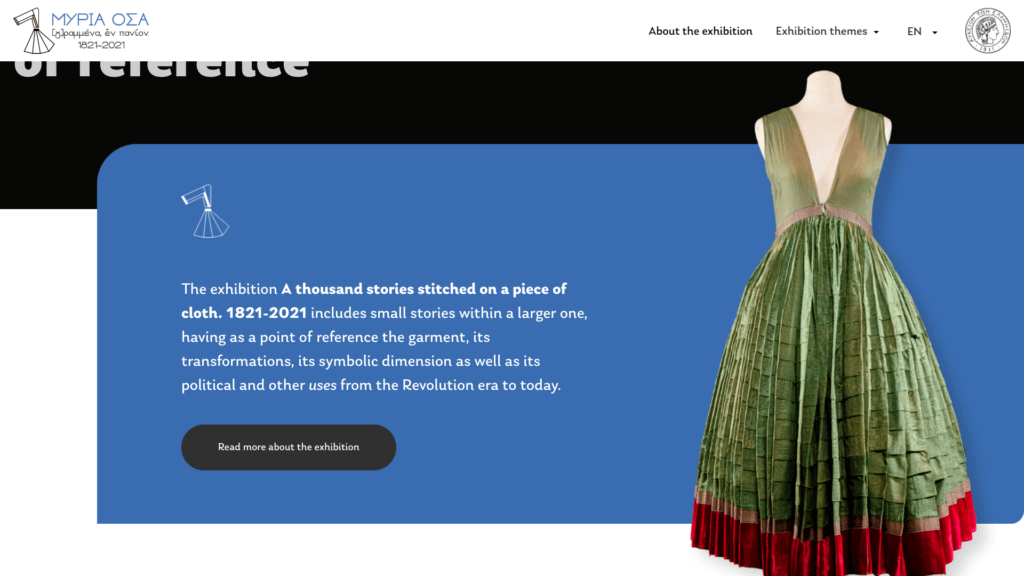
“A thousand stories stitched on a piece of cloth: 1821-2021”, Museum of the History of Greek Costume
The exhibition A thousand stories stitched on a piece of cloth. 1821-2021 includes small stories within a larger one, having as a point of reference the garment, its transformations, its symbolic dimension as well as its political and other uses from the Revolution era to today.
Through indicative examples from different time periods, interconnected and redistributed, the exhibition blends yesterday with today, local with universal, as well as “tradition” with “fashion”.
From the foustanela of the revolution fighters and the versions worn by “King Otto” and by the Evzones, to Mick Jagger’s famous “heretic” variation but also to that of “Iasonas” of Bost’s Medea. From the women of Zalongo to their “motion picture” and other analogues and from the black uniforms of the Sacred Band to those of the Messolonghi Philarmonic Band in their image. In a parallel manner, from the ottoman salvar all the way to the fashion of the bloomers and the spandex, and from the philhellenic fashion à la Bobelina to the commemorative scarf of Hermès Fashion House, offering alternatives and maybe unexpected narrations.
Why You Should Visit This Exhibition…
You will notice that there is more than one exhibition in this position that is looking at national dress, and I think that that is fantastic. National dress isn’t always the most accessible. Depending on the nation in question, it doesn’t always end up in widespread museums. I’ve always been intrigued by modern Greek national dress, but didn’t actually know much about it. I adored that this exhibition spanned traditional dress to contemporary fashion items. “A thousand threads” covers a much bigger story than I thought it would, and it is a wonderful resource!
It incorporates garments, but also photographs, as well as literary texts and written sources. I will admit, it takes slightly longer to navigate, as you have to go into each separate theme. However, because they do go in depth with these themes, I liked that I could tackle one at a time. The close up high-res images of many of the garments makes my heart sing…
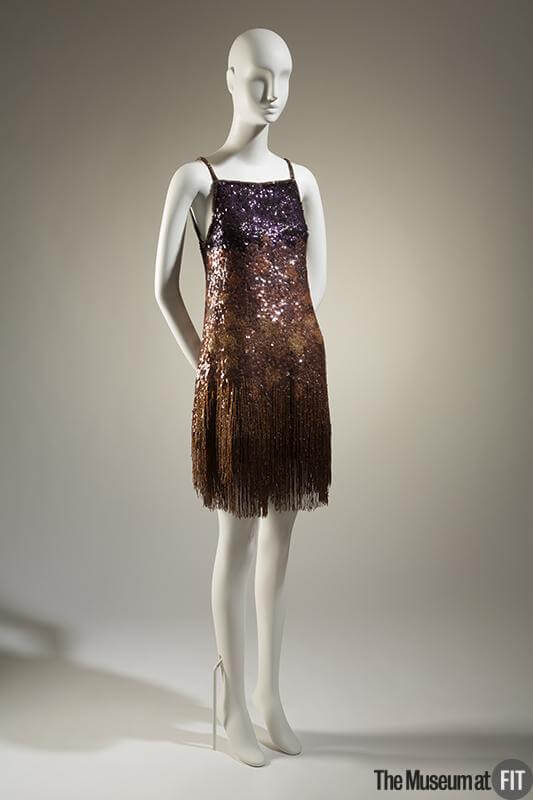
“The Roaring Twenties and the Swinging Sixties”, Museum at FIT
The Fashion Institute of Technology’s School of Graduate Studies and The Museum at FIT (MFIT) present The Roaring Twenties and The Swinging Sixties, a virtual exhibition comparing the fashions of the twenties and sixties, both periods of significant crisis and change. Organized by students of FIT’s Master of Arts program, Fashion and Textile Studies: History, Theory, and Museum Practice, the show features twenty-six objects from the permanent collection of MFIT and fashion illustrations from FIT’s Gladys Marcus Library Special Collections and College Archives (SPARC). It is supplemented with archival photographs that further demonstrate the parallels between the fashion of the two decades. The process of creating an exhibition is a unique experience and a key feature of the Fashion and Textiles Studies graduate program at FIT. For the first time, this student-led project is presented solely online, with the class working together remotely.
Why You Should Visit This Exhibition….
I love everything about MFIT’s exhibitions, I could never deny it. (I think my Ballerina exhibition posts are proof!) Long before 2020, they sought to make their exhibitions and collections accessible. They are an invaluable resource, and as someone who researches things remotely, I am so grateful. And the fact that this was done by students in the graduate program?? Be still my heart.
The 1920s and the 1960s both saw an immense amount of change- in fashion, but also in society. I think that they are fantastic “case studies” and the exhibition does a wonderful job of drawing parallels. There are a lot of connections that I never saw myself, and I think that the exhibition’s use of sketches, garments, and photographs works perfectly to highlight them. (Also, in a purely practical sense, sketches and photographs translate REALLY well to an online exhibition.) Keep your eye out for some famous pieces, including YSL’s Mondrian dress. I also felt like it was very easy to navigate, and the simple layout made it easy to follow!
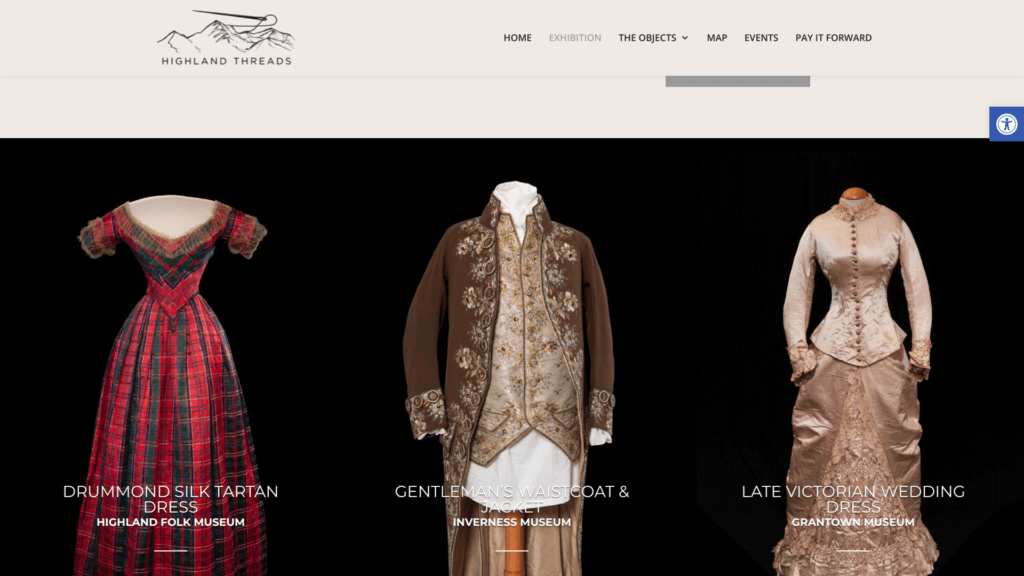
Highland Threads
14 key pieces from museums from all over the Highlands of Scotland, brought to you online via film and photography with supporting stories and archive images from each museum.
Why You Should Visit This Exhibition…
This exhibition caught my eye on Twitter. It was shared by many of the dress historians that I would expect to see it from, but also by political, social, and cultural historians. Given that fashion history is so often ignored, I was doubly intrigued. And I was not disappointed.
As you might imagine, the Drummond Silk Tartan Dress from the Highland Folk Museum is my favourite piece from the exhibition. (It was made for a royal visit in 1842, and really reminds me of Princess Alexandra’s tartan gown.) This exhibition includes a beautifully shot video of the garment that allows you to view it from all sides, and to see a lot of detail. I will say, I think that it let me see more detail than I would in 95% of museums with an in-person visit.
Also, if you are interested in the Highland Threads exhibition, they also have several online events happening in May 2021 to accompany it. You can find the listing here!
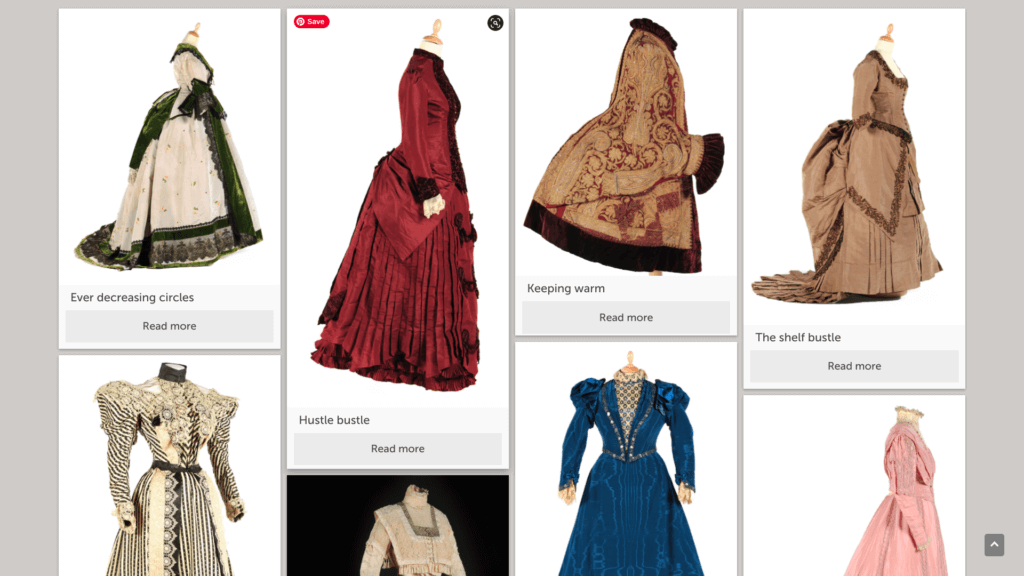
“La Belle Époque”, National Museums NI
The period of around the 1870s to 1910s was one of relative peace and prosperity in Western Europe and has often been referred to as La Belle Époque – “the beautiful era.” Due in part to the industrialisation of textile manufacturing, female fashions during this time changed more rapidly and dramatically than had ever been seen before. This is particularly obvious when we look at the wildly different shapes the female form was expected to metamorphosize into from one decade to the next.Two superb recent gifts to the collection, a wedding gown from 1896, and a 1911 court presentation ensemble, epitomise the drastically different silhouettes the age produced, and show just how belle the beautiful era could indeed be.
Why You Should Visit This Exhibition…
I was lucky enough to do my MA in Dublin on Irish history, albeit on a much earlier period, so I was intrigued right away to see this offering from Belfast. La Belle Époque is an interesting period, but it doesn’t get as much attention as I would expect. Although it is clearly prior to the First World War, we see many political, societal, and cultural changes in these 40 years. And the British Empire is growing exponentially in this period (with all of the good and bad that came with it). Fashion changed drastically more than once, and I think they picked some stunning garments to highlight this.
My favourite piece is a 1911 court dress from when Elizabeth Balfour Clark was presented to Queen Alexandra. The detail on it is simply incredible, and there are several photographs to appreciate it from different angles. This exhibition does a great job of looking at the garment itself, but also its provenance and historical context. They also have such a variety of pieces to look at, it is a fashion history boon.

“Kimono Culture: The Beauty of Chiso”, Worcester Art Museum
Experience the world of traditional kimono design and artistry still practiced by Chiso, the 465-year-old, Kyoto-based kimono house in our virtual exhibition, Kimono Couture: The Beauty of Chiso.
Why You Should Visit This Exhibition…
If 2020 (and 2021 so far) have taught us nothing else, it has taught us that we need to look outside of our own lives and cultures. I don’t know much about Japanese clothing design, aside from kimonos, and I didn’t even know much about that. Something I’ve not seen in many exhibitions, I love that it tied the tradition of kimono making to contemporary garments. Chiso is a fascinating house, and I admit- I fell into a bit of a hole reading about them afterwards.
The exhibition itself is wonderfully constructed. You move through different parts of the exhibition, rather like you would rooms in a museum. There is a mixture of videos and text, and they conveyed a lot of information without it being overwhelming. I’m hopeful that we will continue to see accessible exhibitions on BIPOC fashion, and that museums will keep bringing these stories to life.
Of course, this post will be updated with more 2021 online fashion history exhibitions as I find them- I hope you enjoy! (And let me know if I have missed any exhibitions from this year!)
Cheers,
The Historian
Facebook | Twitter | Instagram | Pinterest | Bloglovin’