I was quite grateful when I lived in Ireland that it is quite a small country, meaning that I could see quite a lot. My MA was in Early Irish History, and I specifically studied the early Irish church. In that year, I spent more time with monastic writings and penitential manuals than I did with people. However, one of the best parts was being able to see the sites I was studying in person- Glendalough in particular. Ireland is rich with historic sites, but it is one of the best. So, today I will be sharing 3 reasons why you should visit Glendalough!

Although you don’t see it a lot on the blog, I do still love Irish history. I tend not to share it as much, simply because what I worked on in particular is more technical than not. (If you are interested in the standing of children in early Irish law, both secular and religious, do let me know!) I understand that while I love it, it may not be the most engaging of history to the uninitiated. However, Glendalough has something for everyone. It is the perfect window in monastic Ireland and you can walk in the footsteps of history. You can find it in Glendalough Valley in County Wicklow (in the east of Ireland), and is easily accessible via car, bus tour, or by a private bus line.

The History of Glendalough
Glendalough was established as a monastic settlement in the sixth century by the future St. Kevin. Descended from one of the ruling families of Leinster, he studied under three holy men and originally visited Glendalough as a child. He would return in adulthood with monks to build his monastery. The monastery flourished, and it was a popular site of pilgrimage. It was particularly known for being a place of learning, and its scriptorium was responsible for several notable mathematical and astronomical texts in both Irish and Latin. It was at the height of its power in the eleventh and twelfth centuries, with the Abbot of Glendalough, Laurence O’Toole, becoming the first Archbishop of Dublin in 1162.
So, why should you visit Glendalough?
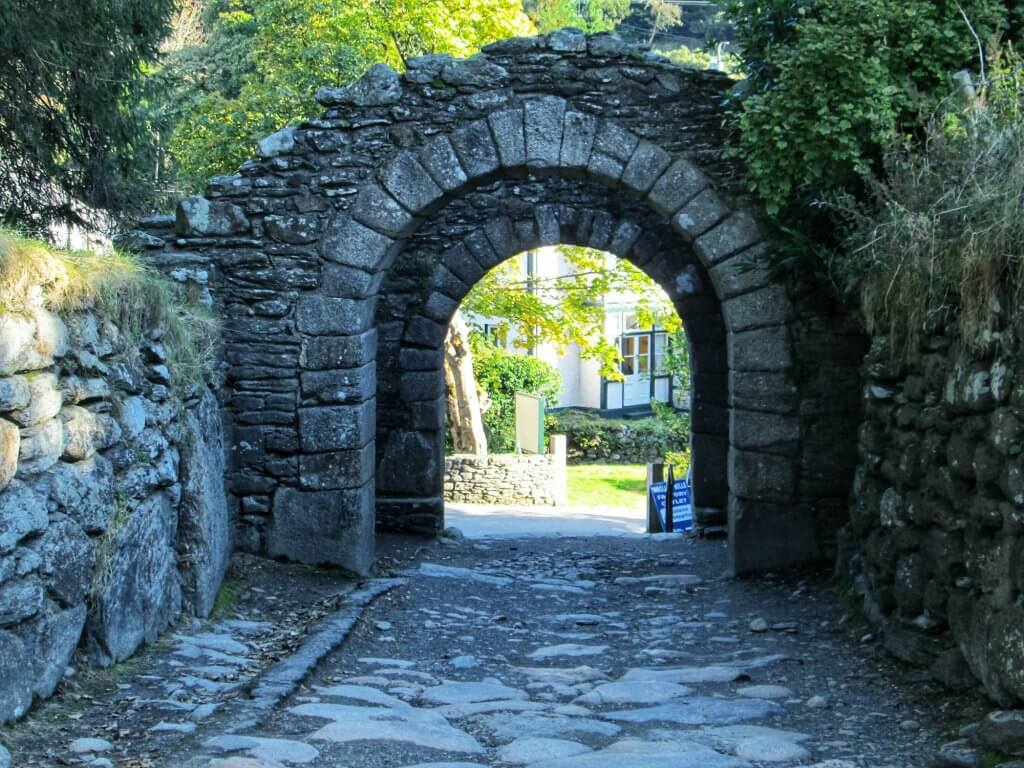
1. The Monuments
If you remember nothing else of Glendalough, you will remember the Round Tower and the other ruins. The Gateway (seen above) is rather unassuming but is one of the most important at Glendalough. This was the gateway into the monastic city, and would denote to anyone who approached that they were entering an area of sanctuary. It was originally a two story gate with two stone arches, with the arches surviving today. This is the only surviving medieval monastic gateway in Ireland.

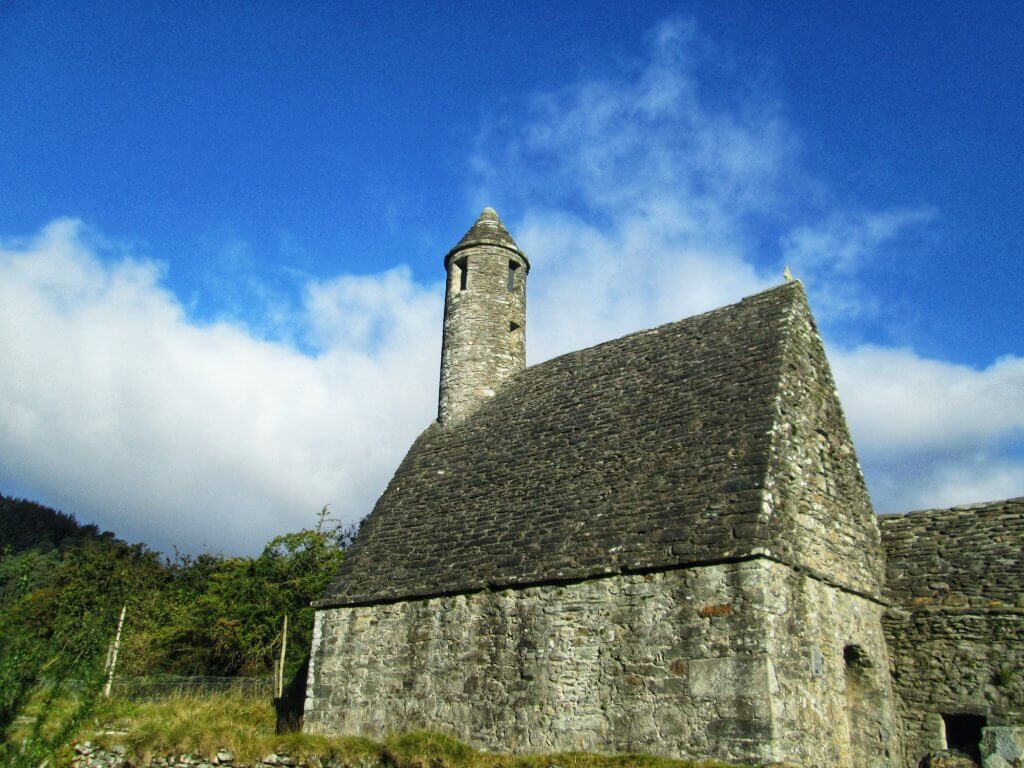
Obviously we have to talk about the Round Tower, as it dominates the landscape. The Round Tower is 30 metres tall, with the entrance roughly 3.5 metres up from the ground. Glendalough was attacked and raided frequently in the twelfth and thirteenth centuries, and the tower provided refuge. When they weren’t under attack, it was also used as a bell tower, a guard tower, and for storage. Originally there were six timber floors inside the tower, which were connected with rope ladders. Each floor had its own window for light, with four windows (in the cardinal directions) on the top floor.

And if you couldn’t guess, this is St. Kevin’s Church, which dates back to the twelfth century. (Yes, you will see “Kevin” all over the place.) Glendalough was known as the city of seven churches, but this is the most complete church now. As you can see peeping out of the back above and in the photo below, there is a circular bell tower on this rectangular church. This led to the name of “St. Kevin’s Kitchen”, as the tower looked like a kitchen chimney. Unfortunately, you can’t enter the church, but it is still incredible to see from the outside.
2. The Everyman
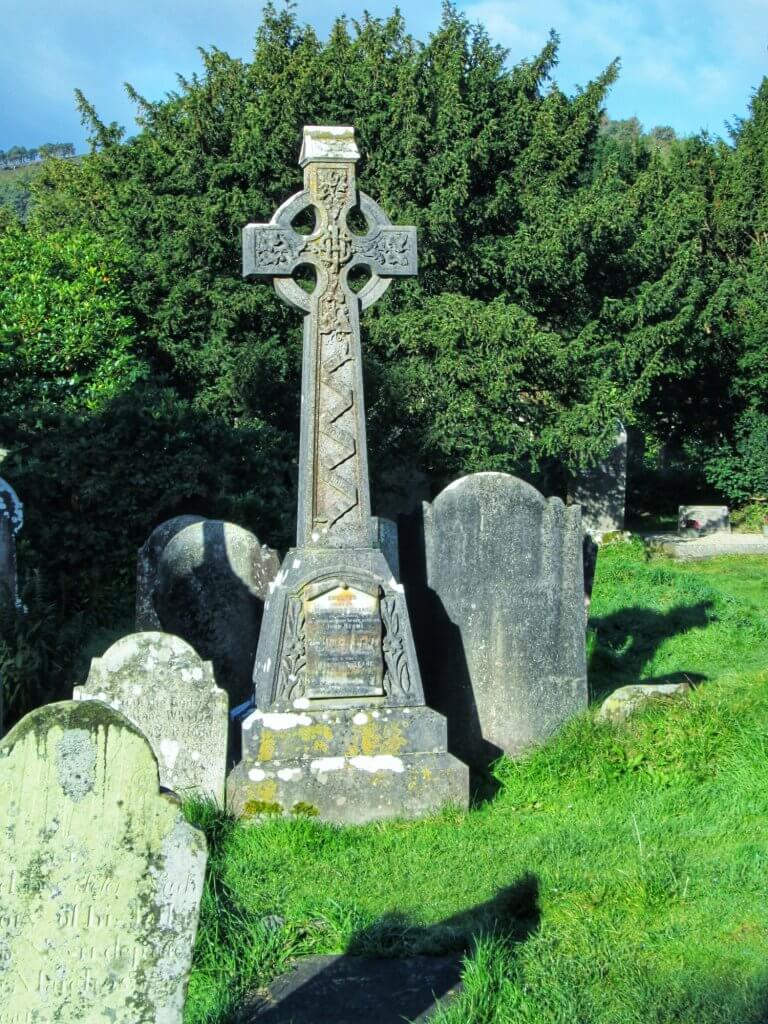
When you first arrive at Glendalough, you cannot help but be taken in by the monuments. You don’t see many round towers surviving these days, let alone one that tall. And then the others take you as well. However, what struck me is just how many regular and common folk were buried at Glendalough. You can wander through the cemetery freely, and I would recommend doing so. There are centuries are parishioners buried here, and they all lead interesting and full lives. It is also remarkable to me how some gravestones endure largely untouched for centuries, while others are worn away so quickly. (Yes, I know it has to do with weather and directions and materials, but it is still striking, none the less!)
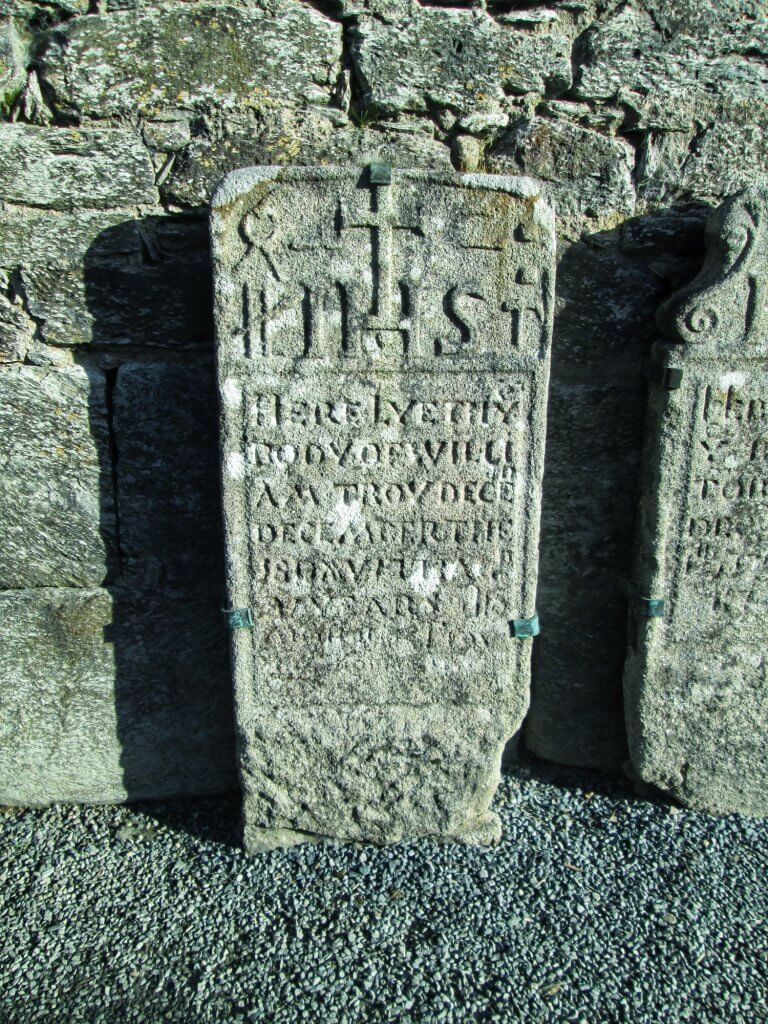
Oddly, some tombstones were propped up against the walls in some the ruined churches. I’m not sure if the stones were originally within those churches, or if they weren’t, if they were put in those spots for particular reasons. In any case, I think that it does offer them slightly more protection and helps preserve them, as in the case of the tombstone below. (“Here lyethy the body of William”- perhaps not anymore…) This was propped up in the Priests’ House, another of the monuments.
3. Glendalough Valley
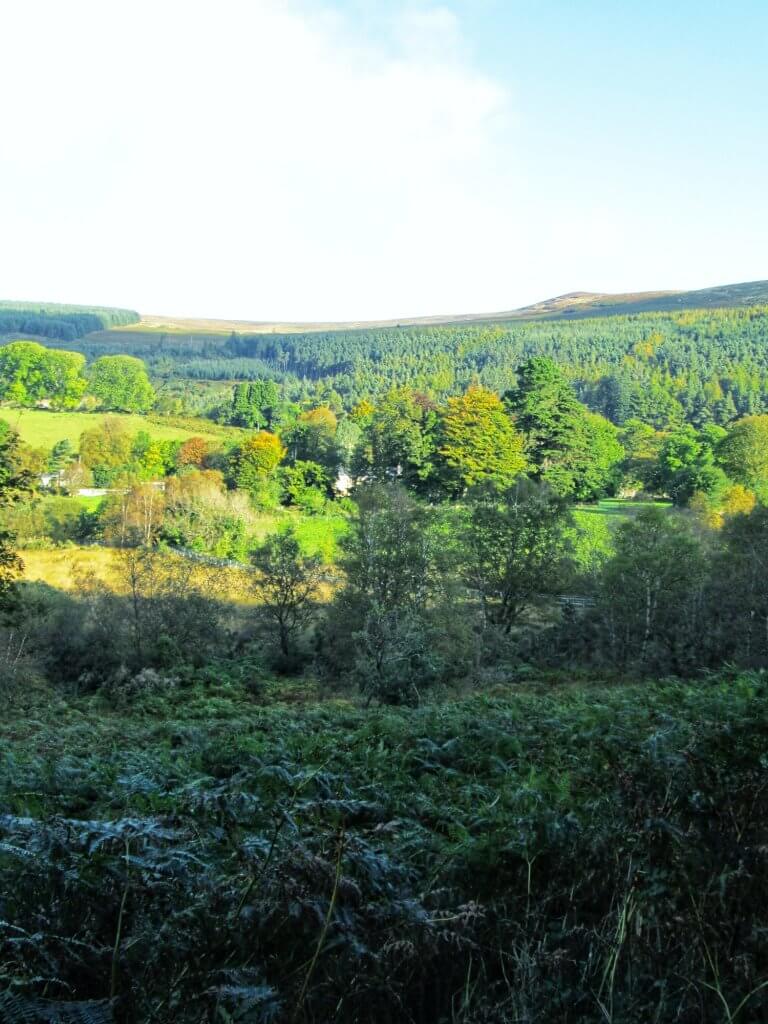
And if you happen to be more a nature rather than a history person, you will certainly have a lot to do at Glendalough. The hiking trails along the Upper Lough and around the valley are known across Ireland, and are incredibly popular. It is a glacial valley, formed during the last ice age, and in addition to the Poulanass River, it is also surrounded by the mountains of Camaderry.
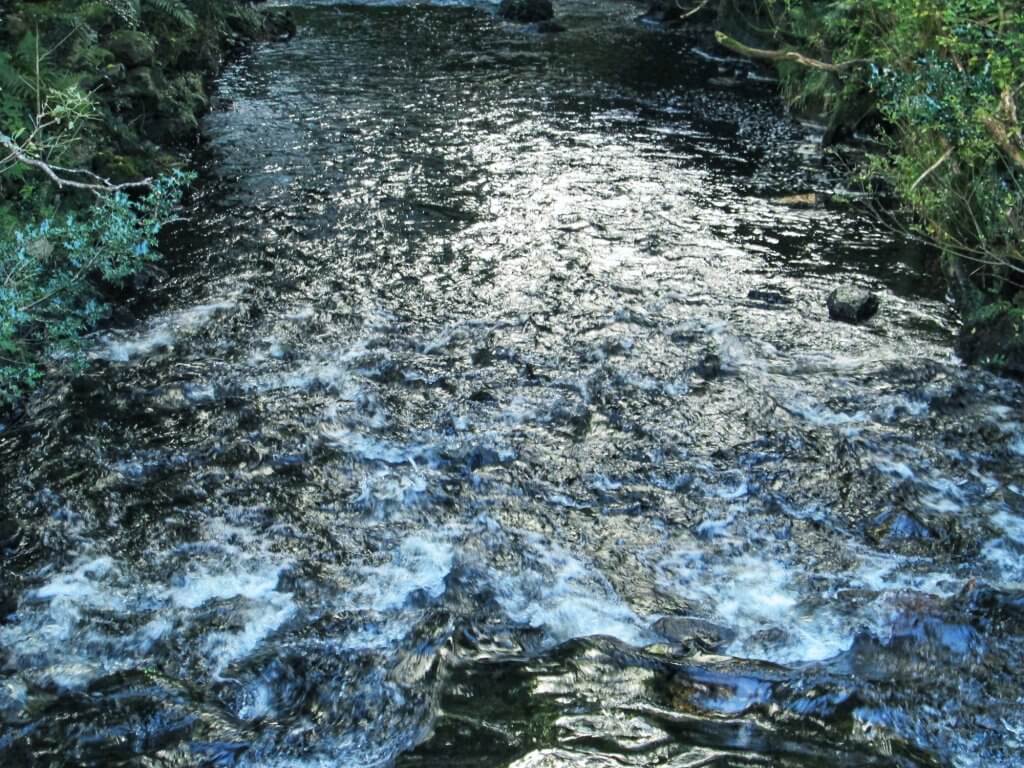
I will admit, I didn’t venture too far on the trails as I spent most of my time exploring the ruins. However, it seems like a rather busy but accessible set of trails. I would recommend taking at least a little time to wander around the park, as you will find some absolutely stunning views with relatively little work. It also gives you an impression of what those monks would have seen for themselves over a millennium ago.
If anyone has been before, why should you visit Glendalough?
Cheers,
The Historian
Facebook | Twitter | Instagram | Pinterest | Bloglovin’
The gateway into the monastic city of Glendalough is the only surviving example of its kind in Ireland. That should be reason enough for you to visit! Standing at the entrance, you can easily imagine the full scale of the gateway into the compound thanks to the impressive remains.
<3 This is so striking. Our visit to Ireland last spring was sadly restrained to only one day… which we used to visit the Rock of Cashel. Also a BEAUTIFUL historic site, but it left me wanting more! Glendalough is stunning, and that round tower in particular is breathtaking. <3 Thank you, as always, for the wonderful history lesson.