World Ballet Day 2019 was a rousing success, if I do say so myself. We were able to see several world class ballet companies working their hardest, and behind the scenes of some upcoming productions. (If only there was a streaming pass to see all of these companies if you don’t live there… Hint, hint, ballet world.) And if you were watching the Royal Ballet’s stream, you would have seen the regular studio and their rehearsal rooms, as well as Paul Hamlyn hall. So, I decided that this is the perfect time to dive into some of the secrets of the Royal Opera House!

The Royal Opera House is in Covent Garden, one of London’s historic central neighbourhoods. Covent Garden was once home to a flower and vegetable market and now is known for the theatres that surround it. Along with the ROH, Covent Garden is surrounded by the Theatre Royal, Drury Lane, the Duchess Theatre, and the Lyceum Theatre, with several other West End theatres within a quick walk.

The Royal Opera House 3.0?
The Royal Opera House theatre is one of my favourite buildings in London. The Neo-Classical facade is beautiful, and the restoration work completed in the 1990s has ensured that the theatre stays in the best possible condition. However, this is the third theatre to stand on the site. The first theatre opened on the site in 1732, and was primarily a playhouse. The company did include opera and ballet periodically. There was fierce competition between Covent Garden (as the theatre was known) and the Theatre Royal on Drury Lane, but Covent Garden introduced seasonal pantomime to their repertoire. This theatre sadly burnt down in September of 1808.
By December of 1808, building on the second theatre had started. The theatre re-opened on 18 September 1809, a year less two days after the original fire. Ballets and operas were regularly performed, and other acts such as clowns, mimes, and child actors were also brought in. Gas lighting was first used in the theatre in 1817, but limelight was introduced in 1837. Though we don’t use limelight itself, performers are still in the limelight! Unfortunately, this theatre was also lost to a fire in March of 1856.
The theatre’s rebuilding took just over two years to complete, re-opening on 15 May 1858. It then became the Royal Opera House in 1892. During the First World War, the ROH was used as a furniture repository, and during the Second World War, the theatre became a dance hall. (You can see a dance card from 1940 here– very cool, if I do say so.) Each night 1,500, dancers would tear up the dance floor, with the theatre returning to its traditional purpose in February of 1946.
Floral Street?
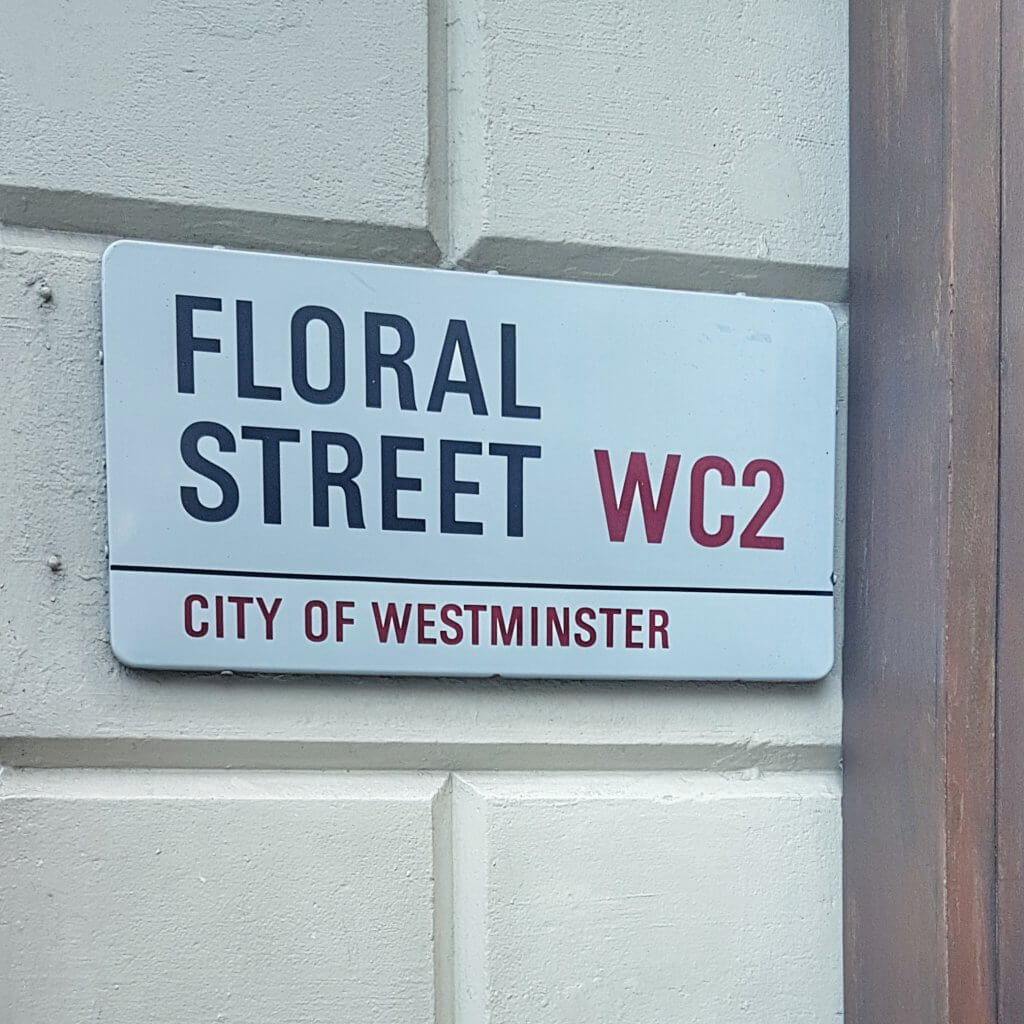
The Royal Opera House sits on Floral Street. I personally love this sign- I always look for it when I’m visiting the theatre. London street signs are so iconic, and the Floral Street sign is the perfect nod to the theatre’s past. You will most likely walk along Bow Street (named for its bow-like shape) to get to the Royal Opera House, but peak around the corner down Floral Street. Originally named Hart Street for the White Hart Inn, it was renamed Floral Street after Floral Hall in 1895, a nod to the flower markets. (It seems particularly fitting that the performers are given flowers after a performance- I’m wondering if the theatre/flower market connection goes back further!)
Paul Hamlyn Hall aka the Rink
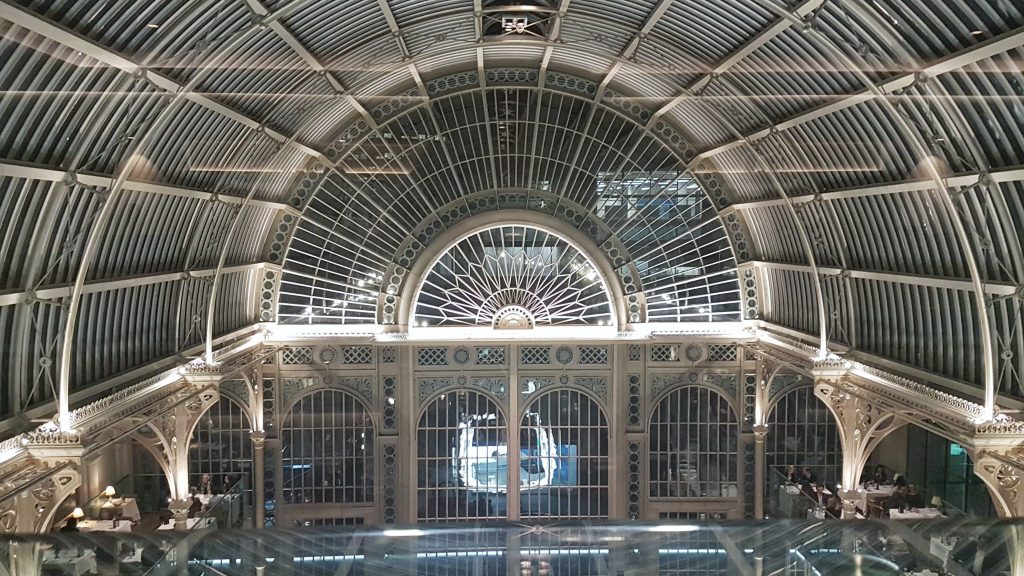
When you think of the Royal Opera House, there is a good chance you are thinking of Paul Hamlyn Hall. The Hall is right beside the theatre, the wrought iron arches are infamous. Originally known as Floral Hall (leading to the name, Floral Street), it was designed by EM Barry who designed the third theatre, to serve as a market to support the theatre. In the nineteenth century, it was also a performance venue and even a skating rink. It fell into disrepair after the roof caught on fire in 1956, and after the Royal Opera House purchased it in 1977, it was used to store scenery for two decades. Now, it is a fantastic restaurant (which you can enjoy with a show at the ROH), and a dance and performance venue. It’s also a champagne bar, if that strikes your fancy. Both the Royal Opera and the Royal Ballet host lunchtime performances that anyone can come watch for free. It is also used extensively on days like World Ballet Day, and we saw several different groups performing there. If you have a chance to see the hall from the second storey, it is a must!

Margot Fonteyn- Afraid of Swans?
No, the amazing Dame Margot Fonteyn was not afraid of swans (as far as I know). However, she did not always love performing Swan Lake, one of the most iconic ballets. According to the ROH, “She confessed to having always found Swan Lake a difficult ballet that both frightened her and gave her great satisfaction.” This is Fonteyn’s own Odile costume from Swan Lake! You can also see other costumes, prints, and photographs from the Royal Ballet and the Royal Opera throughout the years. (If you do the behind the scenes tour, you actually get to pop into the costume department to see more tutus than one could imagine.)

Maria Callas- The Ultimate Tosca?
Tosca is one of the most popular operas for the Royal Opera- since it premiered in 1900, it has been staged at the ROH nearly every year. Set in Italy during the Napoleonic invasions and taking place over just 24 hours, it is a rather intense opear. Maria Callas, the American Soprano, is still considered to be the ultimate Tosca. Infamous Italian director Franco Zeffirelli staged Tosca for the Royal Opera in 1964 and cast Callas in the titular role- that particular production stayed in the Royal Opera’s repertoire for 40 years before being re-staged. This is Callas’ costume from Tosca, including her reticule and shoes, as well as a programme. One of the open secrets of the Royal Opera House? if you want to sneak a peak at the ROH archival pieces, the best way is to visit in person!
Looking for more of the Royal Ballet? Check out my World Ballet Day 2019 post for 4 hours of streaming from the Royal Ballet!

Do you know any secrets of the Royal Opera House?
Cheers,
The Historian
Facebook | Twitter | Instagram | Pinterest | Bloglovin’